Stocks
Is the Stock Fear and Greed Index Reliable?
Quick answer
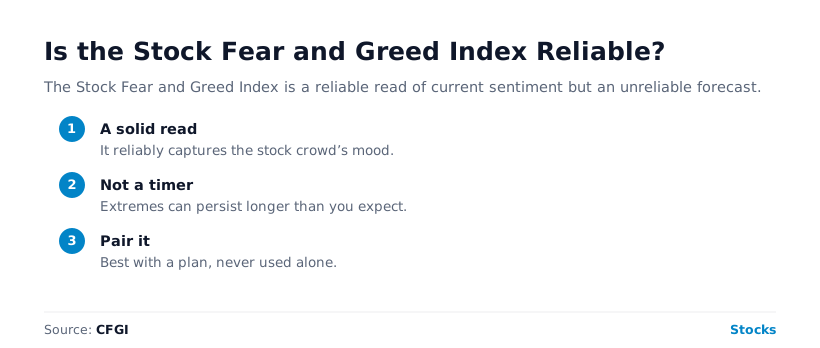
The Stock Fear and Greed Index is reliable at what it measures, current equity sentiment built from measurable signals, but unreliable as a forecast of where price goes next. It describes the crowd accurately and consistently, the same conditions give the same score, yet it predicts the next move only about half the time. Used as context alongside trend and fundamentals it is dependable; used as a standalone timing signal it is not. The distinction is everything. This is education, not financial advice.
CFGI data
Reliability splits in two: CFGI reads sentiment consistently, the same conditions give the same score, but as a forecast it matches the next day only about half the time. The equity score has tracked real extremes since 2021, from 3 on 8 April 2025 to 83 on 19 December 2023, accurately reflecting the crowd at each point on its 0 to 100 scale.
Source: CFGI dataset, 2021 to June 2026.
Key takeaways
- Reliable at reading current sentiment from measurable signals.
- Consistent: the same conditions give the same score.
- Unreliable as a forecast of the next move, about a coin flip.
- It is a thermometer of mood, not a weather forecast.
- Dependable as context, not as a standalone timing tool.
Two Kinds of Reliable
A tool can be reliable at measuring and unreliable at predicting, and the Stock Fear and Greed Index is exactly that. Because it reads measurable signals, volatility, breadth, safe-haven demand, it is consistent: the same market conditions produce the same reading. That makes it dependable as a description of now. As a forecast it is weaker. Sentiment can stay extreme while price keeps moving, so an accurate reading can still be early. That is not the index being unreliable; it is sentiment not being a timing tool.
Reliable At Reading Sentiment
On its core job, measuring the mood, the index is genuinely dependable. It is built from objective, quantifiable inputs rather than opinion, so it is repeatable: feed in the same volatility, breadth and demand data and you get the same score, every time, with no guesswork. This consistency is what lets you compare today’s reading meaningfully against last week’s or last year’s. CFGI’s equity history bears this out, the score has accurately marked real extremes, from a panicked 3 in April 2025 to a confident 83 in December 2023, each one a faithful reflection of how the crowd was actually positioned at that moment. As a mirror of present sentiment, it is reliable in the fullest sense.
Unreliable As a Forecast
Where reliability breaks down is prediction, and the data is honest about it: the index matches the next day’s direction only about half the time, no better than a coin flip. But this is not a flaw in the index so much as a fact about sentiment itself. Moods can persist, a market can stay greedy through a long rally or fearful through a long decline, so even a perfectly accurate reading of today tells you little about tomorrow. Expecting a sentiment gauge to forecast price is asking it to do a job it was never built for, and any "unreliability" you feel usually comes from that mistaken expectation, not from the measurement.
The Honest Split
Trust the index to tell you how the crowd feels now. Do not trust it to tell you what price does next. Those are two different questions, and it answers only the first reliably.
A Thermometer, Not a Forecast
The clearest way to think about it is as a thermometer. A thermometer reliably tells you the temperature right now; it does not tell you whether it will rain tomorrow, and no one calls it broken for that. The Stock Fear and Greed Index is a thermometer for market emotion: it reads the temperature of fear and greed accurately and consistently, which is exactly what a thermometer should do. Judged on that basis, it is a reliable instrument. Judged as a crystal ball, it disappoints, but so would any honest measure. Setting the right expectation, measurement not prophecy, is what turns the index from "unreliable" into genuinely useful.
How to Use It Reliably
To get dependable value from it, use it for what it is good at. Lean on it to read the crowd accurately, and pay most attention at the extremes, where stretched positioning is most informative and the middle says little. Then confirm any action with trend, valuations and a plan, never acting on the number alone. Used this way, as one reliable input among several rather than a self-contained signal, it consistently adds value. The reading below is a dependable measure of where equity sentiment sits right now, not a prediction of tomorrow, and treating it as exactly that is the key to using it well.
There is also a quieter form of reliability worth naming: as a check on yourself. The index reliably shows when your own fear or greed is being shared by the whole crowd, which is exactly when independent thinking pays off most. In that sense its most dependable use may be defensive, a steady, unemotional second opinion at the moments you are most tempted to act on feeling alone.
Frequently asked questions
Is the Stock Fear and Greed Index reliable?
It is reliable at reading current sentiment and unreliable as a forecast. It describes the crowd consistently from measurable signals, but predicts the next move only about half the time, so use it as context, not a timing signal.
Why is it reliable for measuring but not predicting?
Because it is built from objective, repeatable inputs, so the same conditions always give the same score, that is reliable measurement. Prediction is different: moods can persist, so an accurate reading of today tells you little about tomorrow.
How is it like a thermometer?
A thermometer reliably reads the current temperature but does not forecast tomorrow’s weather, and no one calls it broken for that. The index reliably reads market emotion now, but is not a crystal ball for price.
How should I use it reliably?
For what it is good at: reading the crowd, especially at extremes. Confirm any decision with trend, fundamentals and risk management, and never act on the number alone. This is education, not financial advice.
CFGI.io, Market sentiment research
The CFGI research team builds and maintains the CFGI Fear and Greed Index: a 0 to 100 sentiment score from 10 sub-indicators across hundreds of crypto assets and the equity market, refreshed every 15 minutes. We have tracked market emotion through multiple full crypto and equity cycles.
Think we missed something?
Spotted a gap, disagree with a take, or think we should cover a new topic? Message us and we'll act on your input.
Message us on TelegramKeep reading
This article is educational and is not financial advice. Crypto and equities are volatile and you can lose money. See our disclaimer.