Stocks
How to Use the Stock Fear and Greed Index
Quick answer
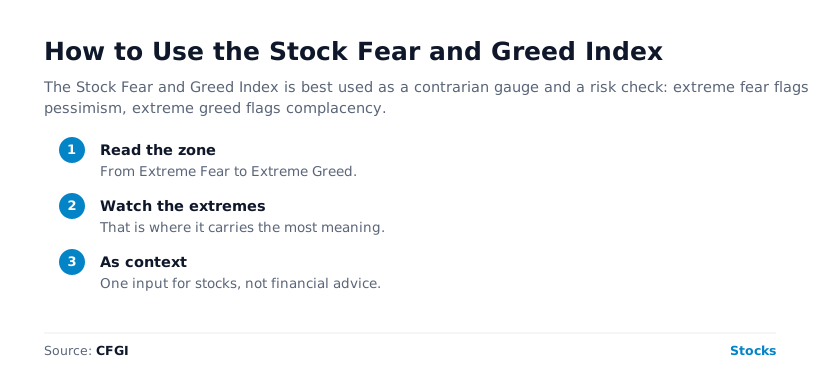
The Stock Fear and Greed Index is most useful as a contrarian gauge and a risk check. Extreme Fear, under 20, suggests the market may be too pessimistic; Extreme Greed, over 80, suggests complacency and crowded positioning. Because the equity crowd panics fast but rarely turns euphoric, a true Extreme Greed reading is a notable event. Long-term investors often use it to check whether they are being swept along by the crowd, not as a trading trigger. This is education, not financial advice.
CFGI data
CFGI scores stock sentiment from 0 to 100 daily, across indices and leading names, since 2021. Equity readings have run from an extreme-fear 3 on 8 April 2025 to 83 on 19 December 2023, fear arriving fast and euphoria staying scarce, which is why deep-fear readings draw the most attention.
Source: CFGI dataset, 2021 to June 2026.
Key takeaways
- Used mainly as a contrarian gauge and a check on your own bias.
- Under 20 is Extreme Fear; 80 or above is Extreme Greed.
- The equity crowd panics fast but rarely turns euphoric.
- Long-term investors use it to avoid being swept along by the crowd.
- It is context, not a trading signal on its own.
What It Is Good For
The Stock Fear and Greed Index reads how fearful or greedy equity investors are. It is best used two ways: as a contrarian gauge, where extremes flag the crowd being one-sided, and as a mirror, a check on whether your own conviction is really the crowd talking. For the large majority of equity investors, who are investing for the long term rather than actively trading, that second use, as a behavioural check rather than a timing tool, is by far the more valuable of the two.
How the Zones Are Read
| Reading | Zone | How it is often read |
|---|---|---|
| Under 20 | Extreme Fear | Pessimism may be overdone |
| 20 to 39 | Fear | Caution dominates |
| 40 to 59 | Neutral | No strong edge |
| 60 to 79 | Greed | Optimism and risk appetite building |
| 80 to 100 | Extreme Greed | Complacency; crowded positioning |
Common readings of each zone. Context, not signals.
As ever, the signal lives at the extremes. A reading in the neutral middle tells you little; a reading deep in Extreme Fear or Extreme Greed is where the index earns its keep.
The Equity Crowd’s Quirk
Reading the stock index well means understanding the distinct character of the equity crowd, which behaves quite differently from crypto. The stock crowd is quick to panic but slow to celebrate: it reaches the depths of fear readily but rarely tips into true euphoria. The CFGI data shows this starkly, the equity score has plunged as low as 3 in a panic but, even across a 21% rally in the S&P 500, never once produced an Extreme Greed close, topping out at 83. This asymmetry has a direct, practical consequence for how you use the index. Because Extreme Greed is genuinely rare in stocks, a true high reading is a notable, attention-worthy event when it does appear, more significant than the same reading would be in crypto. And because deep fear is reached more often, those low readings are the ones that draw the most attention as potential contrarian opportunities. Calibrating your reading to the equity crowd’s cautious-but-rarely-euphoric temperament, rather than to crypto’s wilder swings, is key to using the stock index sensibly.
Stock Greed Is Rare, So It Matters
The equity crowd panics fast but rarely turns euphoric: the score has hit 3 but topped out at 83. So a true Extreme Greed reading in stocks is a rare, notable event worth heeding when it appears.
Using It As a Long-Term Investor
For most investors the value is not in trading the index but in resisting it. Extreme Greed is a prompt to check you are not over-exposed and to question whether your own confidence is just the euphoric crowd talking; Extreme Fear is a prompt to ask whether the panic is justified or just loud, and above all to resist the powerful urge to sell at the bottom. Used this way, the index becomes a behavioural guardrail, a tool that helps a long-term investor avoid the two great mistakes of buying near tops and selling near bottoms, rather than a source of trading signals. CFGI also scores individual stocks, so you can see whether your specific holding is at an extreme rather than only the broad market. The honest caveat applies throughout: sentiment can stay irrational for a long time, fear can persist through a real downturn, and the index is one input for a plan you set in advance, not a buy or sell trigger. This is education, not financial advice.
Frequently asked questions
How do you use the Stock Fear and Greed Index?
As a contrarian gauge and a bias check. Extreme Fear under 20 suggests pessimism may be overdone, Extreme Greed over 80 suggests complacency. For most long-term investors the real value is behavioural, using it to avoid being swept along, not as a trading trigger.
Why does the equity crowd matter for reading it?
Because the stock crowd panics fast but rarely turns euphoric: the score has hit 3 but topped out at 83, with no Extreme Greed close even in a 21% rally year. So a true Extreme Greed reading is a rare, notable event, while deep-fear readings draw the most contrarian attention.
Is Extreme Greed a sell signal for stocks?
Not on its own. It flags that optimism is high and positioning crowded, which raises risk, but greed can persist in a strong market. Treat it as a prompt to check your exposure and your own confidence, alongside other analysis.
Does it work for individual stocks?
Yes. CFGI scores major indices and the most-traded stocks individually, so you can read your specific holding rather than only the broad market. Sentiment can stay irrational for a long time, so use it as one input for a plan, not a trigger. This is education, not financial advice.
CFGI.io, Market sentiment research
The CFGI research team builds and maintains the CFGI Fear and Greed Index: a 0 to 100 sentiment score from 10 sub-indicators across hundreds of crypto assets and the equity market, refreshed every 15 minutes. We have tracked market emotion through multiple full crypto and equity cycles.
Think we missed something?
Spotted a gap, disagree with a take, or think we should cover a new topic? Message us and we'll act on your input.
Message us on TelegramKeep reading
This article is educational and is not financial advice. Crypto and equities are volatile and you can lose money. See our disclaimer.