Stocks
What Is a Circuit Breaker?
Quick answer
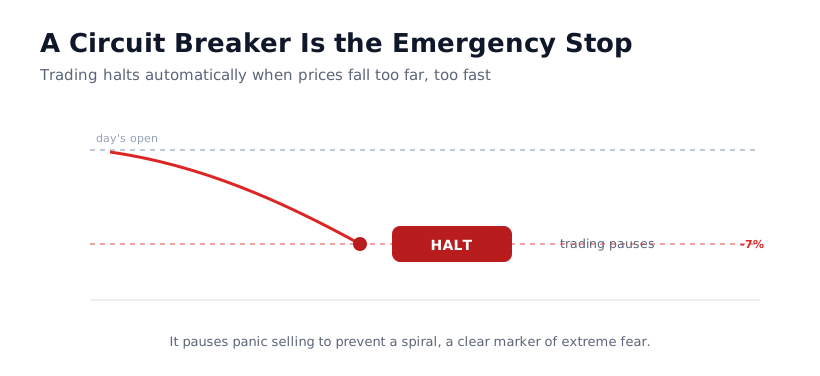
A circuit breaker is an automatic, temporary halt in trading triggered when a market falls too far, too fast. US markets use three tiers: a 7% or 13% drop in the S&P 500 triggers a 15-minute pause, and a 20% drop halts trading for the day. Exchanges use them to pause panic selling, give everyone a moment to breathe, and prevent a crash from spiralling. A triggered breaker is one of the clearest markers of extreme fear there is. This is education, not financial advice.
CFGI data
A circuit breaker is extreme fear made official, the market halting itself mid-panic. CFGI scores that fear on the Stock Fear and Greed Index, 0 to 100, updated daily since 2021: its deepest equity low was 3, on 8 April 2025, exactly the kind of panic these halts are built for.
Source: CFGI dataset, 2021 to June 2026.
Key takeaways
- A circuit breaker is an automatic, temporary halt in trading.
- US tiers: 7% and 13% drops pause 15 minutes; 20% halts the day.
- They were introduced after the 1987 crash.
- Their purpose is to pause panic and prevent a spiral.
- A triggered breaker is a clear marker of extreme fear.
What Is a Circuit Breaker?
A circuit breaker is a rule that halts trading on an exchange when prices drop sharply within a session. Like an electrical breaker that cuts the power to prevent a fire, it cuts trading to prevent a panic from feeding on itself. The halt is temporary, often minutes, after which trading resumes. The name captures the idea perfectly: it is a deliberate, automatic interruption designed to stop a dangerous surge, in this case a surge of fear, from causing lasting damage before anyone can intervene.
How Do Circuit Breakers Work?
US markets use tiered thresholds based on how far the S&P 500 falls from the previous day’s close. A Level 1 decline of 7% and a Level 2 decline of 13% each trigger a 15-minute halt (if they occur before 3:25pm), while a Level 3 decline of 20% halts trading for the rest of the day. The exact levels differ between markets, but the logic is identical everywhere: force a cooling-off period when selling becomes disorderly. Alongside these market-wide breakers, individual stocks have their own "limit up, limit down" bands that pause trading in a single name if it moves too violently. The stock exchange enforces all of this automatically, no human decides in the moment; the rules simply fire when a threshold is breached.
Why Markets Have Them
Circuit breakers were born from disaster. After Black Monday in October 1987, when the Dow fell about 22% in a single day, regulators concluded that markets needed a built-in pause to break the kind of self-reinforcing panic that had turned a sell-off into a freefall. The rationale is to interrupt the feedback loops that make crashes so violent: automated selling triggering more automated selling, margin calls forcing yet more sales, and a stampede for the exits feeding on itself. A halt gives the market time to breathe, lets participants absorb information and find buyers, and aims to prevent a disorderly cascade from spiralling out of control. It is, in essence, an attempt to insert a moment of human reflection into a process that can otherwise run on pure, mechanical fear.
Do Circuit Breakers Actually Help?
The honest answer is that they are debated. The case for them is intuitive: a forced pause halts the panic, gives traders time to reassess, and has, on occasion, been followed by calmer trading when the market reopened. But there is a credible case against. Critics point to a "magnet effect", as a falling market nears a circuit-breaker level, some traders rush to sell before the halt locks them in, which can actually accelerate the decline toward the threshold. And a pause does nothing to address the underlying reason for the selling; it merely delays it, so a market can simply resume falling once trading restarts. Most observers land somewhere in the middle: circuit breakers are a sensible safety valve against truly disorderly, technology-driven crashes, but they are a brake on panic, not a cure for the fear causing it.
A Brake, Not a Cure
A circuit breaker can interrupt a disorderly panic, but it cannot remove the fear behind it. Sometimes the selling simply resumes when trading restarts, because the cause has not changed.
What Do Circuit Breakers Say About Fear?
They are panic, formalised. A circuit breaker only trips when fear is so intense that selling has turned disorderly, the kind of capitulation that defines a market crash. So a triggered breaker is one of the clearest, most objective markers of extreme fear there is, the market literally hitting its own emergency stop. CFGI scores the surrounding equity mood on the Stock Fear and Greed Index, where such moments sit deep in the fear zone, near readings like its equity low of 3. While the breaker marks a single dramatic instant, the sentiment score traces the whole arc of fear around it, the build-up before and the slow recovery of nerve after, putting that one halt in the context of the broader panic.
Frequently asked questions
What is a circuit breaker?
An automatic, temporary halt in trading triggered when a market falls too far, too fast. Like an electrical breaker cutting power to prevent a fire, it pauses trading to stop a panic from feeding on itself.
What triggers a circuit breaker?
In US markets, a fall in the S&P 500 from the prior close: a 7% (Level 1) or 13% (Level 2) drop triggers a 15-minute halt before 3:25pm, and a 20% (Level 3) drop halts trading for the day. Individual stocks also have "limit up, limit down" bands.
Do circuit breakers actually work?
It is debated. They can interrupt a disorderly, self-reinforcing panic, but critics note a "magnet effect" where traders rush to sell before a halt, and a pause does not fix the cause of the selling. Most see them as a useful safety valve, not a cure.
What does a circuit breaker say about sentiment?
It signals extreme fear. A breaker only trips when selling has become disorderly, so it is one of the clearest, most objective markers of capitulation and panic, the market hitting its own emergency stop. This is education, not financial advice.
CFGI.io, Market sentiment research
The CFGI research team builds and maintains the CFGI Fear and Greed Index: a 0 to 100 sentiment score from 10 sub-indicators across hundreds of crypto assets and the equity market, refreshed every 15 minutes. We have tracked market emotion through multiple full crypto and equity cycles.
Think we missed something?
Spotted a gap, disagree with a take, or think we should cover a new topic? Message us and we'll act on your input.
Message us on TelegramKeep reading
This article is educational and is not financial advice. Crypto and equities are volatile and you can lose money. See our disclaimer.