Stocks
CFGI vs CNN Fear and Greed Index
Quick answer
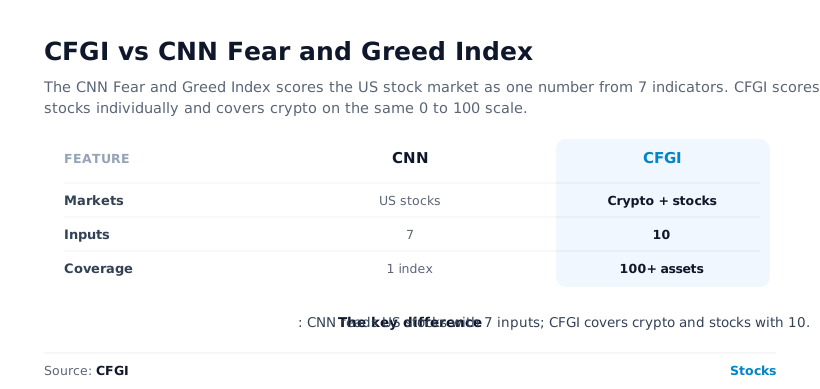
The CNN Fear and Greed Index scores the US stock market as a whole, from 0 to 100, using 7 equally weighted indicators. CFGI runs the same 0 to 100 idea but scores individual stocks and indices, and covers crypto on the same scale, from 10 indicators, so you can compare the mood of one stock against another, or stocks against crypto. Same format, broader coverage and per-asset detail. This is education, not financial advice.
CFGI data
CNN scores one number for the whole US market. CFGI scores stocks individually and reads equities and crypto on one 0 to 100 scale. CFGI equity sentiment has spanned the full range, from an extreme-fear 3 on 8 April 2025 to a high of 83 on 19 December 2023, with fear arriving fast and euphoria staying scarce.
Source: CFGI dataset, 2021 to June 2026.
Key takeaways
- CNN scores the whole US stock market as one number, from 7 indicators.
- CFGI scores individual stocks and indices, plus crypto, on the same scale.
- CNN uses 7 equally weighted inputs; CFGI uses 10 indicators.
- The methods overlap on volatility, breadth and safe-haven demand.
- Same 0 to 100 format; the difference is breadth and per-asset detail.
What Does Each One Cover?
The CNN Fear and Greed Index popularised the format. It scores the US stock market as a whole from 7 equally weighted indicators: market momentum, stock price strength, stock price breadth, put and call options, market volatility (the VIX), junk bond demand and safe-haven demand. CFGI scores stocks too, but individually, across major indices and the most-traded names, from 10 indicators. It also scores crypto on the same 0 to 100 scale, so the equity crowd and the crypto crowd can be read side by side.
Indicators: 7 Versus 10
Under the hood, the two indexes share a good deal of DNA. Both read market behaviour rather than opinion, and both lean on classic stress signals: volatility (the VIX), market breadth, safe-haven demand and the appetite for risky versus safe bonds all feature in each. The differences are in depth and breadth. CFGI reads 10 indicators rather than 7, giving it a few extra angles on the same equity mood, and crucially, its methodology extends to crypto, where it folds in signals that have no equity equivalent, like on-chain whale flows, Bitcoin dominance and social activity. So while the two are close cousins when reading US stocks, CFGI is built from the ground up to read a second, very different asset class on the same scale, which a stock-only index simply is not.
CFGI vs CNN, Side by Side
| CNN | CFGI | |
|---|---|---|
| Scope | US stock market, one number | Individual stocks + indices |
| Asset classes | US equities only | Equities and crypto, one scale |
| Inputs | 7 equally weighted indicators | 10 indicators |
| Per-asset scores | No | Yes |
| Crypto coverage | No | Yes, hundreds of assets |
| Scale | 0 to 100 | 0 to 100 |
The two stock-market Fear and Greed indexes compared.
The Big Difference: Breadth and Granularity
The headline distinction is not really the indicator count, it is what each index can show you. CNN produces one number for the entire US stock market, which is clean but inevitably an average that hides internal divergences. CFGI, by scoring assets individually and across both equities and crypto, can surface exactly those divergences, which are often where the useful information lives. It can show the equity crowd cautious while crypto runs hot, or one stock in fear while another runs greedy. On 5 February 2026, for example, CFGI scored crypto at an all-time low of 12 while the stock market sat at 35, two very different moods at the same instant, the kind of split a single market gauge can never reveal. For anyone active in more than one market, or in specific names, that granularity is the whole point.
A Number Versus a Map
CNN gives one number for US stocks; CFGI gives a per-asset, cross-market map. The map reveals the divergences, one market fearful while another runs hot, that a single average hides.
Which Should You Use?
Neither is strictly better; they suit different needs. If you only watch the broad US market and want a single, trusted, glanceable read, CNN gives exactly that, and its long-standing prominence is a genuine virtue. If you trade specific stocks, or you hold both stocks and crypto, CFGI is built for that: it scores names individually and puts equities and crypto on one comparable scale, so you can see where each crowd actually stands rather than relying on a single market average. Many people find the honest answer is to appreciate CNN for what it pioneered while using a per-asset, multi-market index when they need to go deeper than one number, matching the tool to the breadth of what they actually invest in.
Frequently asked questions
Is CFGI the same as the CNN Fear and Greed Index?
No. Both score sentiment from 0 to 100, but CNN scores the US stock market as one number from 7 indicators, while CFGI scores individual stocks and indices, and crypto, from 10 indicators on the same scale.
How do the indicators differ?
They overlap a lot: both use volatility (the VIX), breadth, safe-haven demand and junk-bond appetite. CFGI reads 10 rather than 7, and extends to crypto with signals that have no equity equivalent, like on-chain whale flows, Bitcoin dominance and social activity.
Can I compare stocks and crypto with CFGI?
Yes. CFGI scores equities and crypto on one 0 to 100 scale, so you can see the equity crowd cautious while crypto runs hot, or the reverse. On 5 February 2026 crypto sat at 12 while stocks were at 35. CNN covers US stocks only.
Which should I use?
CNN for a clean single read of the broad US market; CFGI if you trade specific names or hold both stocks and crypto and want per-asset, cross-market detail. They suit different needs rather than one being strictly better. This is education, not financial advice.
CFGI.io, Market sentiment research
The CFGI research team builds and maintains the CFGI Fear and Greed Index: a 0 to 100 sentiment score from 10 sub-indicators across hundreds of crypto assets and the equity market, refreshed every 15 minutes. We have tracked market emotion through multiple full crypto and equity cycles.
Think we missed something?
Spotted a gap, disagree with a take, or think we should cover a new topic? Message us and we'll act on your input.
Message us on TelegramKeep reading
This article is educational and is not financial advice. Crypto and equities are volatile and you can lose money. See our disclaimer.