Crypto
What Is Bitcoin Dominance?
Quick answer
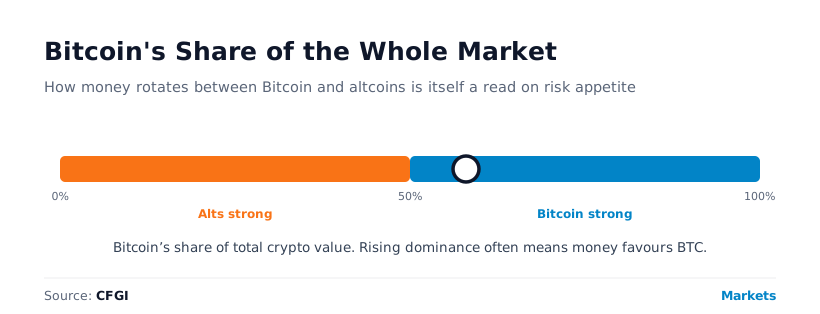
Bitcoin dominance is Bitcoin’s share of the total crypto market value. If all of crypto is worth 100 and Bitcoin is worth 55 of it, dominance is 55%. It matters because the way money rotates between Bitcoin and altcoins is itself a read on risk appetite: rising dominance often means caution, falling dominance often means greed and an "altcoin season". CFGI tracks it as one of its 10 sentiment indicators. This is education, not financial advice.
CFGI data
Bitcoin dominance is itself a sentiment gauge. CFGI uses market dominance as one of its 10 indicators: money crowding into Bitcoin, rising dominance, often signals risk-off caution, while money rotating into altcoins signals risk appetite. It feeds a 0 to 100 score tracked every 15 minutes since March 2022.
Source: CFGI methodology and dataset, March 2022 to June 2026.
Key takeaways
- Bitcoin dominance is Bitcoin’s share of total crypto market value.
- It is Bitcoin’s market cap divided by the whole market’s.
- Rising dominance often means money is playing it safe in Bitcoin.
- Falling dominance often signals an "altcoin season".
- CFGI uses dominance as one of its 10 sentiment indicators.
What Is Bitcoin Dominance?
Bitcoin dominance is the percentage of the entire crypto market’s value that sits in Bitcoin. Add up the market value of every coin, then ask how much of that total is Bitcoin. That share is dominance. It moves as money flows between Bitcoin and the rest of the market, so it is less about Bitcoin’s price alone and more about where the crowd is putting its risk, a single figure that captures the balance of power between Bitcoin and the thousands of altcoins that make up the rest of the market.
How Dominance Is Calculated
The maths is simple: take Bitcoin’s total market capitalisation (its price multiplied by the number of coins in circulation) and divide it by the combined market capitalisation of all cryptocurrencies, then express it as a percentage. So if the entire crypto market is worth 100 and Bitcoin accounts for 55 of that, dominance is 55%. One subtlety is worth understanding, because it trips people up: because dominance is a ratio, it can rise even when Bitcoin’s price is flat or falling, as long as altcoins are falling faster, and it can drop even when Bitcoin is rising, if altcoins rise faster still. It measures relative share, not absolute price, which is precisely why it is read as a gauge of rotation, of where money is moving within crypto, rather than as a measure of Bitcoin’s performance on its own.
Why Does Dominance Signal Sentiment?
Bitcoin is the safest, most established crypto asset, the closest thing the asset class has to a blue-chip. So when traders get cautious, they often rotate out of riskier altcoins and into Bitcoin, and dominance rises. When confidence returns, money spreads back out into altcoins chasing higher returns, and dominance falls. In effect, dominance behaves like a risk dial for the entire crypto market, telling you whether the crowd is huddling in the relative safety of Bitcoin or venturing out along the risk curve in search of bigger gains.
A Risk Dial
Read dominance as a risk dial for crypto: up tends to mean risk-off and caution, down tends to mean risk-on and greed. It is a tendency, not a rule.
Dominance and Altcoin Season
The clearest expression of this risk dial is the phenomenon traders call "altcoin season". A common pattern in a crypto bull market runs in stages: first Bitcoin leads a recovery, drawing money in and pushing dominance up; then, as confidence grows and Bitcoin’s gains start to feel "safe", capital rotates outward into larger altcoins like Ethereum, and then into smaller, riskier coins, sending dominance down. That falling-dominance phase, when altcoins broadly outperform Bitcoin, is "alt season", and it tends to coincide with peak risk appetite and greed. The cycle often reverses in a downturn, when fear sends money fleeing back to the relative safety of Bitcoin and dominance climbs again. Watching dominance trend up or down, therefore, is a way of reading which phase of this risk rotation the crypto market is in, and how adventurous, or fearful, the crowd has become.
How Does CFGI Use Dominance?
Because dominance carries this risk signal, CFGI uses it as one of the 10 indicators behind its Fear and Greed Index. It sits alongside price, volatility, volume and on-chain flows, so the rotation between Bitcoin and altcoins is folded into the single 0 to 100 score. Rising dominance, the flight to Bitcoin, leans the reading toward caution, while falling dominance, the spread into altcoins, leans it toward risk appetite. This is a good example of how the index blends structural market signals with pure emotional ones: dominance is not a feeling, but it reliably reflects one, the crowd’s appetite for risk within crypto, which is exactly why it earns a place among the inputs.
Frequently asked questions
What is Bitcoin dominance?
Bitcoin’s share of the total crypto market value, the percentage of all crypto value that sits in Bitcoin. It captures the balance of power between Bitcoin and the thousands of altcoins, and where the crowd is putting its risk.
How is Bitcoin dominance calculated?
Bitcoin’s market cap divided by the total market cap of all cryptocurrencies, as a percentage. If the whole market is worth 100 and Bitcoin is 55, dominance is 55%. Because it is a ratio, it can rise even if Bitcoin is flat, as long as altcoins fall faster.
What is altcoin season?
A phase when altcoins broadly outperform Bitcoin and dominance falls, typically as confidence grows and capital rotates from Bitcoin out into riskier coins chasing bigger gains. It tends to coincide with peak risk appetite and greed.
Is dominance a sentiment indicator?
Yes. CFGI uses market dominance as one of the 10 indicators behind its 0 to 100 Fear and Greed score, because the Bitcoin-versus-altcoin rotation reliably tracks risk appetite. Rising dominance leans cautious, falling leans risk-on. This is education, not financial advice.
CFGI.io, Market sentiment research
The CFGI research team builds and maintains the CFGI Fear and Greed Index: a 0 to 100 sentiment score from 10 sub-indicators across hundreds of crypto assets and the equity market, refreshed every 15 minutes. We have tracked market emotion through multiple full crypto and equity cycles.
Think we missed something?
Spotted a gap, disagree with a take, or think we should cover a new topic? Message us and we'll act on your input.
Message us on TelegramKeep reading
This article is educational and is not financial advice. Crypto and equities are volatile and you can lose money. See our disclaimer.