Stocks
What Is a Broker?
Quick answer
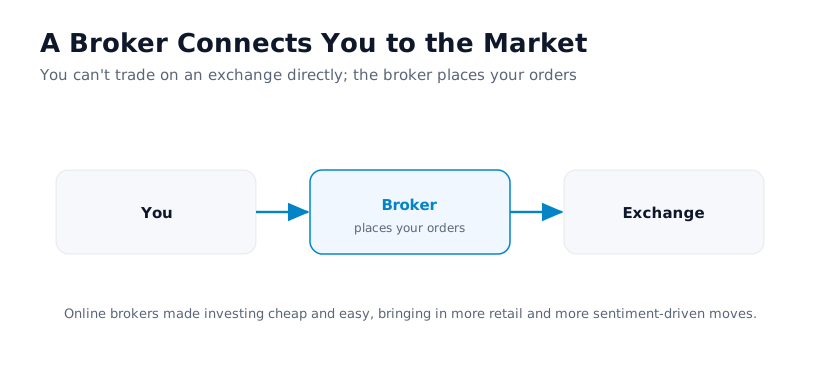
A broker is a firm or platform that buys and sells stocks on your behalf, connecting you to the stock exchange, since individuals cannot trade there directly. Modern online brokers made investing cheap, fast and accessible, often with zero commission, which brought millions of new retail investors into markets, and with them, more sentiment-driven price moves. Your broker also holds your investments in custody, a role with its own rules and protections. This is education, not financial advice.
CFGI data
Low-cost brokers brought millions of retail investors into markets, and retail flows are emotional, so they sharpen sentiment swings. CFGI scores that mood from 0 to 100 on the Stock Fear and Greed Index, updated daily since 2021 across major indices and leading stocks.
Source: CFGI dataset, 2021 to June 2026.
Key takeaways
- A broker buys and sells securities on your behalf.
- Individuals cannot trade on an exchange directly.
- Types range from full-service to discount to robo-advisers.
- Brokers hold your assets in custody, protected by SIPC if one fails.
- Cheap online brokers made markets more retail- and sentiment-driven.
What Is a Broker?
A broker is the middleman between you and the stock exchange. You cannot walk onto an exchange and trade; instead you place an order with a licensed broker, who executes it for you. Today this is usually an app or website where you can buy a stock in seconds, but the role is the same one brokers have always played: a regulated intermediary that connects ordinary investors to a market they could not otherwise reach.
Broker Versus Dealer
A small but important distinction: a broker buys and sells securities on behalf of clients, acting as an agent, while a "dealer" buys and sells for its own account, taking the other side of trades. Many firms do both and are called "broker-dealers". The difference matters because it shapes whose interest is being served: as a broker, the firm is meant to act for you, finding the best execution for your order; as a dealer, it is trading its own book. Knowing which hat a firm is wearing in a given transaction is part of understanding how the market really works.
What Types of Broker Are There?
- Discount or online brokers: low-cost, self-directed platforms, often commission-free, the modern default for most people.
- Full-service brokers: offer personal advice, planning and portfolio management, typically for a fee of around 1% to 2% of assets a year.
- Robo-advisers: automated platforms that build and manage a portfolio for you by algorithm, usually for a low fee of roughly 0.25% to 0.5%.
How Do Brokers Make Money?
If trading is "free", how does the broker get paid? The honest answer is several ways. Traditionally it was commissions, a fee per trade, and full-service and robo firms still charge a percentage of the assets they manage. But the rise of zero-commission trading was funded by other channels: interest earned on the cash and on margin loans in your account, fees on premium features, and, controversially, payment for order flow, where the broker is paid to route your trades to a market maker. The lesson is the familiar one: when a service looks free, it is worth understanding how it is actually being paid for.
Is My Money Safe? Custody and SIPC
Your broker is also your "custodian": it holds your investments on your behalf, but it does not own them, and rules forbid it from using your assets to fund its own business. If a broker fails, a separate safety net steps in. In the US, the SIPC, created by law in 1970, protects the custody function: it works to return customers’ securities and cash, up to 500,000 dollars in total, of which up to 250,000 can be cash, when a member brokerage collapses.
What SIPC Does and Does Not Cover
SIPC protects you if your broker fails, returning your securities and cash up to the limits. It does not reimburse you if your investments simply fall in value, or if you are defrauded. It guards the plumbing, not your investment decisions.
How Brokers Changed the Market
Brokers have reshaped who invests. When trading was expensive and gated behind phone calls and high commissions, markets were dominated by professionals. Cheap, app-based brokers tore down that barrier, bringing millions of retail investors into the market with fractional shares and one-tap orders. That democratisation is largely a good thing, more people can build wealth, but it has a side effect: retail money tends to move on emotion and narrative, so equity markets have become a little faster, more crowded and more sentiment-driven than they were in the gated era.
Brokers and Market Sentiment
By opening the doors so wide, brokers have amplified the role of sentiment in markets. A larger, more emotional retail crowd means sharper swings between fear and greed, the very thing a Stock Fear and Greed Index measures on a 0 to 100 scale. CFGI scores that mood daily across major indices and leading stocks, which makes a sentiment gauge more useful now than ever: in a market shaped by millions of new, easily reachable investors, knowing when the crowd is at an emotional extreme is a genuine edge.
Frequently asked questions
Do I need a broker to buy stocks?
Yes. Individuals cannot trade on an exchange directly, so you use a broker, today usually an app or website, to place your orders. The broker is a regulated intermediary between you and the market.
What is the difference between a broker and a dealer?
A broker buys and sells securities on behalf of clients, as an agent; a dealer trades for its own account, taking the other side. A firm that does both is a broker-dealer.
How do commission-free brokers make money?
Through interest on your cash and margin loans, fees on premium features, and payment for order flow, where a market maker pays to execute your trades. "Free" trading is funded by these other channels.
Is my money safe with a broker?
Your broker holds your assets in custody but does not own them, and if it fails, SIPC protects securities and cash up to 500,000 dollars (250,000 in cash). SIPC does not cover investment losses or fraud. This is education, not financial advice.
CFGI.io, Market sentiment research
The CFGI research team builds and maintains the CFGI Fear and Greed Index: a 0 to 100 sentiment score from 10 sub-indicators across hundreds of crypto assets and the equity market, refreshed every 15 minutes. We have tracked market emotion through multiple full crypto and equity cycles.
Think we missed something?
Spotted a gap, disagree with a take, or think we should cover a new topic? Message us and we'll act on your input.
Message us on TelegramKeep reading
This article is educational and is not financial advice. Crypto and equities are volatile and you can lose money. See our disclaimer.