Crypto
How Is the Crypto Fear and Greed Index Calculated?
Quick answer
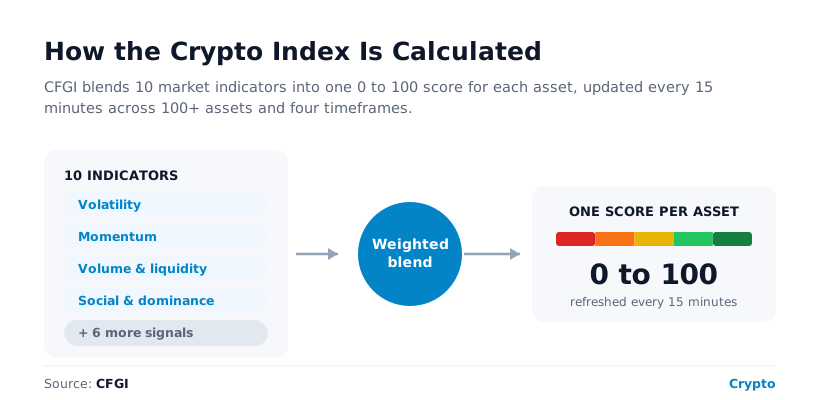
CFGI calculates the Crypto Fear and Greed Index by combining 10 separate indicators into a single score from 0 to 100. Each indicator measures one slice of market behaviour, from price momentum and volatility to social activity and on-chain flows. No single signal dominates, so the score reflects the whole market mood rather than any one chart, and it is recalculated every 15 minutes across four timeframes for hundreds of assets individually. This is education, not financial advice.
CFGI data
CFGI builds every score from 10 indicators, weighted together into a 0 to 100 reading refreshed every 15 minutes across 4 timeframes since March 2022, for hundreds of assets individually. Because the inputs are measurable, the same conditions produce the same score, which is what makes it trackable rather than a matter of opinion.
Source: CFGI methodology and dataset, March 2022 to June 2026.
Key takeaways
- The score combines 10 indicators into one 0 to 100 reading.
- It reads measurable behaviour, not opinion, so it is repeatable.
- No single signal dominates, so it reflects the whole mood.
- On-chain flows are read as fear or greed by direction.
- It is recalculated every 15 minutes across 4 timeframes, per asset.
What Are the 10 Indicators?
CFGI blends 10 measurable signals. Each captures a different angle on how the crowd is behaving:
| Indicator | What it reads |
|---|---|
| Price | Momentum: how far price sits above or below recent ranges |
| Volatility | How sharply price is swinging |
| Volume | How much is actually trading |
| Impulse | The strength and speed of the current move |
| Technicals | Common chart signals traders watch |
| Social | Activity and tone across social platforms |
| Dominance | The rotation between Bitcoin and altcoins |
| Search interest | How much the public is searching for crypto |
| Whales | Large holders moving coins on-chain |
| Order book | Buy and sell pressure waiting at the exchange |
The 10 indicators behind every CFGI score.
Why Measure Behaviour, Not Opinion?
A defining choice in how the index is calculated is that every one of those 10 indicators reads behaviour, what people are actually doing with their money, rather than opinion, what they say in a survey. This matters enormously, because actions are far more honest than words: a trader can claim to be bullish while quietly selling, but the volume, the exchange flows and the order book reveal the truth. By building the score entirely from measurable market and on-chain data, the index sidesteps the noise, spin and manipulation that plague survey-based sentiment, and crypto is the ideal place to do this, because its public blockchains record the real behaviour of millions of participants in the open. The payoff is objectivity and repeatability: because the calculation is grounded in hard, quantifiable inputs rather than judgement, the same market conditions always produce the same score, which is exactly what makes the index something you can track and trust over time rather than argue about.
How Are They Combined Into One Number?
Each indicator is measured, scaled to the same 0 to 100 range, then weighted together into the final score. Spreading the reading across 10 inputs is deliberate: it stops any single noisy signal, a one-off volume spike, say, from swinging the whole index. This is the core advantage of a composite over any single gauge, a false or misleading reading in one indicator is diluted and outvoted by the other nine, producing a far more robust and reliable picture of the overall mood than any one chart could give. The result is recalculated every 15 minutes across 4 timeframes, and separately for hundreds of assets, so the Crypto Fear and Greed Index you read is always current.
Ten Signals, One Robust Score
Each indicator is scaled to 0 to 100 and weighted together, so no single noisy signal can swing the index. A false reading in one is outvoted by the other nine, making the composite far harder to mislead.
How Do On-Chain Flows Read As Fear Or Greed?
Direction is the key. Coins flowing onto exchanges signal intent to sell, which reads as fear; stablecoins flowing onto exchanges signal intent to buy, which reads as greed. Whale movements and dominance shifts add further context, large holders moving coins, or capital rotating from Bitcoin into riskier altcoins, each tell their own part of the story. Reading these correctly matters: buy pressure building near the price is bullish, while large sell walls are bearish. CFGI folds all of it into the one score, so you do not have to track each signal yourself. This on-chain layer is part of what makes a crypto sentiment index richer than its stock-market equivalent: it can see not just how prices and volatility are behaving, but the actual flow of coins and money beneath the surface, an extra, behaviour-level window that the transparency of the blockchain uniquely provides.
Frequently asked questions
How is the Crypto Fear and Greed Index calculated?
By combining 10 measurable indicators, price momentum, volatility, volume, impulse, technicals, social activity, dominance, search interest, whale movements and order-book pressure, each scaled to 0 to 100 and weighted together into one score, recalculated every 15 minutes across 4 timeframes for hundreds of assets.
Why does it read behaviour instead of opinion?
Because actions are more honest than words: a trader can claim to be bullish while selling, but volume, exchange flows and the order book reveal the truth. Building the score from measurable on-chain and market data makes it objective and repeatable, the same conditions always give the same score.
Why use 10 indicators instead of one?
So no single noisy signal can swing the index. A false or misleading reading in one indicator is diluted and outvoted by the other nine, making the composite far more robust and harder to mislead than any single chart.
How do on-chain flows read as fear or greed?
By direction: coins flowing onto exchanges signal intent to sell (fear); stablecoins flowing on signal intent to buy (greed). Whale moves and dominance shifts add context. This on-chain layer, unique to transparent blockchains, makes a crypto index richer than a stock one. This is education, not financial advice.
CFGI.io, Market sentiment research
The CFGI research team builds and maintains the CFGI Fear and Greed Index: a 0 to 100 sentiment score from 10 sub-indicators across hundreds of crypto assets and the equity market, refreshed every 15 minutes. We have tracked market emotion through multiple full crypto and equity cycles.
Think we missed something?
Spotted a gap, disagree with a take, or think we should cover a new topic? Message us and we'll act on your input.
Message us on TelegramKeep reading
This article is educational and is not financial advice. Crypto and equities are volatile and you can lose money. See our disclaimer.