Stocks
Best Stock Market Sentiment Indicator
Quick answer
There is no single best stock-market sentiment indicator; each reads a different slice. The VIX measures expected volatility, the put-call ratio measures hedging, surveys like AAII ask investors directly, breadth measures participation, and a Fear and Greed Index combines several signals into one 0 to 100 score. CFGI rolls volatility, breadth, safe-haven demand and more into that single score, and scores stocks individually. This is education, not financial advice.
CFGI data
Single-input gauges like the VIX or the put-call ratio read one slice of stock sentiment. CFGI combines 10 indicators into one 0 to 100 score and scores stocks individually, with equity readings since 2021 that have spanned an extreme-fear 3 on 8 April 2025 to 83 on 19 December 2023.
Source: CFGI dataset, 2021 to June 2026.
Key takeaways
- No single indicator is best; each reads a different part of sentiment.
- The VIX reads volatility; the put-call ratio reads hedging; surveys ask directly.
- A composite is harder to mislead than any single signal.
- A Fear and Greed Index combines several signals into one 0 to 100 score.
- CFGI uses 10 indicators and scores stocks individually.
What Each Indicator Reads
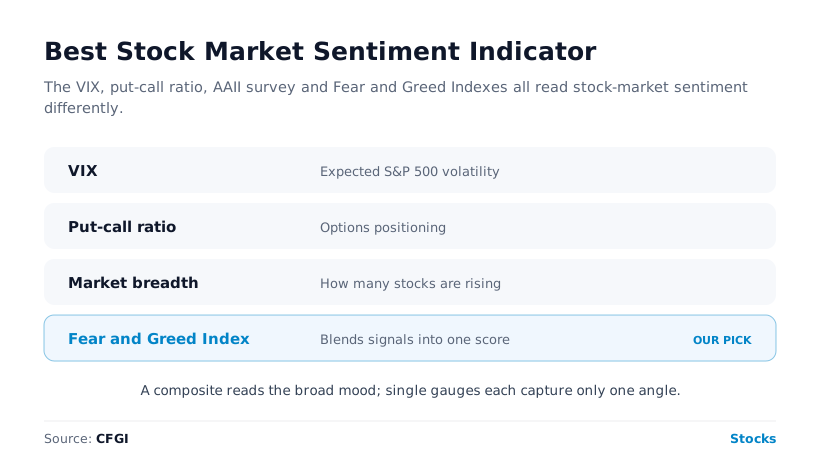
Stock-market sentiment can be read several ways. The VIX measures the expected volatility of the S&P 500. The put-call ratio measures how much investors are hedging. Surveys such as AAII ask investors how they feel. Breadth measures how many stocks are participating. A Fear and Greed Index folds many of these into one score. Each answers a slightly different question, which is the first clue that hunting for a single "best" one is the wrong framing.
Stock Sentiment Indicators, Compared
| Indicator | Reads | Scale |
|---|---|---|
| VIX | Expected volatility | A volatility level |
| Put-call ratio | Hedging activity | A ratio |
| AAII survey | How investors say they feel | % bull / bear |
| Fear and Greed (CFGI) | Several signals combined | 0 to 100, per asset |
What each stock-market sentiment indicator measures.
The VIX is the volatility specialist, the put-call ratio the options-hedging gauge, the AAII survey the direct opinion poll, and a Fear and Greed Index the generalist that combines several of these into one read.
There Is No Single "Best" for Stocks
The honest answer to "which is best?" is that it depends on what you want to see. If you want the level of fear priced into the options market, the VIX is purpose-built. If you want to know how aggressively investors are hedging, the put-call ratio answers that. If you want to know what individual investors say, rather than what the market does, the AAII survey is the tool. If you want to check whether a rally is broadly supported, breadth is the answer. And if you want a single, glanceable read of the overall mood, a Fear and Greed Index is hard to beat. Asking for "the best stock sentiment indicator" is like asking for "the best tool": the right reply is "best for what?" The skill lies in matching the indicator to the specific question you are trying to answer, not in crowning one universal winner.
Why a Composite Wins for the Broad Read
For the common job of gauging the overall mood of the stock market, though, a composite index has a real structural advantage over any single signal. Each individual gauge can be misleading on its own: volatility can be low while a market is quietly fragile, the put-call ratio can be distorted by institutional hedging, a survey can capture talk that positioning contradicts, and breadth tells you nothing about volatility. A Fear and Greed Index blends many such signals, so a false reading in one is diluted by the others, producing a more robust, harder-to-mislead picture of the crowd. This is why the VIX, put-call ratio, breadth and the rest are best thought of not as rivals to a stock Fear and Greed Index but as ingredients within it. Both CNN’s well-known index and CFGI work this way, letting several specialist indicators "vote" and reporting the result as one number.
The Inputs Are Not Rivals
The VIX, put-call ratio and breadth are ingredients in a stock Fear and Greed Index, not competitors to it. A composite is harder to fool than any single one of its parts.
How to Choose
A sensible default is to start with a Fear and Greed Index for the combined read, since it already blends the others, then reach for a specialist when you have a specific question: the VIX for volatility, the put-call ratio for hedging, breadth for participation, the AAII survey for stated opinion. One genuine advantage CFGI offers over most stock sentiment tools is granularity: where the VIX, put-call ratio and CNN’s index all read the market as a whole, CFGI scores stocks individually, so you can read the mood of a single name rather than only the broad market. For most people, beginning with the composite and drilling into a specialist or an individual stock when needed is the most practical way to use the whole toolkit, rather than fixating on finding one perfect indicator.
Frequently asked questions
What is the best sentiment indicator for stocks?
There is no single best one; it depends on the question. The VIX reads volatility, the put-call ratio reads hedging, surveys read stated opinion, and breadth reads participation. A Fear and Greed Index combines several into one 0 to 100 score, which is why many people start there.
Why is a composite better than a single indicator?
Because any single gauge can mislead, volatility can be low while a market is fragile, a survey can contradict positioning. A Fear and Greed Index blends many signals, so a false reading in one is diluted by the others, giving a more robust read of the overall mood.
Is the VIX a sentiment indicator?
It is a volatility indicator that doubles as a fear gauge: it rises when investors expect bigger swings. It reads one slice of sentiment, and it is one of the inputs a stock Fear and Greed Index uses.
Should I use more than one?
Often yes. A Fear and Greed Index gives the combined read, and a single-input gauge like the VIX adds detail on volatility specifically. CFGI also scores stocks individually. None predicts price on its own. This is education, not financial advice.
CFGI.io, Market sentiment research
The CFGI research team builds and maintains the CFGI Fear and Greed Index: a 0 to 100 sentiment score from 10 sub-indicators across hundreds of crypto assets and the equity market, refreshed every 15 minutes. We have tracked market emotion through multiple full crypto and equity cycles.
Think we missed something?
Spotted a gap, disagree with a take, or think we should cover a new topic? Message us and we'll act on your input.
Message us on TelegramKeep reading
This article is educational and is not financial advice. Crypto and equities are volatile and you can lose money. See our disclaimer.