Stocks
Fear and Greed Index vs the AAII Sentiment Survey
Quick answer
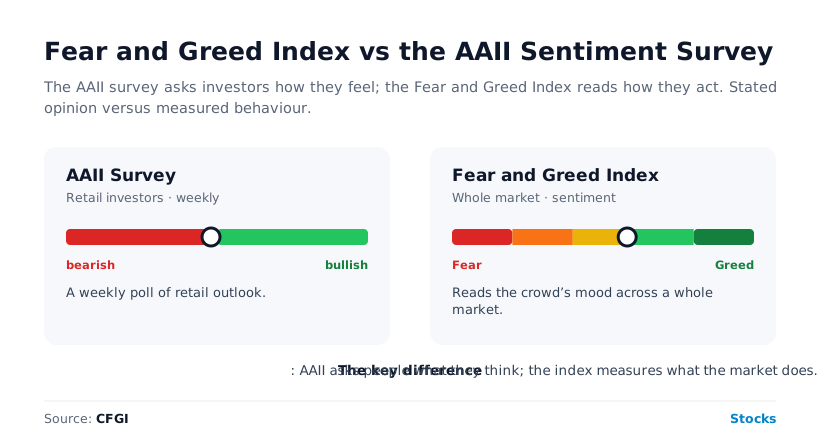
The AAII survey asks individual investors each week whether they are bullish, bearish or neutral over the next six months, so it captures stated opinion. The Fear and Greed Index reads measured behaviour: volatility, breadth, options and more, turned into a 0 to 100 score. One records what investors say; the other records what the market does. Both are used as contrarian gauges at extremes, and they often diverge, which is where the signal lies. This is education, not financial advice.
CFGI data
The AAII survey is a weekly poll of stated opinion. CFGI reads measured behaviour, 10 indicators, into a 0 to 100 score updated daily for stocks and every 15 minutes for crypto. Behaviour and opinion can diverge, which is why a market-based index and a survey are best read together.
Source: CFGI dataset; stocks since 2021, crypto since March 2022.
Key takeaways
- AAII surveys investors weekly: stated bullish, bearish or neutral.
- It has polled its members on the six-month outlook since 1987.
- The Fear and Greed Index reads measured market behaviour into a 0 to 100 score.
- Both are read as contrarian gauges at extremes.
- They can diverge, so each adds something the other misses.
Opinion Versus Behaviour
The AAII Sentiment Survey polls individual investors once a week on whether they expect the market to rise, fall or stay flat. It is a direct read of how people say they feel, which is useful, but stated opinion and actual positioning do not always match. A Fear and Greed Index reads what the market does, not what investors say: volatility, breadth, options activity, safe-haven demand. CFGI turns 10 such signals into one 0 to 100 score, updated continuously rather than weekly.
What the AAII Survey Actually Is
The AAII survey, run by the American Association of Individual Investors, has polled its members since 1987, making it one of the longest-running sentiment series in markets. It works by asking a single question: do you feel the direction of the stock market over the next six months will be up (bullish), no change (neutral), or down (bearish)? The weekly result is simply the percentage of respondents in each camp, published every Thursday. Two features stand out. First, it captures the mood of individual, retail investors specifically, not institutions, which makes it a useful window on the "crowd". Second, it asks about a six-month horizon, so it reflects considered expectations rather than the moment-to-moment emotion a market-based index picks up.
AAII Survey vs Fear and Greed, Side by Side
| AAII survey | Fear and Greed Index | |
|---|---|---|
| Source | Investors polled | Market behaviour |
| Captures | Stated opinion | Measured action |
| Cadence | Weekly | Daily (CFGI stocks) |
| Form | % bull / bear / neutral | 0 to 100 score |
How the AAII survey and a Fear and Greed Index differ.
The clearest practical difference is speed: a weekly survey can miss a sharp shift that a daily, behaviour-based score captures the same day. The clearest conceptual difference is the source: one asks people, the other watches the tape.
The Shared Contrarian Logic
For all their differences, the two share a philosophy: both are read as contrarian gauges at the extremes. The AAII survey is famous for this, when individual investors are overwhelmingly bullish, history suggests caution, and when they are overwhelmingly bearish, it has often marked opportunity, the logic being that the crowd of small investors tends to be most optimistic near tops and most pessimistic near bottoms. This is exactly the same principle that makes a Fear and Greed Index useful at Extreme Greed and Extreme Fear. Both tools, in their different ways, are built on the idea that the crowd is most wrong precisely when it is most united, so an extreme reading on either is a prompt to lean against the prevailing mood rather than join it.
Both Lean Against the Crowd
The survey and the index are most useful at extremes, where each says the same thing: when sentiment is overwhelmingly one-sided, the contrarian case to lean the other way is strongest.
Why Read Both?
The interesting moments are when they disagree: investors saying they are bullish while the market behaves fearfully, or the reverse. A survey catches the mood people report; a market index catches the mood the tape reveals, and the two can come apart because what people say and what they do are not the same. When stated optimism runs ahead of cautious behaviour, or stated fear masks aggressive buying, the gap is often the signal, a hint that opinion and positioning are out of sync and one is likely to catch up to the other. Read together, a slow weekly survey of what the crowd thinks and a fast daily index of what the market is doing give a fuller, more honest picture than either alone. There is also a coverage difference worth keeping in mind: the AAII survey is specifically a read on US individual investors and the stock market, while a Fear and Greed Index like CFGI spans equities and crypto on the same scale, so the index reaches into corners of the market the survey never touches.
Frequently asked questions
Is the AAII survey the same as the Fear and Greed Index?
No. AAII asks individual investors how they feel about the next six months each week; the Fear and Greed Index reads measured market behaviour into a 0 to 100 score. One is stated opinion, the other is action.
What does the AAII survey measure?
The percentage of individual investors who are bullish, neutral or bearish on the stock market over the next six months. It has polled the members of the American Association of Individual Investors weekly since 1987.
Are they used as contrarian indicators?
Yes, both. The AAII survey is famously contrarian, overwhelming bullishness suggests caution, overwhelming bearishness has often marked opportunity, which is the same principle that makes a Fear and Greed Index useful at Extreme Greed and Extreme Fear.
Which is more reliable?
Neither is a forecast. Surveys can lag or contradict positioning; market indexes can be noisy. They are most useful together, especially when stated opinion and measured behaviour diverge. This is education, not financial advice.
CFGI.io, Market sentiment research
The CFGI research team builds and maintains the CFGI Fear and Greed Index: a 0 to 100 sentiment score from 10 sub-indicators across hundreds of crypto assets and the equity market, refreshed every 15 minutes. We have tracked market emotion through multiple full crypto and equity cycles.
Think we missed something?
Spotted a gap, disagree with a take, or think we should cover a new topic? Message us and we'll act on your input.
Message us on TelegramKeep reading
This article is educational and is not financial advice. Crypto and equities are volatile and you can lose money. See our disclaimer.