Stocks
Fear and Greed Index vs the Put-Call Ratio
Quick answer
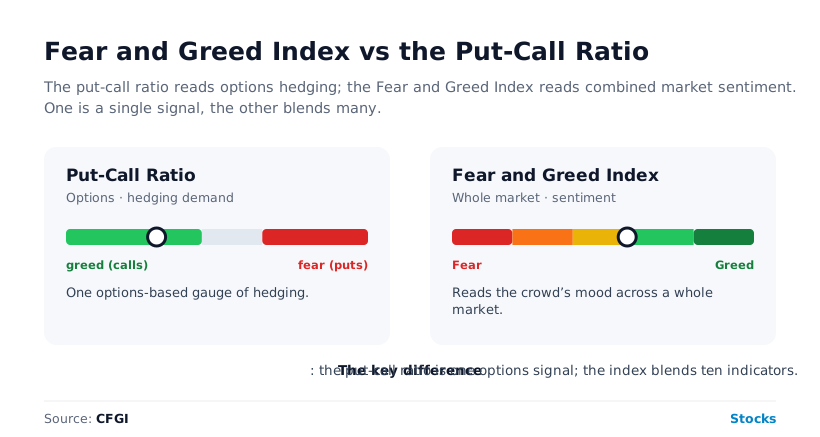
The put-call ratio compares how many put options are traded versus calls: a high ratio means investors are buying protection, a sign of fear, while a low ratio signals complacency or greed. The Fear and Greed Index measures overall sentiment from 0 to 100, combining many signals. The put-call ratio is one slice of sentiment, a contrarian one at extremes; the Fear and Greed Index is the combined read, and it uses options activity as one input. This is education, not financial advice.
CFGI data
The put-call ratio reads one signal, options hedging. CFGI blends 10 indicators into a single 0 to 100 stock sentiment score, scored individually across indices and leading names, with equity readings since 2021 that ran from an extreme-fear 3 on 8 April 2025 to 83 on 19 December 2023.
Source: CFGI dataset, 2021 to June 2026.
Key takeaways
- The put-call ratio reads options hedging: high means fear, low means complacency.
- A ratio above 1 leans bearish; below 1 leans bullish.
- At extremes, it is a contrarian signal.
- The Fear and Greed Index combines many signals into one 0 to 100 score.
- Put-call activity is one of the 10 inputs CFGI uses.
What Does Each One Read?
The put-call ratio divides the volume of put options by call options. Puts are often bought as protection, so a rising ratio means investors are hedging, a sign of fear; a low ratio suggests complacency or greed. It reads one specific behaviour: options positioning. A stock Fear and Greed Index measures sentiment overall, from 0 to 100, blending several signals. Options activity, including the put-call balance, is one of them, alongside volatility, breadth, momentum and safe-haven demand.
How the Put-Call Ratio Works
To read the ratio, you need the two building blocks. A call option is a bet that a price will rise (the right to buy), while a put option is a bet that it will fall, or, very commonly, insurance against a fall (the right to sell). The put-call ratio simply compares how much of each is being traded. A ratio above 1 means more puts than calls are changing hands, the crowd is buying protection and betting on declines, a bearish, fearful posture. A ratio below 1 means calls dominate, the crowd is positioned for gains, a bullish, greedy posture. There is usually a "normal" baseline (often slightly below 1, since calls tend to be a bit more popular), and what matters is the deviation from it. Because options are where traders express conviction with real money and leverage, the put-call ratio is considered an unusually honest, real-time read of how fearful or greedy the options crowd genuinely is.
Put-Call Ratio vs Fear and Greed, Side by Side
| Put-call ratio | Fear and Greed Index | |
|---|---|---|
| Reads | Options hedging | Combined sentiment |
| Form | A ratio | A 0 to 100 score |
| Inputs | Options volume | Several (CFGI uses 10) |
| Per asset | Market-level | Yes, in CFGI |
How the put-call ratio and a Fear and Greed Index differ.
One is a single, sharp signal drawn from the options market; the other is a blended score drawn from many signals, of which options activity is just one. They are a part and a whole.
A Contrarian Signal At Extremes
Like a Fear and Greed Index, the put-call ratio is most useful as a contrarian signal at its extremes, and for the same underlying reason. When the ratio spikes to an unusually high level, it means investors are buying protective puts in a panic, hedging frantically against further declines, which is exactly the kind of one-sided, fearful positioning that tends to cluster near market bottoms, when pessimism is exhausted. Conversely, an unusually low ratio means the crowd has abandoned protection and piled into bullish calls, a sign of the careless complacency that often marks a top. In both cases the logic is the contrarian’s: the options crowd, like any crowd, tends to be most wrong precisely when it is most one-sided. This is why a Fear and Greed Index folds the put-call balance into its score, it is reading the same emotional extremes the index exists to capture, just through the specific lens of the options market.
Extremes Flag Exhaustion
A spiking put-call ratio (panic hedging) clusters near bottoms; an unusually low one (careless complacency) near tops. Like the index, it is a contrarian tell when positioning gets one-sided.
Do They Work Together?
Yes. A spiking put-call ratio confirming an Extreme Fear sentiment reading is a stronger picture than either alone, two independent windows showing the same panic. Because a Fear and Greed Index already folds options activity into its score, the two overlap by design, but the put-call ratio adds detail on hedging specifically, letting you see the options crowd’s behaviour in isolation rather than blended into one number. For an options-focused trader, watching the put-call ratio alongside the broader index is a way to confirm whether the specific fear or greed showing up in options positioning matches the overall market mood, and divergences between the two, options traders panicking while the broad mood stays calm, or the reverse, can themselves be worth a closer look.
Frequently asked questions
What is the put-call ratio?
The volume of put options divided by call options. Puts are often bought as protection, so a high ratio (above 1) means the crowd is hedging and bearish, a sign of fear; a low ratio (below 1) means calls dominate, a bullish, greedy posture.
Is the put-call ratio a fear and greed indicator?
It reads one part of it: options positioning. A high put-call ratio signals fear, a low one signals complacency. At extremes it is a contrarian signal. A Fear and Greed Index combines it with several other signals into one 0 to 100 score.
Does the Fear and Greed Index use the put-call ratio?
Options activity, including the put-call balance, is one of the inputs a stock Fear and Greed Index reads. CFGI uses it as one of 10 indicators, because it captures the same emotional extremes through the lens of the options market.
Which is more useful?
They answer different questions. The put-call ratio is a single sharp read of options hedging; Fear and Greed is the combined mood. Used together they corroborate each other, and divergences are worth a look. Neither predicts price alone. This is education, not financial advice.
CFGI.io, Market sentiment research
The CFGI research team builds and maintains the CFGI Fear and Greed Index: a 0 to 100 sentiment score from 10 sub-indicators across hundreds of crypto assets and the equity market, refreshed every 15 minutes. We have tracked market emotion through multiple full crypto and equity cycles.
Think we missed something?
Spotted a gap, disagree with a take, or think we should cover a new topic? Message us and we'll act on your input.
Message us on TelegramKeep reading
This article is educational and is not financial advice. Crypto and equities are volatile and you can lose money. See our disclaimer.