Markets
What Is Fiscal Policy?
Quick answer
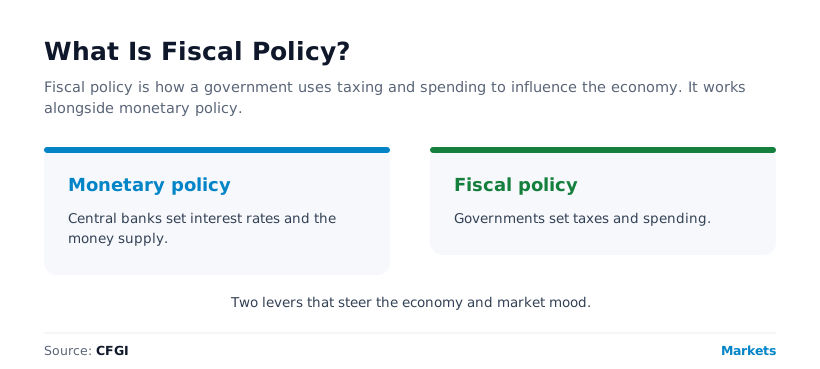
Fiscal policy is how a government uses its spending and taxation to influence the economy. Cutting taxes or increasing spending, called expansionary policy, puts more money into the economy to lift growth, usually in a downturn. Raising taxes or cutting spending, contractionary policy, does the reverse to cool an overheating economy or rein in debt. It works alongside the central bank’s monetary policy, and big fiscal moves can shift growth, jobs, inflation and market confidence.
CFGI data
A stimulus package or a surprise tax change can swing equity sentiment within hours, the kind of mood shift CFGI is built to catch. CFGI scores the market on a 0 to 100 scale, refreshing its stock reading daily and its crypto reading every 15 minutes, so a fiscal headline that moves risk appetite shows up in the gauge fast.
Source: CFGI methodology, 0 to 100 sentiment model.
Key takeaways
- Fiscal policy is government spending and taxation, run by the government not the central bank.
- Expansionary policy boosts demand; contractionary policy cools it.
- The "multiplier" measures how much output each dollar of stimulus creates.
- The 2020 response pushed the US deficit to its highest share of GDP since World War II.
- Stimulus and austerity both move risk appetite, and therefore markets.
Taxing and Spending
Where a central bank steers the economy with money and interest rates, the government steers it with its budget: what it spends and what it taxes. The lever works through "aggregate demand", the total amount of spending in the economy. Put money into people’s pockets through spending or tax cuts and demand rises; take it out through higher taxes or spending cuts and demand falls. That simple push and pull is the whole of fiscal policy.
Expansionary Versus Contractionary
| Expansionary | Contractionary | |
|---|---|---|
| Tools | More spending, lower taxes | Less spending, higher taxes |
| Goal | Lift growth and jobs | Cool inflation, cut debt |
| Used in | Recessions, slowdowns | Booms, overheating |
| Effect on demand | Increases it | Reduces it |
The two directions fiscal policy can push.
Some of this happens automatically. In a downturn, unemployment benefits and food support rise as more people qualify, and tax receipts fall as incomes drop, which cushions the economy without any new law being passed. Economists call these "automatic stabilisers", and they are fiscal policy working on autopilot.
The Multiplier: Bang for the Buck
Not every dollar of stimulus is equal. The "fiscal multiplier" measures how much economic output each dollar of government action creates. A multiplier of 1.5 means 1 dollar of stimulus generates 1.50 of output, because the first recipient spends it, the next person earns and spends it, and so on. When demand is weak, measures aimed at people who will spend quickly, such as unemployment benefits or food assistance, tend to have multipliers above 1, while tax cuts aimed at those who are likely to save the money do less to move the economy. This is why the design of stimulus matters as much as its size.
Fiscal Policy In the Real World: 2020
The clearest modern example is the response to COVID-19. In March 2020 the United States passed the CARES Act, around 2 trillion US dollars of cash payments, expanded unemployment benefits and business support, the largest single relief package in its history. It was followed by more: a roughly 868 billion dollar package in December 2020 and the 1.9 trillion dollar American Rescue Plan in March 2021, taking total pandemic relief past 5 trillion dollars.
The effect on the public finances was historic. The US federal deficit hit 3.1 trillion dollars in 2020, more than triple the year before, reaching 14.9% of GDP, the highest share since World War II, and national debt climbed from 79% of GDP in 2019 to 97% by 2022. Whatever one makes of it, it was fiscal policy at full throttle, and it reshaped markets for years.
The Cost: Deficits, Debt and Crowding Out
Expansionary policy is rarely free. Spending more than it collects, a government runs a deficit and adds to its debt, which must eventually be serviced. Economists also warn of "crowding out": heavy government borrowing can absorb capital that would otherwise fund private investment, which over time can weigh on wages and growth. There is a timing problem too, since fiscal changes need legislation and arrive slowly, sometimes after the moment of need has passed. None of this makes stimulus wrong, but it explains why fiscal policy is always a trade-off, not a free boost.
Fiscal Versus Monetary Policy
The two main levers are easy to confuse. Fiscal policy is the government’s budget, spending and taxes, decided by politicians. Monetary policy is the central bank’s control of money and interest rates, decided by unelected officials. Monetary policy can move fast, often within days, while fiscal policy is slow and political. But when interest rates are already near zero, the central bank runs low on room, and fiscal policy becomes the more powerful tool, which is exactly why the two were used together in 2020.
Why Markets Watch Fiscal Moves
Big fiscal decisions, stimulus, tax changes, infrastructure programmes, ripple straight into company earnings and risk appetite. A large stimulus can spark a risk-on rally and tip the mood toward greed, while austerity, a debt-ceiling standoff or a surprise tax rise can spread fear. That swing in confidence is what the Fear and Greed Index measures on a 0 to 100 scale. Reading a fiscal headline alongside where sentiment already sits tells you far more than the headline alone about how the crowd is likely to react.
Frequently asked questions
What is fiscal policy?
How a government uses spending and taxation to influence the economy. Increasing spending or cutting taxes (expansionary) lifts demand and growth; cutting spending or raising taxes (contractionary) cools the economy.
How is fiscal policy different from monetary policy?
Fiscal policy is run by the government through its budget, spending and taxes, and tends to be slow and political. Monetary policy is run by the central bank through interest rates and the money supply, and can move quickly. They often work together.
What is the fiscal multiplier?
A measure of how much economic output each dollar of stimulus produces. A multiplier of 1.5 means 1 dollar of spending creates 1.50 of output. Measures aimed at people who spend quickly tend to have the highest multipliers.
How does fiscal policy affect markets?
Large moves like stimulus or tax changes shift the growth outlook, move whole sectors, and can swing sentiment toward greed or fear depending on how investors read them. This is education, not financial advice.
CFGI.io, Market sentiment research
The CFGI research team builds and maintains the CFGI Fear and Greed Index: a 0 to 100 sentiment score from 10 sub-indicators across hundreds of crypto assets and the equity market, refreshed every 15 minutes. We have tracked market emotion through multiple full crypto and equity cycles.
Think we missed something?
Spotted a gap, disagree with a take, or think we should cover a new topic? Message us and we'll act on your input.
Message us on TelegramKeep reading
This article is educational and is not financial advice. Crypto and equities are volatile and you can lose money. See our disclaimer.