Markets
What Is Deflation?
Quick answer
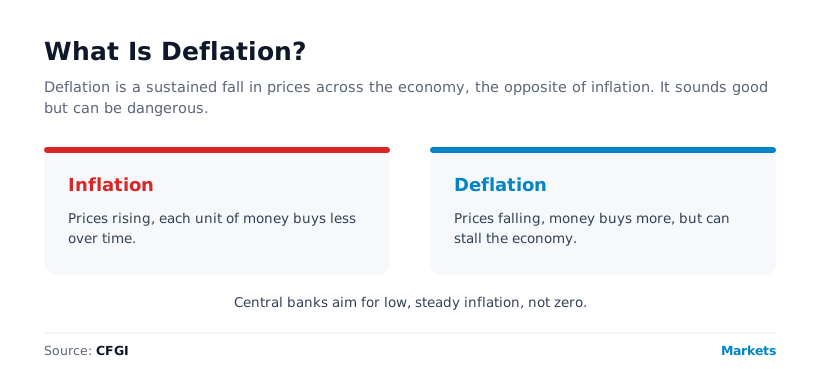
Deflation is a sustained fall in the general level of prices across an economy, the opposite of inflation. Cheaper prices sound like good news, but persistent deflation is dangerous, because when people expect prices to keep falling they delay spending, which slows the economy, cuts wages and profits, and can feed on itself. It is closely tied to recessions and deep, lasting fear in markets, which is exactly why central banks fight it so hard.
CFGI data
A deflationary spiral is the kind of persistent risk-off mood CFGI logs as sustained Extreme Fear, below 20 on its 0 to 100 scale, held across long stretches rather than the brief sub-20 spike of a single panic. CFGI has tracked that scale since March 2022, where a one-day scare and a grinding loss of confidence look very different.
Source: CFGI methodology, 0 to 100 sentiment model.
Key takeaways
- Deflation is a sustained fall in prices, the opposite of inflation.
- Expecting cheaper prices makes people delay spending, which slows the economy.
- A deflationary spiral feeds on itself: less spending leads to more deflation.
- Debt gets heavier in real terms, deepening the damage.
- Japan and the Great Depression are the cautionary tales central banks remember.
Falling Prices, Rising Danger
Where inflation erodes the value of money as prices rise, deflation does the reverse: prices fall and each unit of money buys more over time. At first glance that looks like a gift to consumers. The problem is what it does to behaviour. If you expect a television, a car or a house to be cheaper next month, the rational move is to wait, and when a whole economy waits at once, spending dries up. That single shift in expectations is the seed of every deflationary problem.
The Deflationary Spiral
Deflation is dangerous because it is self-reinforcing. The loop runs like this: shoppers delay purchases expecting lower prices, so business revenues fall, so companies cut wages and jobs, so households have less to spend, which pushes prices down further and confirms everyone’s expectation that waiting was right. Each turn of the wheel makes the next turn more likely.
This is the opposite of the mild, steady inflation economies are built to run on. A little inflation greases spending and investment; deflation freezes them. Once the expectation of falling prices sets in, it becomes a trap that is very hard to climb out of, because the behaviour that causes it is also a sensible response to it.
Why Debt Makes It Worse
There is a second, crueller mechanism. Debts are fixed in money terms, but in deflation money is rising in value, so the real weight of every loan grows even as wages and revenues shrink. A mortgage or a business loan that was manageable becomes crushing, not because the number changed but because everything around it fell. Borrowers cut spending to service debt, some default, banks tighten, and the whole economy contracts further. Economists call this "debt deflation", and it is what turns an ordinary downturn into a depression.
The Core Trap
In inflation, time quietly shrinks your debts. In deflation, time quietly grows them. That reversal is why deflation and heavy debt are such a dangerous pairing.
Two Warnings From History
The textbook cases are seared into central-bank memory. During the Great Depression of the 1930s, US prices fell by 20 to 30 percent in some years, deepening mass unemployment and wiping out borrowers. Decades later, Japan offered the modern version: after a giant asset bubble burst in the early 1990s, the country slid into a deflationary trap so persistent it cost not one but several "lost decades" of stagnant growth, despite enormous policy effort to escape it.
Japan’s experience is the one policymakers fear most, because it showed how stubborn deflation becomes once expectations adjust. Getting out proved far harder than staying out would have been.
Why Central Banks Fear It
This is why a central bank typically targets around 2 percent inflation rather than zero: it wants a comfortable buffer away from the deflationary edge. Deflation is also hard to fight, because the main tool, cutting interest rates, runs out of room once rates hit zero, while expectations of falling prices keep pulling the economy down. Not all falling prices are alarming, a cheaper television from better technology is healthy "good" deflation, but an economy-wide fall driven by collapsing demand is the dangerous kind, and the one that keeps policymakers awake. It is why even a hint of broad deflation tends to trigger an aggressive response, deep rate cuts and money-printing programmes, long before the falling prices look serious on paper.
Deflation, Recession and Sentiment
Deflation rarely travels alone. It tends to arrive with recessions, rising unemployment and the kind of deep, grinding fear that pins a Fear and Greed Index to the low end of its 0 to 100 scale for a long time. That is the tell that distinguishes a deflationary mood from an ordinary sell-off: not a single sharp drop, but a persistent refusal of the crowd to take risk. Watching how long sentiment stays in fear, not just how deep it goes, is part of reading whether a downturn is a passing scare or something more structural.
Frequently asked questions
What is deflation?
A sustained fall in the general level of prices across an economy, the opposite of inflation. Money buys more over time, but the wider effects on spending, jobs and debt can be severe.
Why is deflation bad if prices fall?
Because expecting cheaper prices leads people to delay spending, which cuts revenues, wages and jobs, and pushes prices down further in a self-reinforcing spiral. Debt also gets heavier in real terms as incomes shrink.
What is an example of damaging deflation?
The Great Depression, when US prices fell 20 to 30 percent in some years, and Japan’s "lost decades" after its early-1990s bubble burst, when persistent deflation stalled growth for decades.
How is deflation different from disinflation?
Deflation is prices actually falling (negative inflation). Disinflation is inflation slowing but still positive, so prices are rising more slowly, not falling. This is education, not financial advice.
CFGI.io, Market sentiment research
The CFGI research team builds and maintains the CFGI Fear and Greed Index: a 0 to 100 sentiment score from 10 sub-indicators across hundreds of crypto assets and the equity market, refreshed every 15 minutes. We have tracked market emotion through multiple full crypto and equity cycles.
Think we missed something?
Spotted a gap, disagree with a take, or think we should cover a new topic? Message us and we'll act on your input.
Message us on TelegramKeep reading
This article is educational and is not financial advice. Crypto and equities are volatile and you can lose money. See our disclaimer.