Stocks
What Causes a Stock Market Crash?
Quick answer
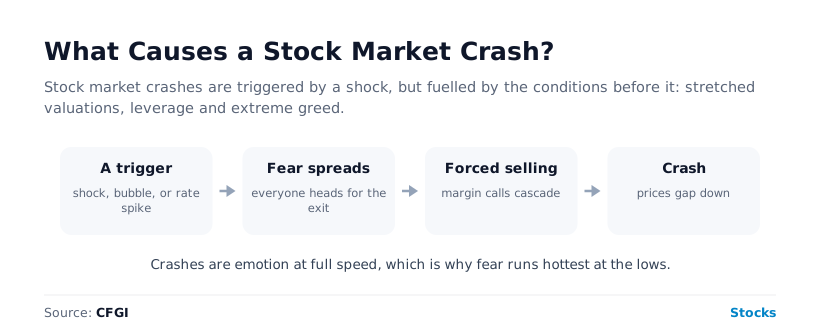
A stock market crash usually has two parts: a trigger and the conditions that let it spread. The trigger can be a shock, a rate surprise, a crisis or a burst bubble. The conditions are what make it severe: stretched valuations, high leverage and Extreme Greed, where everyone is already invested and confident. Once it starts, forced selling and margin calls create a self-reinforcing cascade. A crash is fear taking over a market that had run on greed. This is education, not financial advice.
CFGI data
Crashes tend to start from greed, not fear. CFGI marks Extreme Greed as a score of 80 or above, and the crowded, confident conditions it reflects are exactly what makes a market fragile, when a shock hits, there are few new buyers and many forced sellers.
Source: CFGI dataset, 2021 to June 2026.
Key takeaways
- A crash needs a trigger and fragile conditions to spread.
- Triggers include shocks, crises, rate surprises or a burst bubble.
- Fragility comes from stretched valuations, leverage and greed.
- Crashes tend to start from Extreme Greed, not fear.
- Forced selling and margin calls turn a fall into a cascade.
The Trigger and the Conditions
People look for the single cause of a crash, but there are usually two ingredients. A trigger lights the fire: an economic shock, a financial crisis, an interest-rate surprise, or a bubble bursting. The conditions decide how far it spreads: when valuations are stretched and investors are leveraged and confident, a small trigger can cascade. The same spark that fizzles out in a calm, cautious market can set off an inferno in a hot, crowded one, which is why the conditions matter at least as much as the trigger itself.
The Common Triggers
The spark that starts a crash varies, and is usually a surprise. Historically, triggers have included sudden economic shocks (a recession, a pandemic, an oil spike), interest-rate surprises (a central bank hiking faster than expected), financial crises (a bank failure or a credit freeze), the bursting of a speculative bubble, and geopolitical shocks like war. What they share is that they are largely unpredictable in their timing, often a genuine black swan no one was positioned for. This is the key reason crashes cannot be reliably forecast: even when the conditions are visibly fragile, the precise spark that ignites them tends to arrive from an unexpected direction.
The Fragile Conditions
If the trigger is the spark, the fragile conditions are the dry tinder, and they are what a sentiment gauge can actually help you see. The classic ingredients of fragility are stretched valuations (prices far above what earnings justify), high leverage and margin debt (borrowed money amplifying every move), crowded positioning (almost everyone already bullish and invested), and complacency (a long, calm stretch that has lulled the market into ignoring risk). A market with all of these is like a tinder-dry forest: it may look perfectly healthy, even beautiful, but it is primed so that any spark can spread uncontrollably. The more of these conditions are present, the more severe a crash is likely to be when one finally comes.
Dry Tinder, Not the Spark
A sentiment gauge cannot predict the spark, but it can show you how dry the forest is. Stretched valuations, heavy leverage and Extreme Greed are the conditions that turn a small shock into a crash.
Why Crashes Start From Greed
A market deep in Extreme Greed is fragile. Almost everyone who wanted to buy already has, so there are few new buyers to absorb selling, and leverage means falling prices force more selling. That is why crashes rarely begin from fear, when the crowd is already cautious and lightly positioned, but from greed, when it is most crowded and most exposed. It is one of the market’s great ironies: the moment of maximum confidence, when everything feels safest and the gains feel endless, is precisely the moment of maximum danger, because there is no one left to buy and everyone to potentially sell.
Why a Fall Becomes a Cascade
What turns an ordinary decline into a crash is the way fear feeds on itself once selling starts. The central mechanism is forced selling. When prices fall far enough, leveraged investors face margin calls, demands to add cash or sell, and that forced selling pushes prices lower still, triggering yet more margin calls in a vicious downward spiral. Automated stop-loss orders fire in waves, and the simple human stampede for the exits, everyone trying to sell at once to a market with few buyers, does the rest. This self-reinforcing feedback loop is why crashes are so much faster and more violent than the rallies that preceded them, why, as the old saying goes, the market takes the stairs up and the elevator down. The honest read is that no one reliably predicts the trigger or the timing, but Extreme Greed flags the fragile conditions crashes tend to start from. This is education, not financial advice.
Frequently asked questions
What causes a stock market crash?
A trigger, such as a shock, crisis or burst bubble, combined with fragile conditions: stretched valuations, high leverage and Extreme Greed. The conditions decide how severe the trigger becomes, and forced selling turns the fall into a cascade.
What are the common triggers of a crash?
Economic shocks, interest-rate surprises, financial crises like a bank failure, bursting bubbles and geopolitical shocks. They share one thing: they are largely unpredictable in timing, often a black swan no one was positioned for.
Do crashes start from fear or greed?
Usually greed. A market deep in Extreme Greed is crowded and leveraged, with few new buyers, so a shock can cascade. Fear is what the crash produces, not what it starts from, the moment of maximum confidence is the moment of maximum danger.
Can a Fear and Greed Index predict a crash?
No. It reads current sentiment, not the future, and the trigger is by nature unpredictable. It can flag the greedy, crowded conditions crashes tend to start from, which is a warning, not a forecast. This is education, not financial advice.
CFGI.io, Market sentiment research
The CFGI research team builds and maintains the CFGI Fear and Greed Index: a 0 to 100 sentiment score from 10 sub-indicators across hundreds of crypto assets and the equity market, refreshed every 15 minutes. We have tracked market emotion through multiple full crypto and equity cycles.
Think we missed something?
Spotted a gap, disagree with a take, or think we should cover a new topic? Message us and we'll act on your input.
Message us on TelegramKeep reading
This article is educational and is not financial advice. Crypto and equities are volatile and you can lose money. See our disclaimer.