Markets
Who Created the Fear and Greed Index?
Quick answer
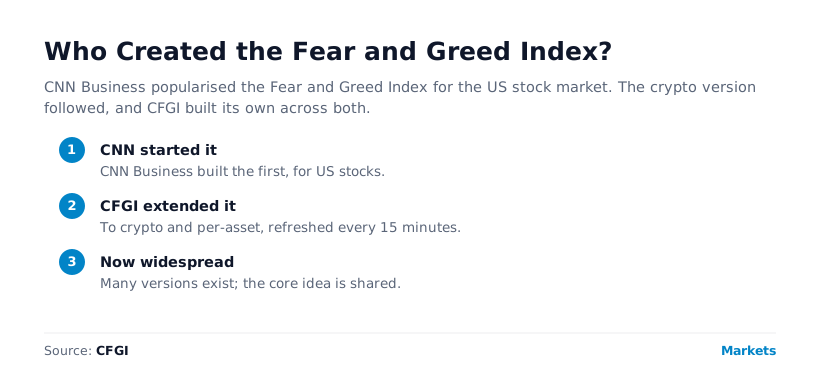
CNN Money, now CNN Business, created the modern Fear and Greed Index in 2012, building a 0 to 100 gauge for the US stock market from seven indicators. A crypto version, pioneered by alternative.me in 2018, followed for Bitcoin using different metrics. CFGI then built its own index across both crypto and equities, scoring hundreds of assets individually from 10 indicators rather than reducing each market to a single number. This is education, not financial advice.
CFGI data
The format is older than any one website; CFGI’s contribution is breadth and granularity. It scores hundreds of assets individually across crypto and stocks, every 15 minutes for crypto since March 2022 and daily for equities, where the originals each cover one market with one number on a 0 to 100 scale.
Source: CFGI dataset, March 2022 to June 2026.
Key takeaways
- CNN Money created the modern stock Fear and Greed Index in 2012.
- It blends seven indicators into one 0 to 100 gauge for the US market.
- alternative.me pioneered the crypto version for Bitcoin in 2018.
- CFGI built its own across crypto and equities, scoring hundreds of assets individually.
- The idea of reading crowd emotion is far older than any index.
The Short History
The modern Fear and Greed Index was created by CNN Money, now CNN Business, in 2012. It took a scattering of market signals and combined them into a single, easy-to-read gauge from 0 to 100, where low means fear and high means greed. The crypto world built its own version a few years later, and CFGI extended the concept further still. But the underlying idea is far older than any of them.
Before the Index: An Old Idea
Long before anyone put a number on it, investors knew that markets are driven by emotion. Warren Buffett’s famous advice to be "fearful when others are greedy, and greedy when others are fearful" captured the whole principle decades before the index existed. The academic backing came from behavioural finance, the study of how real, emotional humans make money decisions. The Fear and Greed Index did not invent the insight; it simply turned a piece of timeless market wisdom into a single, trackable number that anyone could glance at.
CNN’s Stock Index, 2012
The original gauge measured the US stock market by blending seven indicators: stock price momentum, price strength, market breadth, put and call options, volatility, junk-bond demand and safe-haven demand. Each captures a different facet of how fearful or greedy investors are behaving, and together they produce one daily reading on the 0 to 100 scale. Its genius was accessibility: it took data a professional would track across many screens and distilled it into a number a beginner could understand at a glance.
The Crypto Version, 2018
When crypto needed its own sentiment gauge, the site alternative.me built one in 2018, focused on Bitcoin. Because crypto markets behave differently, it used a different mix of inputs, volatility, trading volume, social-media chatter, Google Trends, surveys and Bitcoin dominance, but kept the same familiar 0 to 100 scale. It quickly became the reference point for crypto sentiment, proving the format travelled well beyond the stock market it was born in.
How CFGI Extended the Idea
CFGI took the concept and pushed it in two directions the originals did not. First, breadth: rather than one number for a whole market, CFGI scores hundreds of individual assets, so you can read the mood on a single coin or stock, not just the crowd as a whole. Second, granularity and coverage: it draws on 10 indicators, spans both crypto and equities, and refreshes its crypto readings every 15 minutes to match a market that never closes. The result keeps the simple 0 to 100 promise of the original while answering a sharper question, not just "how does the market feel?" but "how does the crowd feel about this?".
Why the Format Endures
More than a decade on, the Fear and Greed Index has outlasted countless fancier tools for one simple reason: it answers a question every investor genuinely has, in a form anyone can use. Is the crowd fearful or greedy right now, and am I being swept along with it? By compressing a tangle of market behaviour into a single number, it gives a fast, contrarian gut-check that pairs with deeper analysis rather than replacing it. That blend of simplicity and genuine signal is why the idea, born at CNN in 2012, is now everywhere.
Reading Any Fear and Greed Index Well
Whichever version you use, the same habits apply. Treat it as a contrarian context tool rather than a buy or sell button: the extremes, deep fear and runaway greed, carry far more signal than the noisy middle. Watch the trend across several readings, not just today’s number, because sentiment can sit at an extreme for a while. And know what feeds the gauge you are reading, since a stock index built from options and breadth captures something different from a crypto index built from volatility and social chatter. Used this way, an index built more than a decade ago still does exactly what it was designed to do: give you a quick, honest read on whether the crowd is being driven by fear or by greed.
The Version That Scores Both Markets
Frequently asked questions
Who created the Fear and Greed Index?
CNN Money, now CNN Business, created the modern stock-market version in 2012, blending seven indicators into a 0 to 100 gauge. alternative.me built an early crypto version in 2018, and CFGI built its own across crypto and equities.
When was the crypto Fear and Greed Index created?
The crypto version was pioneered by alternative.me in 2018, originally focused on Bitcoin, using inputs like volatility, volume, social media, Google Trends, surveys and Bitcoin dominance.
Is CFGI the same as CNN’s index?
No. CFGI uses the same 0 to 100 format but scores hundreds of assets individually from 10 indicators, and covers crypto as well as stocks. CNN scores only the US market, as a single number.
Where does the idea come from?
The notion of reading crowd emotion is far older than any index, captured in sayings like being fearful when others are greedy. The index just puts a number on it. This is education, not financial advice.
CFGI.io, Market sentiment research
The CFGI research team builds and maintains the CFGI Fear and Greed Index: a 0 to 100 sentiment score from 10 sub-indicators across hundreds of crypto assets and the equity market, refreshed every 15 minutes. We have tracked market emotion through multiple full crypto and equity cycles.
Think we missed something?
Spotted a gap, disagree with a take, or think we should cover a new topic? Message us and we'll act on your input.
Message us on TelegramKeep reading
This article is educational and is not financial advice. Crypto and equities are volatile and you can lose money. See our disclaimer.