Markets
What Is a Pullback?
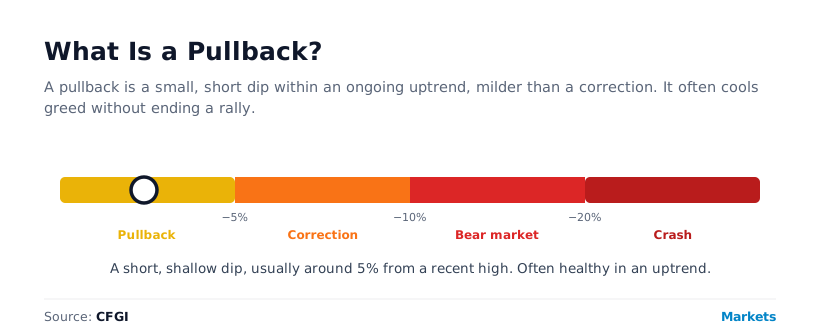
Quick answer
A pullback is a brief, modest dip in price within an ongoing uptrend, typically 5% to 10% off a recent high, milder and shorter than a 10% to 20% correction. Pullbacks are normal and often healthy: they let an overheated, greedy market catch its breath without ending the rally, and they are often viewed as buying opportunities. A pullback usually cools sentiment from greed back toward neutral, which a Fear and Greed Index captures in real time. This is education, not financial advice.
CFGI data
A pullback is a small sentiment reset. It tends to ease CFGI from greed toward neutral on its 0 to 100 scale without tipping into deep fear, distinguishing a healthy pause from a true correction or the start of a decline. The depth of the sentiment dip helps tell them apart.
Source: CFGI dataset, 2021 to June 2026.
Key takeaways
- A pullback is a small, short dip within an uptrend, often 5% to 10%.
- It is milder than a 10% to 20% correction.
- It often cools greed without ending the rally.
- Pullbacks are often treated as "buy the dip" opportunities.
- It usually eases sentiment from greed toward neutral.
A Pause, Not a Reversal
Uptrends do not rise in a straight line. A pullback is one of the small dips along the way, a few percent off a recent high, before the trend resumes. It is gentler than a correction, which is a 10% or larger fall, and far gentler than a crash. Traders often see pullbacks as healthy, since they relieve overbought conditions. The challenge is that a pullback and the start of something bigger look identical at first; only with hindsight, or context, is the difference clear.
How Big Is a Pullback?
Pullbacks sit at the shallow end of the spectrum of declines, defined by being small and short.
| Decline | Typical size | Typical length |
|---|---|---|
| Pullback | 5% to 10% | Days to a month |
| Correction | 10% to 20% | Months |
| Bear market | 20%+ | Months to years |
The spectrum of declines.
A pullback typically retraces just a small slice of the prior advance over days or a few weeks, while the upward momentum stays intact. If the dip deepens past roughly 10% and drags on, it has graduated from a pullback into a correction.
Why Pullbacks Happen
Pullbacks have ordinary, healthy causes. After a strong run, some investors simply take profits, which eases prices back. A piece of unsettling news can spark a quick dip that fades once the crowd decides the impact was transitory. And when a mean-reverting market becomes overbought, stretched too far above its recent average, a pullback brings it back toward something sustainable. In each case the underlying uptrend is not broken; the market is just pausing to catch its breath. That is why pullbacks are generally seen as a sign of a healthy, breathing rally rather than a troubled one.
Buy the Dip
Because pullbacks tend to resolve upward within a strong uptrend, many investors treat them as buying opportunities, the famous "buy the dip". The logic is sound when the broader trend really is intact: you get to add to a rising asset at a temporary discount. But the strategy carries a sharp danger, because the same instinct, buying weakness, is disastrous in a genuine downtrend, where each "dip" is just another step down. Buying the dip in a bull market is shrewd; buying the dip in a bear market is "catching a falling knife". The skill is not in buying dips but in judging whether the trend beneath the dip is still your friend.
The Buy-The-Dip Trap
Buying dips works in an uptrend and ruins you in a downtrend, where every dip keeps falling. The strategy is only as good as your read on the underlying trend.
Pullback, Or Something Bigger?
The hardest question in real time is whether a dip is a harmless pullback or the first leg of a correction or bear market, and at the start they are genuinely indistinguishable. Traders look for clues in the structure: a pullback tends to hold above key support levels and on calmer volume, while a reversal breaks support and accelerates. But no signal is certain in the moment, which is why managing risk matters more than calling it perfectly. Treating every dip as a guaranteed buying opportunity is how investors get hurt when an ordinary-looking pullback quietly turns into the start of a much deeper decline.
Pullbacks and Sentiment
A Fear and Greed Index adds useful context to a dip. A true pullback tends to ease the score from greed back toward neutral, a healthy cooling, without plunging into deep fear. If a dip instead drives sentiment hard toward Extreme Fear, the crowd is reacting far more violently than a routine pullback warrants, a hint that it may be something more serious. So watching how far the sentiment falls, not just how far the price falls, gives you an extra read: a shallow dip in mood suggests the trend is intact, while a collapse in mood suggests the dip has touched a deeper nerve. The depth of the fear is itself a clue.
Frequently asked questions
What is a pullback?
A brief, modest dip in price within an ongoing uptrend, typically 5% to 10% off a recent high and lasting days to a month, milder and shorter than a 10% to 20% correction. Pullbacks are normal and often healthy.
Is a pullback the same as a correction?
No. A pullback is smaller and shorter, usually 5% to 10% over weeks; a correction is a fall of 10% to 20% over months. A pullback is a pause within a trend, not a deeper decline.
Should I "buy the dip" on a pullback?
It can work when the broader uptrend is genuinely intact, letting you add at a discount. But the same instinct is dangerous in a downtrend, where every dip keeps falling, "catching a falling knife". The strategy depends entirely on reading the underlying trend.
How does sentiment help identify a pullback?
A true pullback eases the Fear and Greed Index from greed toward neutral without plunging into deep fear. A dip that drives sentiment hard toward Extreme Fear may be more than a pullback. This is education, not financial advice.
CFGI.io, Market sentiment research
The CFGI research team builds and maintains the CFGI Fear and Greed Index: a 0 to 100 sentiment score from 10 sub-indicators across hundreds of crypto assets and the equity market, refreshed every 15 minutes. We have tracked market emotion through multiple full crypto and equity cycles.
Think we missed something?
Spotted a gap, disagree with a take, or think we should cover a new topic? Message us and we'll act on your input.
Message us on TelegramKeep reading
This article is educational and is not financial advice. Crypto and equities are volatile and you can lose money. See our disclaimer.