Markets
How Is Market Sentiment Measured?
Quick answer
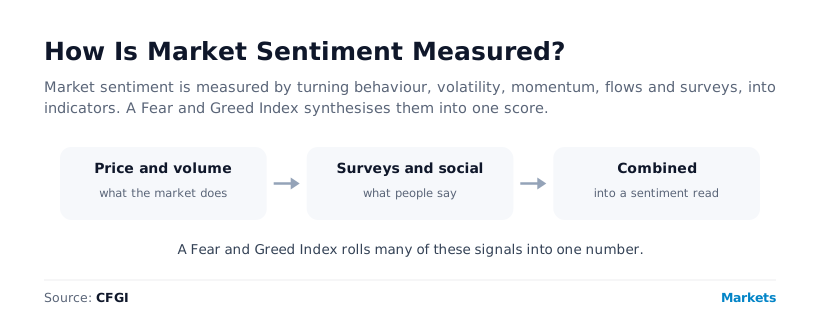
Market sentiment is measured by tracking the behaviour that emotion produces, not the emotion itself. Analysts use indicators built from volatility, price momentum, trading volume, options activity, fund flows and surveys, each capturing one angle of how fearful or greedy investors are. These split into "behavioural" gauges, what people do, and "survey" gauges, what people say. A Fear and Greed Index goes further, blending many into a single 0 to 100 score so the whole mood can be read at a glance. This is education, not financial advice.
CFGI data
CFGI measures sentiment by synthesis, not a single survey. It folds 10 indicator groups into one 0 to 100 score per asset, refreshed every 15 minutes since March 2022, which is why no single noisy input, like social chatter, can distort the read.
Source: CFGI dataset, March 2022 to June 2026.
Key takeaways
- Sentiment is measured through behaviour, not emotion directly.
- Behavioural gauges read what people do; survey gauges, what they say.
- Indicators use volatility, momentum, volume, options, flows and surveys.
- Extremes matter because the crowd is most wrong when most one-sided.
- A Fear and Greed Index blends many into one score.
Reading Emotion Through Behaviour
You cannot poll the whole market’s feelings, so sentiment is measured indirectly, through the footprints emotion leaves in the data. When investors are fearful, volatility rises, money flows to safe havens and options skew defensive. When they are greedy, momentum strengthens and risk appetite broadens. Each of these can be turned into an indicator.
| Signal | What it reveals |
|---|---|
| Volatility | Fear when high, calm when low |
| Momentum | Greed when strong |
| Fund flows | Risk appetite direction |
| Options activity | Bullish or bearish lean |
| Surveys | Stated optimism or fear |
Signals that reveal the mood.
Two Families: Behavioural and Survey
Sentiment gauges fall into two broad camps. "Behavioural", or market-based, indicators read what investors actually do with their money: the VIX volatility index, the put/call options ratio, market breadth, fund flows and short interest all fall here. "Survey" indicators instead ask investors directly how they feel, such as long-running polls of bullishness and bearishness. The two can disagree, and when they do, behavioural gauges are usually trusted more, because money on the line is a more honest signal than words in a questionnaire. The strongest readings come when both point the same way, stated fear confirmed by defensive behaviour.
Actions Over Words
People can say one thing in a survey and do another with their portfolio. Behavioural gauges read the money, which is why they tend to be the more reliable measure of real sentiment.
The Main Sentiment Gauges
A handful of gauges do most of the work. The VIX measures expected volatility and is known as the "fear gauge". The put/call ratio compares demand for bearish versus bullish options. Market breadth checks how many stocks are participating in a move. Safe-haven demand tracks money rotating into bonds and gold, and fund flows show where capital is heading. In crypto, on-chain data, social-media volume and search trends add further angles. Each is a single lens on the crowd; none is complete on its own, which is exactly why the next step, combining them, is so valuable.
Why the Extremes Are What Matter
The reason for measuring sentiment at all is the contrarian insight that the crowd tends to be most wrong precisely when it is most one-sided. Near a top, almost everyone is greedy and already invested, leaving few buyers left; near a bottom, almost everyone is fearful and has already sold, leaving few sellers. So a sentiment measure is most useful at its extremes, where it flags that positioning has become stretched. Measuring sentiment is, in effect, measuring how crowded a trade has become, which is why "be greedy when others are fearful, and fearful when others are greedy" is the logic behind reading these gauges in the first place.
From Many Signals to One Score
Individual indicators each tell part of the story, but reading a dozen at once is hard, and they sometimes conflict. A Fear and Greed Index solves that by synthesising many signals into one 0 to 100 number, which makes the overall mood readable instantly and harder for any single noisy input to distort. CFGI does this with ten indicator groups per asset, so a single gamed signal, like a burst of social-media hype, cannot swing the whole reading. The synthesis turns a scattered dashboard of gauges into a single, glanceable answer to the only question that matters: how fearful or greedy is the crowd right now?
The Limits of Measuring Sentiment
However it is measured, sentiment has honest limits worth keeping in mind. It is a snapshot of the present, not a forecast of the future: a market can stay fearful or greedy far longer than seems reasonable, so a stretched reading flags elevated risk, not a guaranteed turn. Some inputs lag, surveys are only as fresh as their last poll, and others, like social-media volume, can be noisy or deliberately gamed, which is precisely why blending many signals matters. The goal of measuring sentiment is not to predict tomorrow but to know where the crowd stands today, and how stretched that stance has become. Used that way, as context rather than prophecy, a sentiment measure is one of the more useful things an investor can read.
Frequently asked questions
How is market sentiment measured?
Indirectly, through the behaviour emotion produces: volatility, momentum, volume, options activity, fund flows and surveys. Each captures one angle of how fearful or greedy investors are.
What is the difference between behavioural and survey gauges?
Behavioural gauges read what investors do with their money, like the VIX, put/call ratio and fund flows; survey gauges ask investors how they feel. Behavioural gauges are usually trusted more, because actions are more honest than words.
Why does sentiment matter most at extremes?
Because the crowd tends to be most wrong when most one-sided. Near a top almost everyone is already greedy and invested; near a bottom almost everyone has sold. Measuring sentiment shows how stretched, and crowded, positioning has become.
Can you measure sentiment with one number?
Yes, by synthesis. A Fear and Greed Index blends many indicators into a single 0 to 100 score, so the overall mood can be read at a glance and no single noisy input can distort it. This is education, not financial advice.
CFGI.io, Market sentiment research
The CFGI research team builds and maintains the CFGI Fear and Greed Index: a 0 to 100 sentiment score from 10 sub-indicators across hundreds of crypto assets and the equity market, refreshed every 15 minutes. We have tracked market emotion through multiple full crypto and equity cycles.
Think we missed something?
Spotted a gap, disagree with a take, or think we should cover a new topic? Message us and we'll act on your input.
Message us on TelegramKeep reading
This article is educational and is not financial advice. Crypto and equities are volatile and you can lose money. See our disclaimer.