Markets
How Is the Fear and Greed Index Calculated?
Quick answer
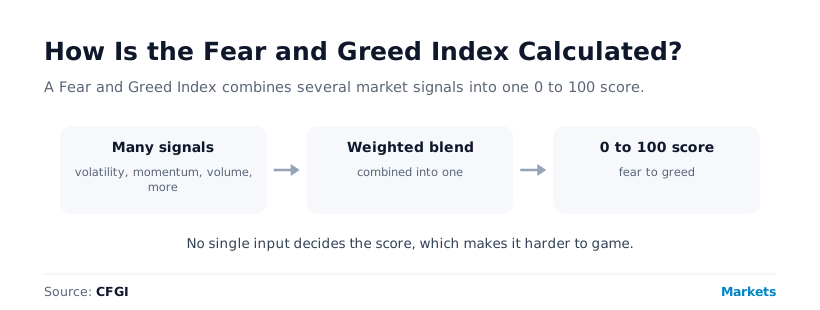
A Fear and Greed Index is calculated by measuring several market signals, each on its own scale, then combining them into one number from 0 to 100. Signals that show fear pull the score down; signals that show greed push it up. CFGI builds each score from 10 indicators, so no single signal dominates, normalises each against its own history, and computes the result for hundreds of crypto assets every 15 minutes and for stocks daily. This is education, not financial advice.
CFGI data
CFGI builds each 0 to 100 score from 10 indicators, including price momentum, volatility, volume, social activity, market dominance, search interest and on-chain signals, refreshed every 15 minutes for crypto across 4 timeframes since March 2022. Using 10 inputs is what keeps any one signal from dominating the result.
Source: CFGI dataset, March 2022 to June 2026.
Key takeaways
- Several signals are measured, then combined into one 0 to 100 score.
- Each signal is normalised against its own history before blending.
- Fear signals pull the score down; greed signals push it up.
- CFGI uses 10 indicators so no single signal dominates.
- It is computed per asset, per timeframe, every 15 minutes for crypto.
The Basic Method
The calculation has three steps. First, measure each signal, how volatile the market is, how strong momentum is, how active social chatter is, and so on. Second, score each signal on its own fear-to-greed scale. Third, combine them, usually as a weighted blend, into one number from 0 to 100. The point of using many signals is robustness: a Fear and Greed Index that leaned on one input would just track that input. Blending several means the score reflects the overall mood, not a single metric.
The Three Steps In Detail
Each step does real work. Measuring means pulling raw, live data for every input, prices, trading volume, volatility, social posts and more. Scoring is the clever part: each raw number is "normalised", compared against its own recent history, so it becomes a fear-to-greed reading rather than an absolute figure. This matters because a volatility level that is high for one asset may be normal for another; normalising lets very different signals speak the same language. Finally, the normalised signals are blended into a single 0 to 100 score. Because each input is judged relative to its own baseline, the index measures how unusual today’s mood is, not just the raw numbers.
Why Normalising Matters
Each signal is scored against its own normal range, so the index reads how stretched conditions are today, not just raw levels. That is what lets ten very different inputs combine into one meaningful number.
The 10 Indicators CFGI Reads
CFGI combines ten distinct families of signal, each capturing a different face of the crowd’s emotion.
- Price momentum: how far price sits above or below its recent averages.
- [Volatility](/learn/markets/what-is-volatility/): rising volatility signals fear, calm signals confidence.
- [Trading](/learn/markets/what-is-trading/) volume: how much activity is behind the move.
- Social activity: the volume and tone of chatter about an asset.
- Market dominance: shifts between Bitcoin and the rest of the market.
- Search interest: how intensely the public is searching for it.
- On-chain signals: whale movements, order-book pressure and similar.
Each is scored and weighted into the final reading, recomputed every 15 minutes for crypto and daily for stocks.
Why Blend So Many Signals
The blending is the whole point, for two reasons. First, accuracy: any single indicator is partial and noisy, social chatter can be gamed, a price move alone says nothing about conviction, so combining many produces a steadier, fuller picture than any one could. Second, resistance to manipulation: it is far harder to distort a ten-input gauge than a one-input one, because you would have to move many independent signals at once. This is why a synthesised reading at an extreme carries weight: reaching it required many separate measures of fear, or greed, to agree, not a single dramatic data point.
Per Asset, Per Timeframe
CFGI does not stop at one market-wide figure. It runs the whole calculation separately for each of hundreds of crypto assets and for stocks, and across four timeframes from short-term to long-term. That granularity is a deliberate design choice: it lets the index show that Bitcoin can be greedy while another coin is fearful, or that the short-term mood differs from the long-term one. A classic single-number index averages all of that away; computing per asset and per timeframe preserves exactly the differences that carry the most information.
What the Calculation Does and Does Not Do
It is worth being clear about what all this measuring produces. The calculation is designed to capture the present state of sentiment accurately, how fearful or greedy the crowd is right now, drawn from real, current behaviour. What it is not is a forecast. No amount of blending turns a measurement of today’s mood into a reliable prediction of tomorrow’s price; the index reads the present, and sentiment can stay extreme for a long time. So the calculation should be judged on the right terms: it is a careful, manipulation-resistant snapshot of crowd emotion, not a crystal ball. That distinction, between accurately describing now and predicting next, is the single most important thing to understand about how the number is built and how it should be used.
Frequently asked questions
How is the Fear and Greed Index calculated?
By measuring several market signals, normalising and scoring each on a fear-to-greed scale against its own history, then combining them into one 0 to 100 number. CFGI uses 10 indicators so no single signal dominates.
What signals does CFGI use?
Ten families: price momentum, volatility, volume, social activity, market dominance, search interest and on-chain signals such as whale movements and order-book pressure, each capturing a different face of the mood.
Why normalise each signal?
Because a level that is high for one asset may be normal for another. Comparing each signal to its own recent history turns it into a fear-to-greed reading, so very different inputs can be combined meaningfully.
Why use so many inputs?
For accuracy and to resist manipulation. An index built on a single input would simply track that input and be easy to game, while blending many produces a steadier read that is hard to distort. This is education, not financial advice.
CFGI.io, Market sentiment research
The CFGI research team builds and maintains the CFGI Fear and Greed Index: a 0 to 100 sentiment score from 10 sub-indicators across hundreds of crypto assets and the equity market, refreshed every 15 minutes. We have tracked market emotion through multiple full crypto and equity cycles.
Think we missed something?
Spotted a gap, disagree with a take, or think we should cover a new topic? Message us and we'll act on your input.
Message us on TelegramKeep reading
This article is educational and is not financial advice. Crypto and equities are volatile and you can lose money. See our disclaimer.