Markets
What Is Forex?
Quick answer
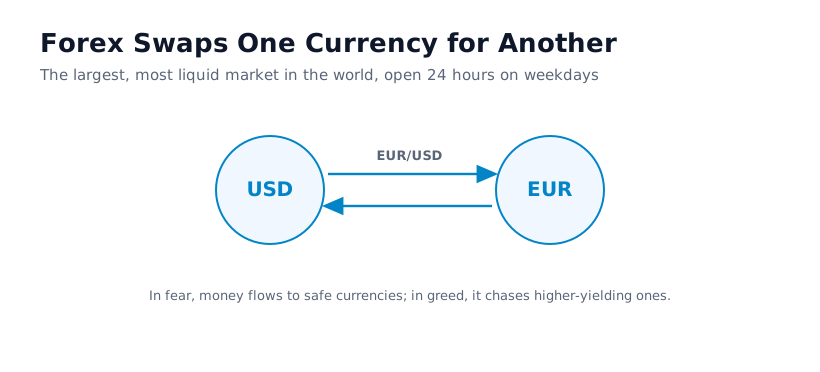
Forex, short for foreign exchange, is the market where currencies are traded, one swapped for another in pairs. It is the largest and most liquid market in the world, with trillions of dollars changing hands every day, open 24 hours on weekdays. Currencies move on interest rates, growth and, crucially, the global mood: in fear, money flows to safe currencies; in greed, it chases higher-yielding ones. A currency chart is, in part, a real-time gauge of risk appetite. This is education, not financial advice.
CFGI data
Currencies move on the global mood between risk and safety, the same fear and greed CFGI scores in crypto and equities. Its 0 to 100 Fear and Greed reading, built from 10 indicators since March 2022, tracks that risk-on, risk-off swing in the two markets where it scores sentiment directly.
Source: CFGI dataset, March 2022 to June 2026.
Key takeaways
- Forex is the market for trading one currency against another, in pairs.
- It is the largest, most liquid market in the world, trillions a day.
- A pair’s price is how much of the quote currency buys one of the base.
- Currencies move on rates, growth and the global mood.
- In fear, money flows to safe currencies; in greed, to higher-yield ones.
What Is Forex?
Forex is where one currency is exchanged for another, the US dollar for the euro, the yen for the pound, and so on. Prices are quoted in pairs, because a currency only has value relative to another. It is enormous and always moving: trillions of dollars change hands every day, around the clock on weekdays, traded not on a single central exchange but across a global, decentralised network of banks, companies, governments and traders.
Currency Pairs and How They Work
Every forex price is a pair, written with two three-letter codes like EUR/USD or USD/JPY. The first currency is the "base" and the second is the "quote", and the price tells you how much of the quote currency it takes to buy one unit of the base. So EUR/USD at 1.10 means one euro costs 1.10 dollars. Trading forex means betting on how that ratio will change: if you think the dollar will strengthen against the euro, you sell EUR/USD. The most heavily traded pairs, the "majors", all involve the US dollar against another big currency, like the euro, yen, pound or Swiss franc, and they have the deepest liquidity and tightest costs. Because it is always a comparison, you are never just buying a currency, you are buying one and selling another at the same time.
Why Forex Is the Biggest Market
Forex dwarfs every other market, with daily turnover measured in trillions of dollars, far more than all the world’s stock markets combined. The reason is that currency is the plumbing of the entire global economy: every international trade, cross-border investment, tourist purchase and corporate transaction ultimately requires swapping one currency for another. A company importing goods, a fund buying foreign stocks, a traveller exchanging money, all of them touch the forex market. That constant, worldwide demand, layered on top of speculation by banks and traders, is what makes it the largest and most liquid market on Earth, and why it runs continuously as trading follows the sun from one financial centre to the next.
The World’s Plumbing
Forex is so vast because currency underlies all global commerce. Every cross-border trade, investment and trip flows through it, on top of the speculation, making it the deepest market there is.
What Moves Currencies?
A currency’s value reflects the relative strength and attractiveness of its economy, captured by a few key forces.
- Interest rates: higher rates tend to attract money to a currency, since investors earn more holding it. See interest rates.
- Growth and inflation: a strong, stable economy tends to support its currency; high inflation tends to erode it.
- Central bank policy: decisions and signals from the likes of the Federal Reserve move currencies sharply.
- Risk mood: in fear, money flows to safe currencies like the US dollar; in greed, to riskier, higher-yielding ones.
How Does Forex Reflect the Global Mood?
Currencies are a real-time vote on risk. When the world turns fearful, money rushes into safe-haven currencies, the US dollar, the Japanese yen, the Swiss franc, and they strengthen; when confidence returns, the same money fans out into riskier, higher-yielding currencies and assets. So a currency chart is, in part, a risk-on or risk-off gauge, and a strengthening dollar in particular is often a sign that global fear is rising. CFGI does not score currencies directly, but it measures the very same fear and greed in the two markets it covers, crypto and equities, on the Fear and Greed Index. When forex flashes risk-off and the Fear and Greed Index plunges together, it is the same global mood showing up in different markets.
Frequently asked questions
What is forex?
The foreign exchange market, where currencies are traded one against another in pairs. It is the largest and most liquid market in the world, with trillions of dollars traded daily across a global, decentralised network, open 24 hours on weekdays.
How do currency pairs work?
A pair like EUR/USD has a base currency (the first) and a quote currency (the second); the price is how much of the quote buys one unit of the base. Trading forex means betting on how that ratio moves, you always buy one currency and sell another at once.
Why is forex the biggest market?
Because currency underlies all global commerce: every international trade, investment, tourist purchase and corporate transaction requires swapping currencies. That constant worldwide demand, plus speculation, makes it the largest and most liquid market on Earth.
How does forex reflect the global mood?
Currencies are a real-time vote on risk: in fear, money flows to safe-haven currencies like the dollar, yen and franc; in greed, to riskier ones. A currency chart is partly a risk-on, risk-off gauge of the same mood the Fear and Greed Index measures. This is education, not financial advice.
CFGI.io, Market sentiment research
The CFGI research team builds and maintains the CFGI Fear and Greed Index: a 0 to 100 sentiment score from 10 sub-indicators across hundreds of crypto assets and the equity market, refreshed every 15 minutes. We have tracked market emotion through multiple full crypto and equity cycles.
Think we missed something?
Spotted a gap, disagree with a take, or think we should cover a new topic? Message us and we'll act on your input.
Message us on TelegramKeep reading
This article is educational and is not financial advice. Crypto and equities are volatile and you can lose money. See our disclaimer.