Markets
What Are Sentiment Indicators?
Quick answer
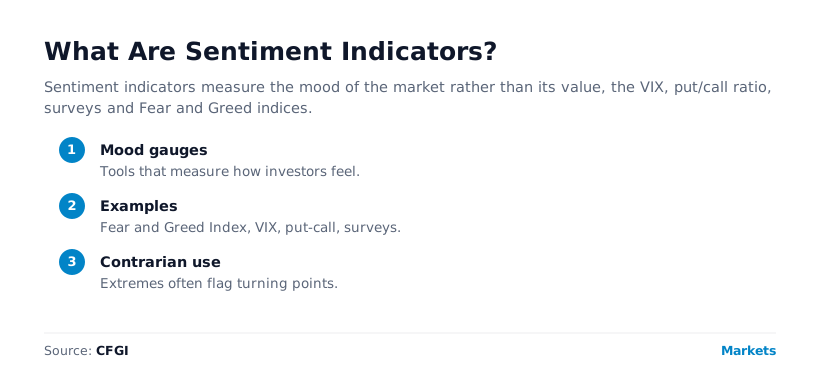
Sentiment indicators are tools that measure the mood of the market, how fearful or greedy investors are, rather than the value of what they own. Examples include the VIX volatility index, the put/call ratio, investor surveys like AAII, margin debt, short interest and market breadth. Most are contrarian by nature: extreme readings flag moments when the crowd is most one-sided, and therefore most likely to be near a turning point. A Fear and Greed Index folds many of them into a single number. This is education, not financial advice.
CFGI data
A Fear and Greed Index is the sentiment indicator that synthesises the others. Rather than reading the VIX, put/call and surveys separately, CFGI folds that family of signals into one 0 to 100 score per asset, refreshed daily for stocks and every 15 minutes for crypto, the single gauge that summarises the rest.
Source: CFGI methodology and standard sentiment-indicator definitions, to June 2026.
Key takeaways
- Sentiment indicators measure market mood, not asset value.
- The VIX, put/call ratio, AAII survey, margin debt and breadth are the main ones.
- Most are contrarian: extremes flag a one-sided, unsustainable crowd.
- Margin-debt peaks have led major market tops by months.
- A Fear and Greed Index synthesises many of them into one score.
The Main Sentiment Indicators
Where fundamental tools ask what something is worth, sentiment indicators ask how people feel about it. Several are widely watched, and each reads the mood from a different angle.
| Indicator | Reads |
|---|---|
| VIX | Expected volatility, the "fear gauge" |
| Put/call ratio | Hedging versus speculation in options |
| AAII survey | Investors’ stated bullishness |
| Margin debt | How much leverage the crowd is using |
| Market breadth | How many stocks join a move |
| Fear and Greed Index | Many signals, synthesised |
The main sentiment indicators at a glance.
The VIX: The Fear Gauge
The best-known sentiment indicator is the VIX, the volatility index. It measures the market’s expectation of how much the S&P 500 will swing over the next 30 days, derived from the prices investors pay for options. Because people pay up for protection when they are scared, the VIX falls in calm, rising markets and spikes when stocks plunge, which is why it is nicknamed the "fear gauge". A low VIX signals complacency; a soaring VIX signals panic. It is the purest reading of how much fear is priced into the market right now.
Positioning: Put/call, Short Interest, Margin Debt
A second group reads where real money is actually positioned, which can be more honest than what people say. The put/call ratio compares bearish "put" options to bullish "call" options: a high ratio means heavy hedging and fear, a low one means speculative greed. Short interest, the number of shares sold short, rises with negative sentiment. And margin debt, the amount investors have borrowed to buy stocks, measures collective confidence through leverage. Tellingly, margin-debt peaks have preceded major market tops by months, leading both the 2007 and 2021 highs by roughly a quarter, because peak borrowing tends to mark peak greed.
Surveys: Asking the Crowd Directly
A third group simply asks. The best known is the AAII survey, which each week asks individual investors whether they are bullish, neutral or bearish on the next six months. Surveys capture stated mood rather than action, and they are treated as classic contrarian signals: when the crowd is overwhelmingly bullish, the easy buying may already be done, and when it is overwhelmingly bearish, much of the selling may be behind. The gap between what investors say and what they do is itself revealing, which is why positioning and survey indicators are best read together.
Breadth: How Many Are Taking Part
Market breadth measures participation. The advance-decline line tracks how many stocks are rising versus falling, and it matters because a healthy rally is broad, with most stocks joining in, while a fragile one is narrow, carried by just a few giants. When an index keeps climbing but breadth is weakening, that divergence is a quiet warning that the move is running on fumes. Breadth turns the simple question "is the market up?" into the sharper one "is the market up because most of it is, or because a handful of names are masking widespread weakness?".
Why They Are Usually Contrarian
The thread running through almost all sentiment indicators is that they are read against the crowd. When they hit extremes, almost everyone fearful or almost everyone greedy, it often marks a turning point, because a fully one-sided position is unsustainable: if everyone who wants to sell already has, there is no one left to push prices lower. That is the logic of being "fearful when others are greedy, and greedy when others are fearful". The important caveat is that extremes can persist longer than expected, so sentiment indicators improve your odds and your timing, but they are not precise buy and sell signals.
The Shared Rule
Sentiment indicators are most powerful at the extremes and noisiest in the middle. Read them for context and contrarian odds, not as a trigger to act on every wiggle.
One Gauge to Synthesise Them
Watching the VIX, put/call ratio, surveys, margin debt and breadth all at once is a lot to juggle, and they do not always agree. A Fear and Greed Index solves that by rolling a whole family of these signals into one comparable score on a 0 to 100 scale. Instead of interpreting six dashboards, you read a single number that summarises the crowd’s mood, and CFGI does it per asset, so you get that synthesis for an individual coin or stock as well as the market. It is the sentiment indicator built to make sense of the others.
Frequently asked questions
What are sentiment indicators?
Tools that measure the mood of the market, how fearful or greedy investors are, rather than the value of assets. Examples include the VIX, put/call ratio, AAII survey, margin debt, short interest, market breadth and Fear and Greed indices.
What is the most famous sentiment indicator?
The VIX, or "fear gauge", which measures the market’s expected 30-day volatility from S&P 500 options. It is low in calm markets and spikes when stocks plunge, reading how much fear is priced in.
Why are sentiment indicators contrarian?
Because extreme readings flag a one-sided crowd, almost everyone fearful or greedy, which is unsustainable and often marks a turning point. They are usually read against the herd, though extremes can persist.
How does a Fear and Greed Index fit in?
It is a sentiment indicator that synthesises the others, folding signals like volatility, options positioning and momentum into one 0 to 100 score, per asset. This is education, not financial advice.
CFGI.io, Market sentiment research
The CFGI research team builds and maintains the CFGI Fear and Greed Index: a 0 to 100 sentiment score from 10 sub-indicators across hundreds of crypto assets and the equity market, refreshed every 15 minutes. We have tracked market emotion through multiple full crypto and equity cycles.
Think we missed something?
Spotted a gap, disagree with a take, or think we should cover a new topic? Message us and we'll act on your input.
Message us on TelegramKeep reading
This article is educational and is not financial advice. Crypto and equities are volatile and you can lose money. See our disclaimer.