Crypto
What Is the Ethereum Fear and Greed Index?
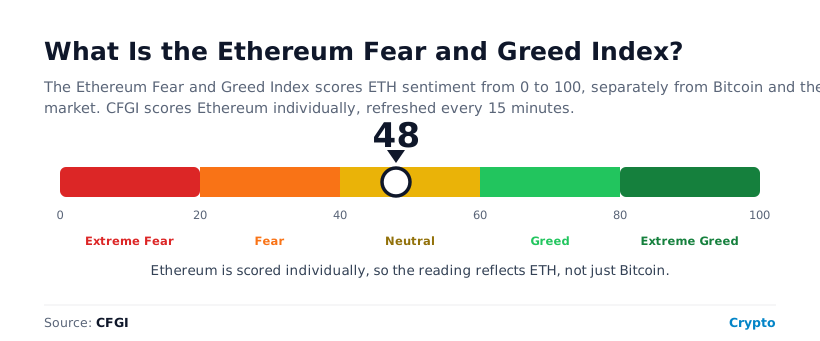
Quick answer
The Ethereum Fear and Greed Index is a 0 to 100 score of sentiment for Ethereum specifically, rather than the crypto market as a whole. CFGI scores ETH individually from 10 indicators, refreshed every 15 minutes, so Ethereum can read fearful while Bitcoin or the broader market reads greedy. Because Ethereum moves on its own catalysts, network upgrades, staking, scaling and fees, a single market gauge cannot show that split, but a per-asset reading can. This is education, not financial advice.
CFGI data
CFGI scores Ethereum on its own data, and ETH has spanned roughly 12 in Extreme Fear to a high near 90 on the 0 to 100 scale, a range of its own that a market-wide number would blur. That spread is the whole reason a dedicated Ethereum gauge is worth reading.
Source: CFGI per-asset history, ETH series.
Key takeaways
- It scores Ethereum sentiment specifically, not the whole market.
- CFGI scores ETH individually from 10 indicators, every 15 minutes.
- Ethereum moves on its own catalysts: upgrades, staking, scaling and fees.
- ETH can read fearful while Bitcoin reads greedy, and vice versa.
- A single market gauge averages that divergence away.
What It Measures
It is a Crypto Fear and Greed Index reading for Ethereum on its own. Rather than one number for all of crypto, CFGI scores ETH from its own price momentum, volatility, volume, social activity and on-chain flows, so the figure reflects Ethereum specifically. The meaning is the same as any fear and greed gauge: low is fear, high is greed, on a 0 to 100 scale.
This matters because Ethereum does not always move with Bitcoin. During an altcoin run, ETH can read greedy while Bitcoin is calmer; in a risk-off move it can be more fearful. Per-asset scoring is what makes that split visible.
Why Ethereum Marches to Its Own Beat
Ethereum is not just "an altcoin"; it is the largest smart-contract platform, and its sentiment swings on catalysts that have little to do with Bitcoin. Network upgrades move it sharply: the 2022 Merge, which switched Ethereum to proof of stake and cut its energy use by over 99%, reshaped its entire investment story. Staking yields, the cost of gas fees, the growth of layer-2 scaling networks, and the arrival of spot Ethereum funds have all driven its mood independently of the wider market. As the home of DeFi and most tokens, Ethereum also acts as a bellwether for the whole smart-contract ecosystem, so its score often leads the broader altcoin market.
How the Score Is Built
CFGI builds the Ethereum score the same way it scores Bitcoin and hundreds of other assets: by reading ETH’s own market behaviour rather than asking anyone how they feel. It blends 10 indicators, momentum, volatility, volume, social signals and on-chain activity, into one 0 to 100 figure, and refreshes it every 15 minutes across multiple timeframes to keep pace with a market that never closes. The result is a live read on how fearful or greedy the crowd is on Ethereum specifically.
Reading the Scale
| Reading | Mood | What it often suggests |
|---|---|---|
| 0 to 24 | Extreme Fear | Capitulation risk, but potential value |
| 25 to 44 | Fear | Caution, weak confidence |
| 45 to 55 | Neutral | No strong emotional lean |
| 56 to 74 | Greed | Optimism, rising risk appetite |
| 75 to 100 | Extreme Greed | Euphoria, elevated pullback risk |
What the 0 to 100 bands broadly mean.
As with any sentiment gauge, the middle is unremarkable and the extremes carry the signal. The most useful reading is often relative: how Ethereum’s score compares with Bitcoin’s and the market’s.
Ethereum Versus Bitcoin: The Ratio
One of the most-watched relationships in crypto is the ETH/BTC ratio, how Ethereum is doing against Bitcoin. When risk appetite is high and money rotates out of Bitcoin into the rest of the market, Ethereum tends to lead and its sentiment runs hotter than Bitcoin’s; when the market turns defensive and Bitcoin dominance rises, ETH often cools faster. A per-asset gauge captures this directly: a wide gap between Ethereum’s score and Bitcoin’s is telling you which way capital is rotating. ETH’s own range, from around 12 in deep fear to near 90 in euphoria on CFGI’s data, shows how much independent emotional ground it covers.
What Ethereum’s Score Is Good For
The main use is catching what a market average hides: an Ethereum-specific move driven by an upgrade, a fee spike or a scaling narrative that Bitcoin’s number would never reflect. As with any fear and greed reading, treat it as a contrarian context tool, deep Extreme Fear hinting at value, runaway Extreme Greed hinting at caution, rather than a precise timing signal. And as always, pair the score with an eye on what is actually driving it, since a spike fuelled by one upgrade headline behaves differently from steady, broad accumulation.
Reading It Live
You can read Ethereum’s score alongside Bitcoin and hundreds of other assets on the by-coin directory, or the market overall on the live index. The same 0 to 100 zones apply: below 20 is Extreme Fear, 80 or above is Extreme Greed.
Frequently asked questions
Does Ethereum have its own Fear and Greed Index?
On CFGI, yes. Ethereum is scored individually from 10 indicators on the 0 to 100 scale, separate from Bitcoin and the market, and refreshed every 15 minutes.
What drives Ethereum’s sentiment?
Its own catalysts: network upgrades like the 2022 Merge, staking yields, gas fees, the growth of layer-2 scaling, and spot Ethereum funds. As the home of DeFi, it also leads the broader smart-contract market.
Can Ethereum and Bitcoin sentiment differ?
Yes. ETH does not always move with BTC. Per-asset scoring lets Ethereum read fearful while Bitcoin reads greedy, or the reverse, which a single market number cannot show, and the ETH/BTC gap signals how capital is rotating.
How often does it update?
CFGI refreshes crypto scores, including Ethereum, every 15 minutes across multiple timeframes. This is education, not financial advice.
CFGI.io, Market sentiment research
The CFGI research team builds and maintains the CFGI Fear and Greed Index: a 0 to 100 sentiment score from 10 sub-indicators across hundreds of crypto assets and the equity market, refreshed every 15 minutes. We have tracked market emotion through multiple full crypto and equity cycles.
Think we missed something?
Spotted a gap, disagree with a take, or think we should cover a new topic? Message us and we'll act on your input.
Message us on TelegramKeep reading
This article is educational and is not financial advice. Crypto and equities are volatile and you can lose money. See our disclaimer.