Crypto
What Is Proof of Stake?
Quick answer
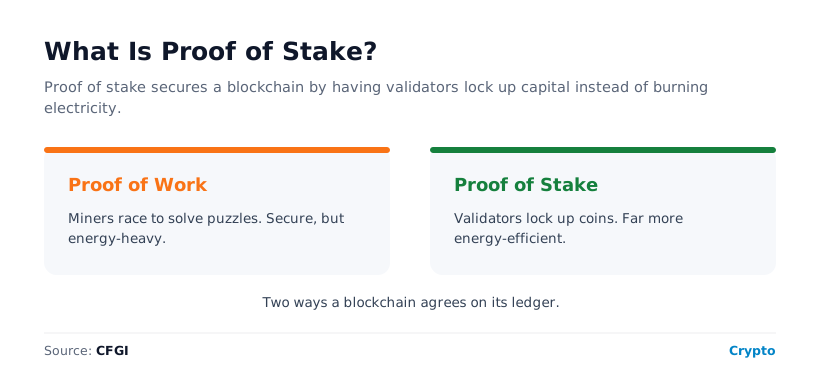
Proof of stake is a way to secure a blockchain by having participants lock up, or stake, their own coins for the right to validate transactions. The network picks validators to add new blocks roughly in proportion to how much they have staked, and a validator who tries to cheat loses part of that stake. It replaces the heavy electricity cost of proof of work with a capital cost, which is why it uses a tiny fraction of the energy.
CFGI data
Ethereum’s shift to proof of stake reshaped its story from "energy villain" to "yield-bearing asset", and stories move markets. CFGI has tracked crypto sentiment on a 0 to 100 scale since March 2022, swinging from a fearful 12 to a greedy 87, and staking yields, upgrades and ETH-supply narratives are among the threads that tug it back and forth.
Source: CFGI dataset, March 2022 to June 2026.
Key takeaways
- Validators stake their own coins to earn the right to secure the network.
- On Ethereum, running a validator takes 32 ETH staked as a deposit.
- Slashing destroys part of a cheating validator’s stake, keeping it honest.
- The 2022 Merge cut Ethereum’s energy use by about 99.95%.
- Liquid staking has created a new centralisation worry around providers like Lido.
Security Through Staked Capital
Instead of miners burning electricity to earn the right to add a block, proof of stake asks validators to put up capital. They lock coins into a deposit, and the network selects validators to propose and check blocks roughly in proportion to how much they have staked. The deposit is the security: a validator who tries to cheat can have part of it destroyed, so behaving honestly is simply the financially rational choice. The cost of attacking the network is owning a fortune in the very coin you would be attacking.
How You Become a Validator
On Ethereum, becoming a validator means depositing 32 ETH into a staking contract and running the software that checks and occasionally proposes blocks. The figure of 32 is deliberate: it is large enough to keep validators serious, but small enough that the software can run on ordinary, modest hardware rather than the warehouse-scale machines proof-of-work mining demands. That choice is central to the pitch that proof of stake is more open to individuals.
Slashing: The Stick
The penalty that makes the whole system work is called slashing: the network destroys some of a misbehaving validator’s stake and ejects them. The two classic triggers are double-signing, trying to validate conflicting versions of history, and prolonged downtime, since a validator that is offline cannot do its job. Crucially, the penalty scales with how many validators misbehave at once, so a coordinated attack is punished far more harshly than a single honest mistake. Honesty is not requested; it is priced in.
Rewards: The Carrot
In return for securing the chain, validators earn rewards, which is the basis of staking. On Ethereum the base yield has run in the region of 3 to 4 percent a year, topped up by a share of users’ priority fees and, for some, additional income from ordering transactions. You do not have to run your own validator to take part: staking services and pools let people contribute smaller amounts and share the rewards, which is what turns staking from a technical role into something closer to earning interest on a holding.
| Proof of stake | Proof of work | |
|---|---|---|
| Secured by | Staked capital | Computing power |
| Energy use | Very low | Very high |
| Barrier to enter | 32 ETH (or a pool) | Specialised mining hardware |
| Main example | Ethereum (today) | Bitcoin |
Proof of stake versus proof of work.
The Merge and the Energy Case
The clearest demonstration of the difference came on 15 September 2022, when Ethereum executed "the Merge", switching from proof of work to proof of stake on a live network worth hundreds of billions of dollars. The headline result was a roughly 99.95% drop in energy use, making the network around 2,000 times more energy-efficient overnight. It answered crypto’s loudest environmental criticism in a single upgrade, and remains the strongest argument proof of stake has.
The New Worry: Liquid Staking
Proof of stake fixed one centralisation problem and quietly created another. Proof-of-work mining tends to concentrate in the hands of those who can buy hardware and cheap power at scale. Proof of stake avoids that arms race, but the rise of "liquid staking" has introduced a fresh concern. Liquid staking lets people stake with less than 32 ETH through a provider, receiving a token that represents their staked coins. It is convenient, but it pools enormous amounts of stake under a handful of operators.
The most-cited example is Lido, which at times has controlled roughly a third of all staked ETH, several times more than the next-largest provider. Researchers warn that any single staking entity approaching the one-third mark gains worrying influence over the network. It is a reminder that "decentralised" is a property you have to keep defending, not a box you tick once.
The Trade-Off
Proof of stake is cleaner and more open at the hardware level, but it concentrates power around whoever holds and pools the most coins. Different model, different centralisation pressure.
Proof of Stake and Market Sentiment
Proof of stake gave Ethereum a new narrative, a productive, yield-bearing asset with a shrinking energy footprint, and narratives are a big driver of crypto sentiment. Staking yields, network upgrades and the supply effects of staking all feed the mood that the Crypto Fear and Greed Index measures on a 0 to 100 scale. Understanding what secures a chain, and what staking really involves, helps you judge whether a wave of optimism rests on something real or is just the latest story the market wants to believe.
Frequently asked questions
What is proof of stake?
A system that secures a blockchain by having validators lock up their own coins for the right to validate transactions, losing part of their stake if they cheat. It uses a tiny fraction of the energy of proof of work.
How much do you need to stake on Ethereum?
32 ETH to run your own validator, chosen so the software runs on modest hardware. You can also take part with less through staking pools and liquid staking providers that share the rewards.
What is slashing?
The penalty in proof of stake where the network destroys part of a validator’s stake and removes them for misbehaviour, such as double-signing or extended downtime. Coordinated cheating is punished more harshly than honest mistakes.
How is proof of stake different from proof of work?
Proof of work secures the chain with computing power and electricity; proof of stake secures it with staked capital, using about 99.95% less energy on Ethereum since the 2022 Merge. This is education, not financial advice.
CFGI.io, Market sentiment research
The CFGI research team builds and maintains the CFGI Fear and Greed Index: a 0 to 100 sentiment score from 10 sub-indicators across hundreds of crypto assets and the equity market, refreshed every 15 minutes. We have tracked market emotion through multiple full crypto and equity cycles.
Think we missed something?
Spotted a gap, disagree with a take, or think we should cover a new topic? Message us and we'll act on your input.
Message us on TelegramKeep reading
This article is educational and is not financial advice. Crypto and equities are volatile and you can lose money. See our disclaimer.