Crypto
What Is an Altcoin?
Quick answer
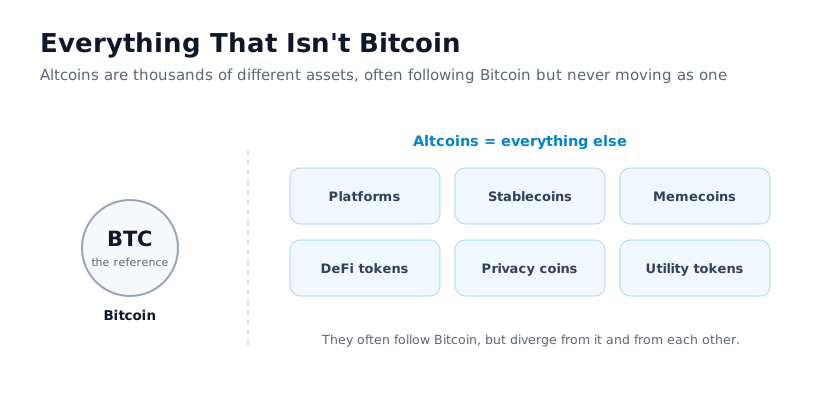
An altcoin is any cryptocurrency that is not Bitcoin. The word is short for "alternative coin". It covers everything from Ethereum to stablecoins to meme tokens, which is thousands of very different assets. Altcoins are generally smaller, newer and more volatile than Bitcoin, and while they often follow it, they do not move as one. Reading them all with a single market number hides more than it shows. This is education, not financial advice.
CFGI data
Altcoins do not move as one. CFGI scores hundreds of assets individually from 0 to 100, and the splits show plainly: XRP ran to a high of 91 on 15 November 2024 while Bitcoin sat far lower, an altcoin writing its own story rather than shadowing the market. Tracked every 15 minutes since March 2022.
Source: CFGI dataset, March 2022 to June 2026.
Key takeaways
- An altcoin is any crypto asset that is not Bitcoin.
- The category spans platforms, stablecoins, meme tokens and more.
- Altcoins are generally smaller and more volatile than Bitcoin.
- They often follow Bitcoin but frequently diverge from it and each other.
- CFGI scores hundreds of assets individually, so divergence is visible.
What Is an Altcoin?
Altcoin simply means "any cryptocurrency other than Bitcoin". When Bitcoin launched it was the only coin, so everything that came after was an alternative. The term has stuck even though some altcoins, like Ethereum, are now huge in their own right. It is a vast and varied category, spanning tens of thousands of coins that range from serious, multi-billion-dollar technology platforms to joke tokens created in an afternoon, which is why "altcoin" tells you only what something is not, rather than what it is.
What Are the Main Types of Altcoin?
| Type | Example role |
|---|---|
| Smart-contract platforms | Run apps and other tokens (Ethereum, Solana) |
| Stablecoins | Hold a steady price, used as the market’s cash |
| Meme coins | Driven largely by community and sentiment |
| Utility and app tokens | Power a specific project or network |
The main families of altcoin.
There are further families too, governance tokens that grant a vote over a protocol, privacy coins built for anonymity, and more. The key point is that these types behave very differently: a stablecoin is designed not to move at all, while a meme coin is pure sentiment. Treating them as a single block called "altcoins" obscures the fact that a blue-chip platform token and a fleeting joke coin have almost nothing in common beyond not being Bitcoin, which is why the category is best understood as a loose umbrella rather than a coherent asset class.
Altcoins Versus Bitcoin
Compared with Bitcoin, altcoins generally sit further out on the risk spectrum. They tend to be smaller, younger, less liquid and more volatile, which means they can deliver larger gains in a rally but also fall harder and faster when the mood turns. Within crypto, Bitcoin often plays the role of the relative safe harbour, the most established and widely held asset, while altcoins are the higher-risk, higher-potential-reward plays that attract capital when risk appetite is high. This is the logic behind "Bitcoin dominance": when traders turn cautious, money tends to concentrate in Bitcoin, and when they turn adventurous, it flows out into altcoins, the classic "altcoin season". Understanding that altcoins are, broadly, the risk-on end of an already-risky market is essential to reading them sensibly.
The Risk-On End of Crypto
Altcoins are generally smaller and more volatile than Bitcoin, so they swing harder both ways. Within crypto, Bitcoin is the relative safe harbour and altcoins are the higher-risk plays.
Why Do Altcoins Not All Move Together?
Altcoins share the same tide as Bitcoin, but they have their own currents. A platform token can rally on a network upgrade while a meme coin dumps on fading hype, all in the same week, because each has its own narrative, community and catalysts. Lumping them into one market mood erases exactly the information that matters. This is why CFGI scores each asset on its own Fear and Greed Index rather than publishing one crypto number, the divergences between coins can be enormous, with one altcoin running to euphoric greed while another languishes in fear. XRP, for instance, reached a high of 91 while Bitcoin sat far lower, an altcoin clearly writing its own story rather than simply shadowing the market.
Reading Altcoins With Per-Asset Sentiment
The practical upshot is that altcoins demand a per-asset view. A single market-wide crypto number is an average that, by its nature, blurs together the very different moods of thousands of distinct coins, hiding the rotations and divergences that are the real story of the altcoin market. CFGI’s approach of scoring hundreds of assets individually lets you scan the whole field and see precisely which altcoins are fearful while others run greedy, the sentiment-level picture of capital rotating around the market. You can scan that field on the by-coin directory, comparing coins side by side rather than guessing from one headline figure, which is exactly the granularity a market as fragmented and fast-moving as altcoins requires.
Frequently asked questions
What is an altcoin?
Any cryptocurrency that is not Bitcoin, short for "alternative coin". It covers everything from Ethereum and stablecoins to meme tokens, tens of thousands of very different assets ranging from serious platforms to joke coins.
Are altcoins riskier than Bitcoin?
Generally yes. They tend to be smaller, younger, less liquid and more volatile, so they swing harder in both directions, the higher-risk, higher-potential-reward end of crypto. Per-asset sentiment helps you see which altcoins are stretched. This is education, not financial advice.
Is Ethereum an altcoin?
Technically yes, because an altcoin is anything that is not Bitcoin. But Ethereum is so large that it is often treated as a category of its own. CFGI scores it individually.
Do all altcoins follow Bitcoin?
Often, but not always. They share Bitcoin’s broad direction yet diverge frequently, with one coin running greedy while another sits in fear, which is why CFGI scores hundreds of assets separately instead of using one market-wide number.
CFGI.io, Market sentiment research
The CFGI research team builds and maintains the CFGI Fear and Greed Index: a 0 to 100 sentiment score from 10 sub-indicators across hundreds of crypto assets and the equity market, refreshed every 15 minutes. We have tracked market emotion through multiple full crypto and equity cycles.
Think we missed something?
Spotted a gap, disagree with a take, or think we should cover a new topic? Message us and we'll act on your input.
Message us on TelegramKeep reading
This article is educational and is not financial advice. Crypto and equities are volatile and you can lose money. See our disclaimer.