Crypto
What Is Altcoin Season?
Quick answer
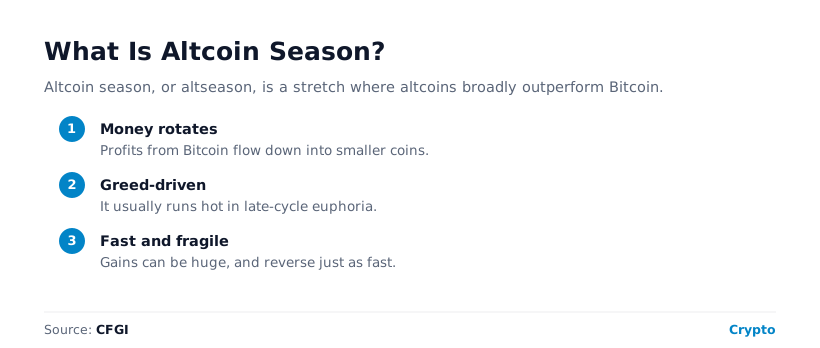
Altcoin season, often shortened to altseason, is a period when altcoins broadly outperform Bitcoin, sometimes dramatically. It usually follows a strong Bitcoin run, when profits rotate out of Bitcoin and down the risk curve into smaller coins chasing higher returns. Altseasons run on greed and risk appetite rather than fundamentals, and they tend to coincide with the most greedy readings on a Fear and Greed Index, which is what makes them both exciting and dangerous.
CFGI data
Altseasons line up with the greedy end of the CFGI scale. CFGI marks Extreme Greed as 80 or above on its 0 to 100 scale, tracked since March 2022, and broad altcoin outperformance, especially in the smallest, most speculative coins, tends to happen exactly when the crowd is most greedy and most willing to chase risk.
Source: CFGI dataset, March 2022 to June 2026.
Key takeaways
- Altseason is when altcoins broadly beat Bitcoin.
- It follows a Bitcoin rally as profits rotate down the risk curve.
- It is "confirmed" when about 75% of top altcoins outperform Bitcoin.
- Bitcoin dominance falls, often toward 40% or below.
- It runs on greed and tends to arrive late in a cycle.
How Altseason Works
In an altseason, money rotates down the risk curve. Fresh capital tends to enter crypto through Bitcoin first, because it is the most trusted and the easiest for institutions to buy. Once Bitcoin’s price stabilises after a run, instead of cashing out, traders shift that money within crypto, chasing the bigger percentage gains that smaller coins can offer. As they do, altcoins start to outpace Bitcoin, and that broad outperformance is what people mean by altseason.
The Rotation Sequence
The rotation is not random; it tends to flow in a recognisable order, step by step down the size ladder.
- Money enters and lifts Bitcoin first, raising its price and its dominance.
- As Bitcoin consolidates, capital moves into large-cap altcoins like Ethereum.
- Then into mid-cap coins as risk appetite grows.
- Finally into small-cap and meme coins, the most speculative end, where the wildest gains, and losses, happen.
Each step is driven by profit-taking and rising risk tolerance: having made money on the safer bet, the crowd reaches for something racier. By the time the smallest coins are flying, the rotation is usually in its late, frothy stage.
How to Measure It: The Altcoin Season Index
The most common gauge is the Altcoin Season Index, which checks how many of the top altcoins have beaten Bitcoin over the past 90 days. The widely used rule is that an "official" altseason requires about 75% of the top coins to outperform Bitcoin; a low reading, say 22, means only 22% have, firmly a Bitcoin-dominated market. The other classic signal is Bitcoin dominance, Bitcoin’s share of the total crypto market. In a Bitcoin-led phase it sits above 50 to 60%; as altseason takes hold, dominance falls, often toward 40% or lower, as money floods into everything else. No single number is definitive, though, so experienced traders look for the index, falling dominance and broad strength across many coins to line up together before they call a rotation confirmed rather than a brief blip.
What It Looked Like: 2021
The textbook altseasons came in 2017 and 2021, each following a powerful Bitcoin run. The numbers from 2021 capture how extreme the divergence can get: during one stretch of that rotation, large-cap altcoins delivered returns of around 174% while Bitcoin itself managed roughly 2% over the same period. That is the allure of altseason in a single statistic, and also its trap, because outperformance on that scale is rarely built on fundamentals and rarely lasts.
The Pattern to Remember
Altseason rewards moving early in the rotation and punishes arriving late. By the time it is obvious and the meme coins are soaring, much of the easy money, and most of the safety, is already gone.
Why Altseason Is a Late-Cycle Signal
Chasing the smallest, most speculative coins requires a crowd that is confident, risk-hungry and convinced prices only go up, which is precisely the psychology of a market top. Historically, full-blown altseasons have clustered near the late stages of bull runs, not the start, which is why experienced investors treat a raging altseason with caution rather than pure excitement. The same broad greed that powers the gains is the signal a contrarian reads as a warning that the cycle may be closer to its end than its beginning.
Altseason and Greed
Altseason is, at heart, a greed phenomenon, and that is exactly what a Crypto Fear and Greed Index measures. Broad altcoin outperformance, especially at the speculative end, tends to coincide with Extreme Greed, 80 or above on the 0 to 100 scale. That makes the gauge a useful companion to the dominance charts: when an altseason is roaring and sentiment is pinned to extreme greed, the case for caution is loudest, even, and especially, when it feels most like the party will never end.
Frequently asked questions
What is altcoin season?
A period when altcoins broadly outperform Bitcoin, usually after a strong Bitcoin rally as profits rotate down the risk curve into smaller coins. It runs on greed and risk appetite rather than fundamentals.
How do you know it is altcoin season?
The common rule is that about 75% of the top altcoins must outperform Bitcoin over 90 days, measured by the Altcoin Season Index. Falling Bitcoin dominance, often toward 40% or lower, is another classic sign.
How big can altseason gains be?
Very large and very fragile. In the 2021 rotation, large-cap altcoins gained around 174% while Bitcoin managed about 2% over the same stretch. Such outperformance rarely rests on fundamentals and rarely lasts.
Is altseason a good time to buy?
It is when risk is highest, because it runs on greed in the most speculative coins and tends to arrive late in a cycle. The greed that drives the gains is also what contrarians treat as a warning. This is education, not financial advice.
CFGI.io, Market sentiment research
The CFGI research team builds and maintains the CFGI Fear and Greed Index: a 0 to 100 sentiment score from 10 sub-indicators across hundreds of crypto assets and the equity market, refreshed every 15 minutes. We have tracked market emotion through multiple full crypto and equity cycles.
Think we missed something?
Spotted a gap, disagree with a take, or think we should cover a new topic? Message us and we'll act on your input.
Message us on TelegramKeep reading
This article is educational and is not financial advice. Crypto and equities are volatile and you can lose money. See our disclaimer.