Crypto
What Is Slippage?
Quick answer
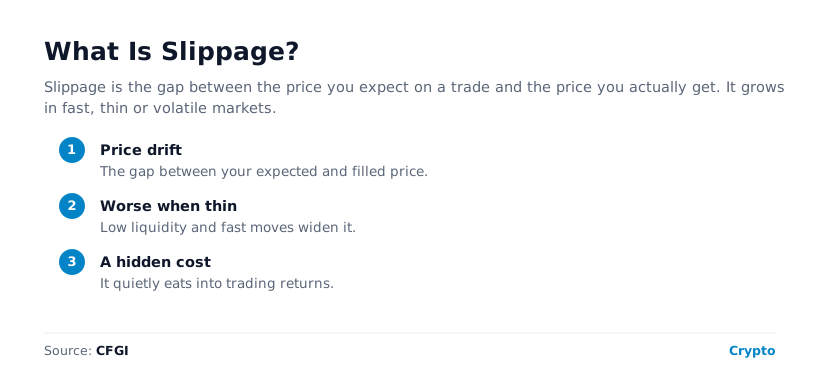
Slippage is the difference between the price you expected when you placed a trade and the price it actually executed at. It happens because prices move and liquidity is limited, so by the time your order fills, the price has shifted, or your order is large enough to push through the order book to worse prices. Slippage is worst in fast, volatile or thinly traded markets, which is exactly when fear and greed are running highest.
CFGI data
Slippage spikes when liquidity thins, and liquidity is one of the conditions CFGI’s inputs reflect. The same thin, fast markets that widen slippage tend to coincide with the extremes, below 20 or above 80 on CFGI’s 0 to 100 scale, where the crowd is most one-sided and everyone is trying to trade in the same direction at once.
Source: CFGI methodology, 10-input 0 to 100 model.
Key takeaways
- Slippage is the gap between the expected and the actual fill price.
- It comes from price movement, low liquidity and large orders.
- It can be positive (a better price) or negative (a worse one).
- On DEXs, a slippage-tolerance setting caps how much you will accept.
- Sandwich-attack bots deliberately profit from traders’ slippage.
Getting a Different Price Than Expected
When you place a market order, you accept the best price available right now, but that price can change between the moment you click and the moment the order fills. If there is not enough liquidity at your expected price, the order fills at progressively worse prices to complete, and the gap between what you expected and what you got is slippage. A large order in a thin market eats through the order book level by level and slips the most.
What Causes Slippage
Four forces drive it, and they often arrive together.
- Volatility. When the price is a fast-moving target, it can shift in the split second your order takes to execute.
- Low liquidity. If there are few orders near the current price, even a modest trade has to reach for worse prices to fill.
- Order size. A large order relative to the market consumes the best prices and works down the book.
- Slow execution. Any delay, network congestion, a laggy connection, gives the price more time to move against you.
Positive and Negative Slippage
Slippage is not always a loss. If the price happens to move in your favour between order and fill, you get positive slippage, a better price than expected. More often, in the conditions that cause it, it runs against you as negative slippage. A simple example: you go to buy a token quoted at 100, but by the time your order clears the available liquidity, the average fill is 101. That extra 1% is negative slippage, an invisible cost on top of any fee, and it scales up fast with order size and volatility.
Slippage On DEXs and the Tolerance Setting
On a decentralised exchange, prices come from liquidity pools rather than a traditional order book, so a large trade in a small pool can move the price dramatically. To manage this, DEXs let you set a "slippage tolerance", the maximum difference between the quoted and executed price you are willing to accept. Set it too tight and your transaction simply fails when the market moves; set it too loose and you authorise a far worse fill than you intended. Choosing it well is a real skill, and getting it wrong is a common, expensive beginner mistake.
Sandwich Attacks: Slippage Weaponised
That tolerance setting is also an attack surface. In a "sandwich attack", a bot spots your pending trade, buys just ahead of it to push the price up, lets your order fill at the inflated price, then sells immediately afterwards, pocketing the difference you lost to slippage. It is one form of MEV, the value extractors capture by reordering transactions in a block. These attacks are not rare: studies have counted thousands of them every single day across decentralised exchanges. A slippage tolerance set carelessly high is an open invitation to them.
Why This Matters
Your slippage tolerance is not just a convenience setting. On a public blockchain it tells bots the maximum they are allowed to take from you. Keep it as tight as the trade allows.
How to Reduce Slippage
- Use limit orders where you can, so you only fill at a price you set, not whatever the market offers.
- Trade liquid markets, deep order books and large pools absorb your order with less price impact.
- Set a sensible slippage tolerance, tight enough to block bad fills, loose enough not to fail needlessly.
- Break large orders into smaller pieces rather than hitting the market all at once.
- Avoid trading into the teeth of major news, when volatility and slippage are at their worst.
Slippage and Market Sentiment
Slippage is largest exactly when markets are most chaotic: during sharp moves, in low-liquidity coins, and around major news, the same moments of extreme sentiment when everyone is rushing to trade in the same direction at once. That is why the worst fills tend to cluster at the extremes the Crypto Fear and Greed Index flags. When the gauge is pinned to deep fear or runaway greed, expect thinner effective liquidity and wider slippage, and trade more carefully because of it.
Frequently asked questions
What is slippage?
The difference between the price you expected when placing a trade and the price it actually executed at, caused by price movement, limited liquidity and order size.
What is slippage tolerance?
A setting, common on decentralised exchanges, for the maximum difference between the quoted and executed price you will accept. Too tight and the trade fails; too loose and you risk a much worse fill, and exposure to sandwich-attack bots.
What is a sandwich attack?
A trading bot buys just before your transaction to push the price up, lets your order fill at the inflated price, then sells right after, profiting from the slippage you suffer. It is a common form of MEV on public blockchains.
How do you reduce slippage?
Use limit orders, trade more liquid markets, set a sensible slippage tolerance, split large orders, and avoid trading during fast, news-driven volatility. This is education, not financial advice.
CFGI.io, Market sentiment research
The CFGI research team builds and maintains the CFGI Fear and Greed Index: a 0 to 100 sentiment score from 10 sub-indicators across hundreds of crypto assets and the equity market, refreshed every 15 minutes. We have tracked market emotion through multiple full crypto and equity cycles.
Think we missed something?
Spotted a gap, disagree with a take, or think we should cover a new topic? Message us and we'll act on your input.
Message us on TelegramKeep reading
This article is educational and is not financial advice. Crypto and equities are volatile and you can lose money. See our disclaimer.