Stocks
What Is a Limit Order?
Quick answer
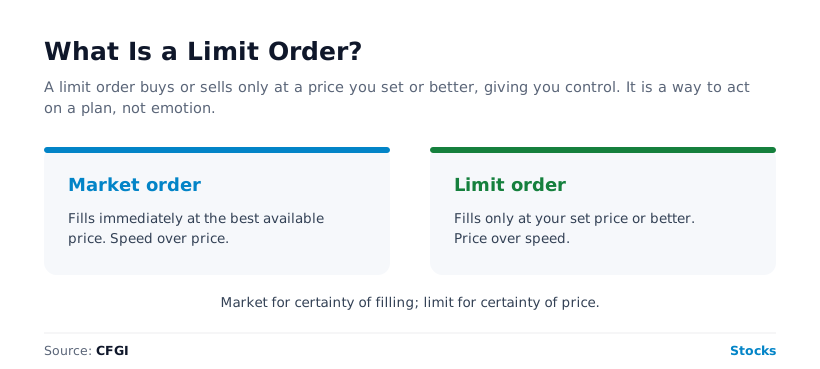
A limit order is an instruction to buy or sell a stock only at a specific price or better. A buy limit fills at your price or lower; a sell limit fills at your price or higher. The trade-off is that it may not fill at all if the market never reaches your level. Its real strength is discipline: a limit order lets you act on a price you decided in advance, rather than chasing in the heat of a move. This is education, not financial advice.
CFGI data
A limit order is pre-committed discipline, the same idea as planning your response to a sentiment extreme. You set the price in calm and let the order act, so a greedy or fearful moment does not push you into a worse fill.
Source: CFGI dataset and standard order-type definitions, June 2026.
Key takeaways
- A limit order fills only at your set price or better.
- A buy limit fills at your price or lower; a sell limit at yours or higher.
- It may not fill if the market never reaches your level.
- It trades price for certainty; a market order does the reverse.
- It is a way to act on a plan, not emotion.
Control Over Price
With a limit order you name the worst price you will accept. Want to buy a stock but only at 95 or below? A buy limit at 95 will not pay more. Want to sell at 110 or above? A sell limit holds out for it. You gain control over price, at the cost of certainty: if the market never reaches your level, the order simply does not fill. It is the counterpart to a market order, which prioritises speed over price. Limit orders prioritise price over speed, the choice between them is really a choice about which of those two things you care about more in a given trade.
How a Limit Order Works
When you place a limit order, you specify both a price and a quantity, and the order then "rests" in the market’s order book, waiting. It will execute only when the market price reaches your limit or better, and if no one is willing to trade at your price, it waits, potentially forever. A worked example: you place a buy limit for 100 shares at 95 while the stock trades at 98. Nothing happens yet. If the price drifts down and someone is willing to sell at 95 or less, your order fills. Limit orders can also fill partially, say 60 of your 100 shares if that is all that is available at your price, and they carry a "time in force": a day order expires at the close if unfilled, while a "good til cancelled" order stays live for weeks. This is the key contrast with a market order, which fills the full quantity immediately at whatever price is available.
When to Use a Limit Order
A limit order is the right tool whenever price matters more than speed. It shines in less liquid stocks, where a market order might get a poor fill as it eats through a thin order book, the limit protects you from that "slippage". It is useful in volatile markets, where prices can jump in the instant between deciding and trading, and it is the natural way to act on a specific target, "I want to buy if it dips to 95" or "I want to take profit at 110", without watching the screen all day. The flip side is that you should not use a limit order when getting filled is more important than the exact price, if you genuinely need to get into or out of a position right now, perhaps to cut a loss, a market order’s certainty is worth more than a limit order’s price control. Matching the order type to your priority is the skill.
Limit, Market and Stop Orders
| Order type | Prioritises | Use when |
|---|---|---|
| Market | Speed | You must fill now, price is secondary |
| Limit | Price | Your price matters more than filling fast |
| Stop-loss | A trigger | You want to exit automatically if price falls |
The three core order types.
These three are the basic toolkit. A market order buys speed, a limit order buys price control, and a stop-loss order automates an exit. Most strategies use a mix of them depending on the situation.
Limit Orders and Discipline
The deeper value of a limit order is behavioural. By setting your price in advance, you let a rule act instead of an emotion, which matters most when fear or greed is running high. In the heat of a fast move, it is desperately tempting to chase a rising price or panic-sell into a falling one, paying a worse and worse price as emotion takes over. A limit order, decided in a calm moment, simply refuses to do that: it holds your discipline for you. It is the trading-mechanics version of deciding your response to a Fear and Greed Index extreme before you reach it, a small piece of pre-commitment that keeps the panicking, greedy version of you from overriding the plan the calm version made.
Frequently asked questions
What is a limit order?
An instruction to buy or sell only at a specific price or better. A buy limit fills at your price or lower; a sell limit at your price or higher. It may not fill if the market never reaches your level.
How does a limit order work?
You set a price and quantity, and the order rests in the order book until the market reaches your limit or better. It can fill partially, and it has a time in force, a day order expires at the close, while a "good til cancelled" order stays live for weeks.
When should I use a limit order?
When price matters more than speed: in less liquid or volatile stocks to avoid a poor fill, or to act on a specific target like buying a dip or taking profit. Use a market order instead when getting filled now matters more than the exact price.
What is the difference between a limit and a market order?
A limit order prioritises price, it fills only at your level or better, but may not fill. A market order prioritises speed, filling immediately at the best available price. It is a trade-off between price control and certainty. This is education, not financial advice.
CFGI.io, Market sentiment research
The CFGI research team builds and maintains the CFGI Fear and Greed Index: a 0 to 100 sentiment score from 10 sub-indicators across hundreds of crypto assets and the equity market, refreshed every 15 minutes. We have tracked market emotion through multiple full crypto and equity cycles.
Think we missed something?
Spotted a gap, disagree with a take, or think we should cover a new topic? Message us and we'll act on your input.
Message us on TelegramKeep reading
This article is educational and is not financial advice. Crypto and equities are volatile and you can lose money. See our disclaimer.