Crypto
Why Is Crypto So Volatile?
Quick answer
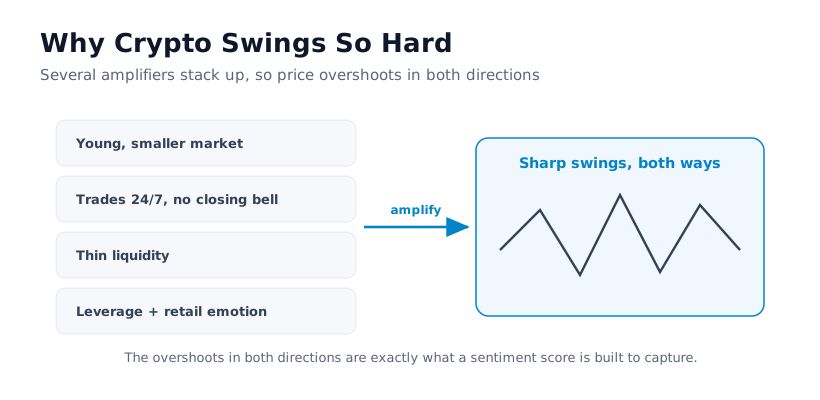
Crypto is volatile because it is a young, around-the-clock market driven heavily by retail emotion and leverage, with thinner liquidity than traditional assets. Large orders move price easily, there is no closing bell to cool things off, many coins have no fundamental anchor, and borrowed positions amplify every swing. The result is a market that regularly overshoots in both directions, which is exactly what makes its sentiment so worth measuring. This is education, not financial advice.
CFGI data
Volatility is emotion made visible, and CFGI has clocked the speed of it. The market’s sharpest single-day jump on record was 37 points on 8 August 2024, a violent rebound from the carry-trade crash days earlier. That 0 to 100 score has tracked the swings across hundreds of assets every 15 minutes since March 2022.
Source: CFGI dataset, March 2022 to June 2026.
Key takeaways
- Crypto is young and relatively small, so large orders move price.
- It trades 24/7, with no closing bell to cool things off.
- Many coins have no fundamental anchor, so narrative drives price.
- Retail emotion and leverage amplify both directions.
- The overshoots in both directions are exactly what sentiment captures.
What Makes Crypto So Volatile?
- A young market: smaller and less liquid than stocks, so big orders move price more.
- Always open: 24/7 trading with no overnight pause to let emotion settle.
- Retail-driven: narratives and sentiment spread fast and reprice together.
- Few anchors: many coins have no earnings or cash flow to anchor a price.
- Leverage: borrowed positions in DeFi and on exchanges magnify moves, and forced liquidations turn dips into cascades.
A Young and Thin Market
The most fundamental reason is simply that crypto is young and, relative to traditional markets, small. The entire crypto market is a fraction of the size of global stocks or bonds, and a smaller market has thinner liquidity, meaning there are fewer orders sitting in the book at any given price. When liquidity is thin, a single large buy or sell can move the price sharply, because there is less depth to absorb it, the same dollar amount that barely nudges a mega-cap stock can swing a mid-sized coin by double digits. Crypto also lacks many of the stabilising mechanisms of mature markets, such as the circuit breakers that pause panicked stock trading. Price discovery in such a young asset class is still a work in progress, and that immaturity shows up directly as volatility.
No Closing Bell, Heavy Leverage
Two more structural features pour fuel on the fire. First, crypto never closes: it trades 24 hours a day, 7 days a week, with no overnight or weekend pause to let emotions cool and information settle. A piece of frightening news at 3am moves the market instantly, where a stock market would have hours to digest it before the open. Second, the market is awash with leverage. Traders routinely borrow heavily through perpetual futures and DeFi protocols, and that leverage magnifies every move. Worse, when prices fall, over-leveraged positions are automatically "liquidated", force-sold by the exchange, and that forced selling drives prices lower still, triggering yet more liquidations in a cascade. This is exactly what produced the sharpest swings on record, like the violent crash and rebound around the carry-trade unwind of August 2024.
How Does Emotion Amplify It?
Each of those structural features is an amplifier for the same thing: crowd emotion. Greed pulls buyers in faster on the way up; fear forces sellers out faster on the way down. With no closing bell and plenty of leverage, those feelings translate into price almost immediately, which is why a crypto bear market can fall so hard and so fast. The lack of a fundamental anchor matters enormously here too: because many coins have no earnings or intrinsic value to tether the price, there is little to stop sentiment from carrying it to extremes in either direction. In a stock, a collapsing price eventually attracts value buyers; in a narrative-driven coin, fear can keep pushing with nothing underneath to catch it, and greed can do the same on the way up.
Is Volatility Good Or Bad?
Volatility is neither good nor bad in itself; it is simply risk in both directions, and it cuts both ways. The same wild swings that make crypto capable of life-changing gains also make it capable of brutal, account-destroying losses, often in the same week. For a trader, that volatility is the opportunity; for a long-term holder, it is the price of admission, the turbulence to be endured for the potential upside. What it demands, above all, is respect: sensible position sizing, an awareness that a 70 to 80% drawdown is a normal feature of a crypto winter rather than an aberration, and a clear head when the swings are at their most frightening or most euphoric. Volatility has tended to ease gradually as the market has grown and matured, but it remains far higher than in traditional assets, and likely will for some time.
Volatility Is Risk, Both Ways
The swings that create crypto’s huge upside also create its brutal drawdowns. Volatility is not a flaw to be feared so much as a feature to be respected, with position size and a clear head.
Why Does Volatility Make Sentiment Worth Measuring?
Because the overshoots are emotional, not random. A market that swings to extremes is a market whose mood you can read, and read usefully, since each violent move is crowd emotion made visible. The more volatile the market, the more there is for a sentiment gauge to say, and the more valuable it becomes as a check on your own reactions. CFGI has tracked that mood from a low of 12 to a high of 87, the full distance between despair and euphoria, and clocked single-day jumps as large as 37 points. Watch it live on the Crypto Fear and Greed Index: in a market this emotional, a measured read of the crowd’s mood is one of the few steadying tools available.
Frequently asked questions
Why is crypto so volatile?
It is a young, relatively small market with thin liquidity, so big orders move price; it trades 24/7 with no pause to cool emotion; many coins have no fundamental anchor; and heavy leverage magnifies every move, with forced liquidations turning dips into cascades.
How does leverage make crypto more volatile?
Borrowed positions magnify gains and losses. When prices fall, over-leveraged positions get force-sold (liquidated), which adds selling and can turn a dip into a self-reinforcing cascade, as in the August 2024 crash.
Is crypto volatility a bad thing?
It is neither good nor bad on its own; it is risk in both directions. The same swings that create huge upside create brutal drawdowns. It is why position size and a clear head matter, and why reading sentiment rather than chasing it is useful.
Will crypto always be this volatile?
Volatility has tended to ease as the market has grown and matured, but crypto remains far more volatile than most traditional assets and likely will for some time. The past is not a forecast, and this is education, not financial advice.
CFGI.io, Market sentiment research
The CFGI research team builds and maintains the CFGI Fear and Greed Index: a 0 to 100 sentiment score from 10 sub-indicators across hundreds of crypto assets and the equity market, refreshed every 15 minutes. We have tracked market emotion through multiple full crypto and equity cycles.
Think we missed something?
Spotted a gap, disagree with a take, or think we should cover a new topic? Message us and we'll act on your input.
Message us on TelegramKeep reading
This article is educational and is not financial advice. Crypto and equities are volatile and you can lose money. See our disclaimer.