Crypto
What Is an Order Book?
Quick answer
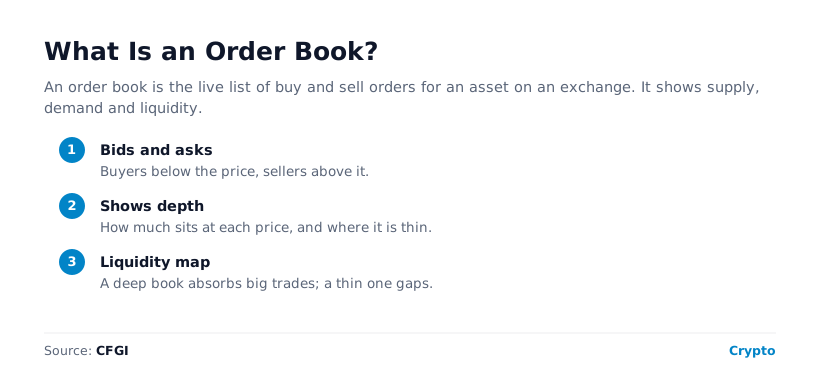
An order book is the real-time list of all the buy and sell orders for an asset on an exchange. Buy orders (bids) sit on one side, sell orders (asks) on the other, each at a chosen price. The order book shows where demand and supply stack up, how much liquidity exists, and the spread between the best bid and ask. It is the live machinery behind every price: a trade happens the moment a bid and an ask meet.
CFGI data
Order-book pressure is one of the 10 indicators CFGI reads. The balance of resting buy and sell orders feeds the 0 to 100 score, refreshed every 15 minutes for crypto, so the book you are looking at is part of what actually moves the gauge, not just a separate trading tool.
Source: CFGI methodology, 10-input 0 to 100 model.
Key takeaways
- An order book lists all open buy (bid) and sell (ask) orders.
- Market depth shows how much volume sits near the price.
- Only limit orders rest in the book; market orders consume it.
- Deep books absorb big trades; thin books swing on small ones.
- Spoofers place and pull fake orders to fake demand or supply.
Where Buyers and Sellers Meet
On an exchange, the order book collects every open order in one place. Bids, the buy orders, are listed by price on one side; asks, the sell orders, on the other. A trade happens the instant a bid and an ask meet at the same price. The gap between the highest bid and the lowest ask is the spread, and the volume of orders stacked on each side is the liquidity. In a real sense, the order book is the market: it is where price is discovered, one matched order at a time.
Reading the Two Sides
The two sides are arranged so the action sits in the middle. Bids are listed in descending order, the highest price a buyer will pay at the top. Asks are listed in ascending order, the lowest price a seller will accept at the top. So the best bid and the best ask sit closest together, with the spread between them, and the rows fan out to worse prices above and below. Reading down each side shows you, at a glance, how much someone would have to pay to buy a lot quickly, or how far the price would fall to sell a lot in a hurry.
Market Depth: Thick and Thin
The most important thing an order book reveals is depth, how much volume rests at each price level. A deep book, with thick layers of orders close to the current price, means large trades can be absorbed without moving the price much; the market is liquid. A thin book, with little volume nearby, means even a modest order can punch through several levels and swing the price hard, which is why low-liquidity coins are so volatile. Thick buy orders stacked below the price act like support, levels where dips may be bought up, while thick sell orders above act like resistance.
Limit Orders Versus Market Orders
A key detail trips people up: only limit orders actually sit in the book. A limit order specifies the price you are willing to trade at and rests in the book until the market reaches it, adding liquidity, which is why limit-order traders are called "makers". A market order does the opposite: it executes immediately at the best available price, matching against, and removing, the orders already resting in the book, which is why market-order traders are "takers". Takers get speed but pay the spread and risk slippage; makers get a better price but only if the market comes to them.
Maker Or Taker?
Place a limit order and you are a maker, adding liquidity to the book. Hit the market and you are a taker, consuming it. The book is the pool both are drawing from.
How a Price Actually Forms
The live price you see quoted is simply the level of the most recent match. As buyers grow more eager and lift their bids to meet the asks, trades happen higher and the price rises; as sellers grow anxious and drop their asks to meet the bids, trades happen lower and the price falls. There is no mysterious force setting the number, just this constant, rapid interaction between two stacks of orders. Understanding that demystifies a lot: a "price" is not a fact handed down, it is the running record of where supply and demand last agreed.
When the Book Lies: Spoofing
The order book can be deliberately deceptive, so it must be read with care. In "spoofing", a manipulator places large orders they never intend to fill, a big wall of fake buy orders to simulate strong demand, for example, to nudge other traders into reacting. As the price approaches, the fake orders are pulled, the apparent demand vanishes, and the manipulator profits from the move they engineered. Related tricks like layering and absorbing liquidity work the same way. Spoofing is illegal in regulated markets and a known problem in less-policed crypto venues, which is why the balance of orders on screen is a clue to pressure, never a guarantee of it.
The Order Book and Sentiment
The order book is not just a trading screen; it is a live readout of supply, demand and liquidity, which is why order-book pressure is one of the inputs behind a Crypto Fear and Greed Index. When buy orders pile up and the book leans bid-heavy, that is a flicker of greed; when asks dominate and depth thins on the buy side, it is fear. CFGI folds that signal, along with nine others, into a single 0 to 100 score, so the book you are reading is part of what moves the gauge. Read together, the raw book and the synthesised score give both the detail and the big picture.
Frequently asked questions
What is an order book?
The real-time list of all open buy and sell orders for an asset on an exchange, with bids (buyers) on one side and asks (sellers) on the other, each at a chosen price. A trade happens when a bid and ask meet.
What is market depth?
How much order volume rests at each price level. A deep book absorbs large trades with little price impact; a thin book swings sharply on small trades. Thick orders below the price act as support, thick orders above as resistance.
What is the difference between a limit and a market order?
A limit order rests in the book at a price you set, adding liquidity (a "maker"). A market order executes immediately at the best available price, consuming orders in the book (a "taker"), gaining speed but paying the spread and risking slippage.
Can the order book be misleading?
Yes. In spoofing, manipulators place large fake orders to create a false impression of demand or supply, then pull them. Read the book as a clue to pressure, not a certainty. This is education, not financial advice.
CFGI.io, Market sentiment research
The CFGI research team builds and maintains the CFGI Fear and Greed Index: a 0 to 100 sentiment score from 10 sub-indicators across hundreds of crypto assets and the equity market, refreshed every 15 minutes. We have tracked market emotion through multiple full crypto and equity cycles.
Think we missed something?
Spotted a gap, disagree with a take, or think we should cover a new topic? Message us and we'll act on your input.
Message us on TelegramKeep reading
This article is educational and is not financial advice. Crypto and equities are volatile and you can lose money. See our disclaimer.