Stocks
What Is a Market Order?
Quick answer
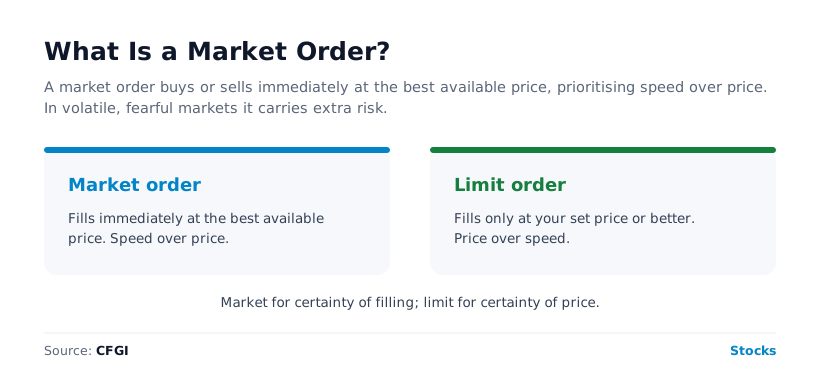
A market order is an instruction to buy or sell a stock immediately at the best available price. It prioritises speed and certainty of execution over control of price, the order will fill, but not necessarily at the price you saw. In calm, liquid markets that gap is tiny. In volatile, fearful or thinly traded conditions, when spreads widen, a market order can fill at a noticeably worse price than expected, a hidden cost called slippage. This is education, not financial advice.
CFGI data
Market orders are riskiest when fear is high. In a panicky, illiquid market, the price can move between clicking and filling. A Fear and Greed Index reading of Extreme Fear is a reminder that conditions may be exactly when a market order’s lack of price control bites.
Source: CFGI dataset and standard order-type definitions, June 2026.
Key takeaways
- A market order fills immediately at the best available price.
- It guarantees execution, not the exact price.
- A limit order is the price-controlled alternative.
- Slippage is the gap between the quote and the fill.
- In volatile, fearful markets it can fill worse than expected.
Speed Over Price
A market order says: get me in, or out, now, whatever the going price. Its advantage is certainty of execution, it will fill almost instantly. Its weakness is the lack of price control: you accept whatever the best available price is at that moment, which may differ from the quote you saw a second earlier. It is the opposite of a limit order, which controls price but may not fill. In deep, calm markets the difference is trivial; in thin or fast ones, it can matter a great deal.
Market Versus Limit Order
The two basic order types embody a fundamental trade-off between certainty and control.
| Market order | Limit order | |
|---|---|---|
| Priority | Speed and certainty | Price control |
| Fills? | Almost always | Only at your price or better |
| Price? | Whatever is available | Exactly what you set, or better |
| Risk | Filling at a bad price | Not filling at all |
The core trade-off.
A market order guarantees you trade but not at what price; a limit order guarantees the price but not that you trade. Neither is better in the abstract, the right choice depends on whether getting it done, or getting a price, matters more to you in that moment.
Slippage: The Hidden Cost
The catch with market orders is "slippage", the difference between the price you saw when you clicked and the price you actually got. In a deep, liquid, calm market, the gap is usually a cent or two and barely noticeable. But in a thinly traded stock, during fast-moving conditions, or outside normal hours, the bid-ask spread widens and prices move quickly, so a market order can fill meaningfully away from the last quote. Slippage is effectively the price of immediacy: you pay for the certainty of getting filled right now by giving up control over the exact price. The less liquid the market, the higher that hidden cost can climb, which is exactly why market orders deserve more caution in volatile conditions.
Slippage is also why the "best available price" in a fast market is a moving target. A large market order can even "walk the book", filling part of itself at progressively worse prices as it consumes the available offers, so a big order in a thin stock may average a price noticeably different from the one quoted when it was placed. For small orders in liquid stocks this is irrelevant; for large orders in thin ones, it is a real consideration, and another reason size and liquidity matter as much as the order type itself.
When to Use a Market Order
A market order is the right tool when speed matters more than a precise price and the market is deep and calm. For a large, heavily traded stock during normal hours, the spread is tiny and a market order fills almost exactly where you expect, so the simplicity is worth it. It is the wrong tool in the opposite conditions: a thin, low-volume stock, a fast-moving or panicky market, or the pre-market and after-hours sessions, where slippage can be severe and a limit order is far safer. Many brokers even refuse market orders in those thin sessions for precisely this reason. The rule of thumb: liquid and calm, a market order is fine; thin or fast, use a limit.
Match the Order to the Market
In deep, calm markets a market order’s slippage is trivial. In thin or fast ones it can be brutal, which is when a limit order earns its keep.
Market Orders and Fear
Market orders are most dangerous when fear is high. In a panicky, volatile market, spreads widen and prices move fast, so a market order can fill well away from where you expected, the very moment people are most tempted to hit the button. There is a cruel overlap here: the urge to dump everything with an instant market order peaks exactly when conditions make that order most costly. A Stock Fear and Greed Index reading of Extreme Fear is a cue for extra care, both because the panic it reflects is rarely the right moment to sell, and because if you do trade, the slippage on a market order is likely to be at its worst.
Frequently asked questions
What is a market order?
An instruction to buy or sell immediately at the best available price. It guarantees execution but not the exact price, prioritising speed and certainty over price control.
What is the difference between a market and limit order?
A market order guarantees you trade but not at what price; a limit order guarantees the price (or better) but not that you trade at all. Market orders prioritise speed; limit orders prioritise price control.
What is slippage?
The difference between the price you saw when you placed a market order and the price it actually filled at. It is usually tiny in deep, calm markets but can be large in thin or fast-moving ones, the hidden cost of immediacy.
When is a market order risky?
In volatile, fearful or thinly traded markets, and in pre-market and after-hours sessions, where spreads widen and prices move fast. The fill can land well away from the price you saw a moment earlier, so a limit order is often safer. This is education, not financial advice.
CFGI.io, Market sentiment research
The CFGI research team builds and maintains the CFGI Fear and Greed Index: a 0 to 100 sentiment score from 10 sub-indicators across hundreds of crypto assets and the equity market, refreshed every 15 minutes. We have tracked market emotion through multiple full crypto and equity cycles.
Think we missed something?
Spotted a gap, disagree with a take, or think we should cover a new topic? Message us and we'll act on your input.
Message us on TelegramKeep reading
This article is educational and is not financial advice. Crypto and equities are volatile and you can lose money. See our disclaimer.