Crypto
What Is Yield Farming?
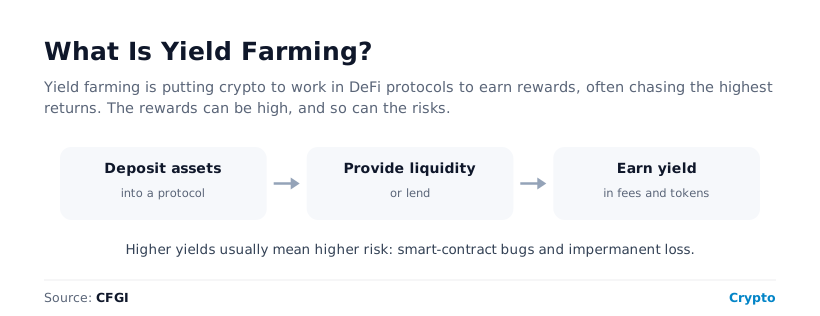
Quick answer
Yield farming is the practice of supplying your crypto to DeFi protocols, usually lending pools or liquidity pools, to earn rewards, often moving funds between protocols to chase the highest return. The rewards combine trading fees and bonus tokens, and the headline yields can look enormous. So can the risks: smart-contract bugs, collapsing reward-token prices, impermanent loss and outright scams. Yield farming tends to boom in greedy markets and dry up when fear returns.
CFGI data
Yield-farming manias are a greed signal you can almost set your watch by. The hunt for the highest yields peaks when the crowd is most risk-hungry, the same conditions CFGI reads as Extreme Greed, 80 or above on its 0 to 100 scale. CFGI has tracked that mood since March 2022, and when farms start promising impossible returns, the gauge is usually running hot.
Source: CFGI dataset, March 2022 to June 2026.
Key takeaways
- Yield farming earns rewards by supplying crypto to DeFi protocols.
- You deposit into a pool, receive LP tokens, and can stake those for more yield.
- The APY comes from trading fees plus bonus token emissions, which can be unsustainable.
- Impermanent loss can leave you worse off than simply holding.
- It booms in greedy markets and fades in fearful ones.
Putting Crypto to Work
In DeFi, protocols need users to supply assets so that other people can trade or borrow them. Yield farming is the act of supplying those assets, into lending pools or liquidity pools, in exchange for a cut of the fees and, often, bonus tokens. Farmers tend to chase the best rates, shifting capital between protocols as yields rise and fall, which is where the restless, "farming" name comes from.
How a Yield Farm Actually Works
The mechanics are more concrete than the jargon suggests. In a typical liquidity-pool farm, you deposit a pair of tokens, say a coin and a stablecoin, into a pool that traders use to swap between them. In return you receive "LP tokens" that represent your share of that pool. Those LP tokens are themselves useful: many protocols let you stake them elsewhere to earn a second layer of rewards, a stacking of yields that DeFi people call composability, or "money legos".
On top of the trading fees, many platforms run "liquidity mining", handing out their own governance tokens, like UNI or SUSHI, to anyone who supplies liquidity. That bonus is what turns an ordinary single-digit fee yield into the eye-watering percentages farms advertise.
APY, APR and Where the Yield Comes From
Yields are quoted as APR (simple interest) or APY (which assumes you compound the rewards), and the difference can be large once high rates are reinvested. The crucial question is always where the yield comes from. A modest, durable yield is usually real trading fees. A spectacular yield is usually token emissions, the protocol printing its own reward token to attract deposits.
The cautionary tale is the "DeFi summer" of 2020, when some farms advertised APYs in the thousands of percent, funded almost entirely by emitting governance tokens. As soon as the incentives slowed or the token price fell, those yields collapsed and the capital fled to the next farm. A number that looks too good to be true is, almost always, being paid in a token whose price is about to find out.
Impermanent Loss: The Risk No One Mentions First
The risk unique to liquidity farming is impermanent loss, and it catches almost everyone out. When you supply two tokens to a pool and their prices move apart, the pool automatically rebalances, leaving you holding more of the loser and less of the winner. The result is that you can end up with less value than if you had simply held the two tokens in your wallet and done nothing. The fees and rewards are meant to make up for it, but in a volatile pair they often do not.
The Honest Test
Before farming a pair, ask whether the rewards realistically beat just holding the two assets. If the only reason the numbers work is a soaring reward token, the yield is borrowed from the future.
The Other Risks: Bugs and Rug Pulls
Two more dangers sit on top. The first is technical: yield farms run on smart contracts, and an unaudited or flawed contract can be drained by an attacker, taking the whole pool with it. The second is human: in a "rug pull", anonymous developers spin up an attractive farm, wait for deposits to pile in, then withdraw the liquidity and vanish. As a rule, the biggest advertised returns carry the biggest of these risks, because outsized yields are exactly the bait used to attract liquidity to the least trustworthy projects.
Yield Farming Versus Staking
It is easy to confuse yield farming with staking, but they are different jobs. Staking locks coins to help secure a proof-of-stake blockchain, and the reward is relatively steady and protocol-level. Yield farming supplies liquidity to applications built on top of a chain, and the rewards are higher, more variable and exposed to impermanent loss and contract risk. Staking is closer to earning interest; farming is closer to running a small, active business with real downside.
Yield Farming and Market Sentiment
Yield farming is one of the most sentiment-driven corners of crypto. When risk appetite is high, capital floods into ever-riskier farms chasing ever-higher yields; when fear takes hold, that capital retreats to safety and the farms wither. That cycle maps directly onto the Crypto Fear and Greed Index, which reads the mood on a 0 to 100 scale. A wave of "impossible" farm yields is itself a sentiment indicator, usually flashing the same Extreme Greed that calls for the most caution.
Frequently asked questions
What is yield farming?
Supplying your crypto to DeFi protocols, such as lending or liquidity pools, to earn a share of fees plus bonus reward tokens, often moving funds between protocols to chase the highest yield.
What is impermanent loss?
The loss a liquidity provider can suffer when the two pooled tokens move apart in price. The pool rebalances into the weaker asset, which can leave you with less value than if you had simply held both tokens.
Is yield farming profitable?
It can be, but advertised yields are often inflated by reward tokens that lose value, and the risks, bugs, exploits, rug pulls and impermanent loss, are real. The biggest yields usually carry the biggest risks. This is education, not financial advice.
When is yield farming most popular?
In greedy, risk-hungry markets, when the crowd chases the highest returns. It fades when fear returns and risk appetite drops, which is why a farming mania often coincides with Extreme Greed.
CFGI.io, Market sentiment research
The CFGI research team builds and maintains the CFGI Fear and Greed Index: a 0 to 100 sentiment score from 10 sub-indicators across hundreds of crypto assets and the equity market, refreshed every 15 minutes. We have tracked market emotion through multiple full crypto and equity cycles.
Think we missed something?
Spotted a gap, disagree with a take, or think we should cover a new topic? Message us and we'll act on your input.
Message us on TelegramKeep reading
This article is educational and is not financial advice. Crypto and equities are volatile and you can lose money. See our disclaimer.