Markets
What Is Finance?
Quick answer
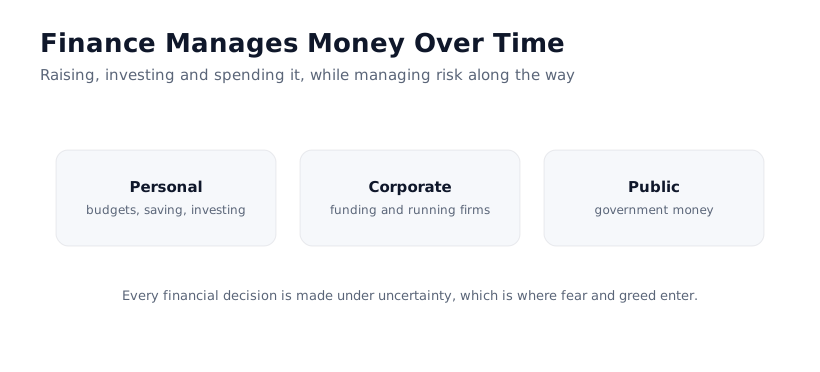
Finance is the management of money over time: raising it, investing it, spending it and managing the risk along the way. It covers personal finance, corporate finance and public finance, and rests on two core ideas, the time value of money and the trade-off between risk and return. At its heart it is about decisions under uncertainty, and uncertainty is where emotion creeps in, which is why markets swing on fear and greed. This is education, not financial advice.
CFGI data
Finance is decision-making under uncertainty, and uncertainty breeds emotion. CFGI measures that emotion as a number: a 0 to 100 Fear and Greed score across crypto and equities, built from 10 indicators and tracked since March 2022, so the mood behind financial decisions is something you can read, not just feel.
Source: CFGI dataset, March 2022 to June 2026.
Key takeaways
- Finance is the management of money over time.
- Its three branches are personal, corporate and public finance.
- It rests on the time value of money and risk versus return.
- Economics is the broad theory; finance is the practical application.
- Decisions under uncertainty are where fear and greed enter markets.
What Is Finance?
Finance is how individuals, companies and governments manage money across time. It answers practical questions: how to raise money, where to invest it, how much risk to take, and how to plan for an uncertain future. Money is the tool; finance is what you do with it. At its broadest, finance is the study and practice of moving value across time, from a future where you will have money to a present where you need it, or from a present surplus to a future goal.
The Three Branches of Finance
- Personal finance: budgeting, saving, borrowing and investing for yourself and your household.
- Corporate finance: how companies fund themselves, through debt or equity, and decide which projects to invest in.
- Public finance: how governments tax, spend and borrow to run a country and shape its economy.
The three scale up from the individual to the nation, but they share the same toolkit and the same questions. All three meet in financial markets, where money is priced, lent and traded, and where the decisions of households, companies and governments collide. A fourth field, sometimes treated separately, is "investments", the study of how to value and manage assets like stocks and bonds, which sits at the crossroads of all three branches. Whichever slice you look at, finance is fundamentally about the same act: deciding how to deploy limited money today to meet uncertain needs and goals tomorrow.
The Core Ideas: Time and Risk
Beneath all its complexity, finance rests on two simple, powerful ideas. The first is the "time value of money": a dollar today is worth more than a dollar tomorrow, because today’s dollar can be invested to grow, and because the future is uncertain. This is why interest exists and why compounding is so powerful. The second is the trade-off between risk and return: safer investments offer lower returns, and to earn higher returns you must accept more risk, the chance of losing money. Almost every financial decision, from a savings account to a startup investment, is really a judgement about these two things, how much to value the future, and how much risk to bear to improve it.
Two Ideas Behind Everything
Money has a time value (sooner beats later), and return is the reward for taking risk. Grasp these two and most of finance becomes variations on a theme.
Finance Versus Economics
Finance is often confused with economics, but they work at different levels. Economics is the broad study of how societies allocate scarce resources, the big-picture theory of production, consumption, inflation, growth and how whole economies behave. Finance is narrower and more applied: the practical management of money, investments and risk by specific actors, a person, a firm, a government. You can think of economics as the science that explains how the financial world behaves, and finance as the engineering that puts that understanding to work in real decisions. The two are deeply intertwined, finance leans on economic ideas constantly, but finance is where theory meets the actual handling of money.
A simple way to keep them straight: economics tends to ask "why" questions, why prices rise, why economies grow or shrink, while finance tends to ask "how" questions, how to fund a project, how to value an asset, how to manage a risk. An economist might study why interest rates affect inflation; a finance professional uses the resulting rates to decide whether a company should borrow to build a factory. Both matter, and the best decisions draw on each, but it is finance that most directly governs the everyday choices people and institutions make with their money.
Where Does Emotion Fit In?
Finance is taught as numbers, but every decision is made by a person facing an unknown future. That is why textbook-rational markets still boom and bust: fear and greed steer real choices about money, often overriding the cool calculations the spreadsheets assume. Measuring that mood is one way to see the human layer the equations miss, the gap between how people should behave and how they actually do. CFGI does exactly that, scoring market sentiment from 0 to 100 on the Fear and Greed Index, turning the emotional dimension of finance into something you can read alongside the figures.
Frequently asked questions
What is finance?
The management of money over time: raising it, investing it, spending it and managing risk. It spans personal, corporate and public finance and rests on the time value of money and the trade-off between risk and return.
What are the three types of finance?
Personal finance (managing your own money), corporate finance (how companies fund and invest) and public finance (how governments tax, spend and borrow). They share the same toolkit at different scales.
What is the difference between finance and economics?
Economics is the broad theory of how societies allocate resources; finance is the narrower, practical management of money, investments and risk. Economics explains how the financial world behaves; finance puts that understanding to work.
Why does emotion matter in finance?
Because financial decisions are made under uncertainty by people, not machines. Fear and greed steer real choices, which is why markets overshoot. CFGI measures that mood as a 0 to 100 score. This is education, not financial advice.
CFGI.io, Market sentiment research
The CFGI research team builds and maintains the CFGI Fear and Greed Index: a 0 to 100 sentiment score from 10 sub-indicators across hundreds of crypto assets and the equity market, refreshed every 15 minutes. We have tracked market emotion through multiple full crypto and equity cycles.
Think we missed something?
Spotted a gap, disagree with a take, or think we should cover a new topic? Message us and we'll act on your input.
Message us on TelegramKeep reading
This article is educational and is not financial advice. Crypto and equities are volatile and you can lose money. See our disclaimer.