Crypto
What Is a Blockchain?
Quick answer
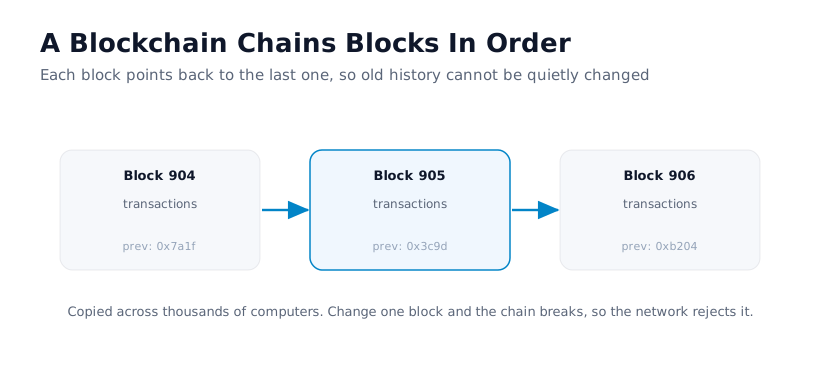
A blockchain is a shared record of transactions, copied across thousands of computers and verified by the network instead of a central authority. Each block of transactions is linked to the one before it, so the history cannot be quietly changed. This lets strangers transact without trusting a middleman, and because the record is public, anyone, including CFGI, can read the behaviour of the whole market from it. This is education, not financial advice.
CFGI data
Because a blockchain is public, sentiment is measurable. CFGI reads on-chain signals such as whale movements and order-book pressure directly off the chain. They are 2 of the 10 indicators behind every CFGI Fear and Greed score, a 0 to 100 reading published every 15 minutes since March 2022.
Source: CFGI methodology and dataset, March 2022 to June 2026.
Key takeaways
- A blockchain is a shared, tamper-evident record verified by a network, not a bank.
- Blocks are chained in order, so old history cannot be quietly rewritten.
- It lets strangers transact without trusting a middleman.
- Its public nature is what makes on-chain behaviour readable by anyone.
- CFGI reads on-chain signals as 2 of the 10 indicators behind every score.
What Is a Blockchain?
A blockchain is a database that no single party controls. Instead of one company holding the master copy, thousands of computers each hold the same copy, and the network agrees on what is true. Transactions are grouped into blocks, and each block is cryptographically linked to the one before, forming a chain. That structure is what makes it trustworthy without a middleman: to fake the history you would have to rewrite every linked block on most computers at once, which is not practical. In plain terms, it is a shared, public notebook that everyone can write to under strict rules, that no one can secretly erase, and that has no single owner who could be bribed, hacked or shut down.
How a Blockchain Works
A few mechanisms make the magic work. Each block contains a batch of transactions plus a "hash", a unique digital fingerprint, of the block before it, which is what chains the blocks together in order: change anything in an old block and its fingerprint changes, breaking the chain and instantly revealing the tampering. To decide which new blocks are valid and keep everyone’s copy in sync without a central referee, the network uses a "consensus mechanism". Bitcoin uses proof of work, where computers (miners) compete to solve a puzzle for the right to add the next block; Ethereum and many others use proof of stake, where validators put up collateral instead. Either way, the result is the same: a "distributed" ledger, held by everyone and controlled by no one, that arrives at a single agreed version of the truth through maths and incentives rather than a trusted authority. That is what "decentralised" really means.
Why Blockchain Is Revolutionary
The reason blockchain matters far beyond its technical cleverness is that it solves a problem that had stumped computer scientists for decades: how to let people who do not know or trust each other transact safely without a trusted middleman in between. Before blockchain, sending digital money required a bank or company to keep the master ledger and prevent the same money being spent twice; you had to trust that institution. A blockchain replaces that trusted third party with transparent, self-enforcing code and a network that polices itself, making transactions "trustless", you trust the system, not any single party. This is what makes it genuinely revolutionary: it enables money, contracts, ownership records and entire applications to operate without a central authority that could censor, freeze, alter or seize them. Whether or not any particular crypto asset succeeds, the underlying idea, a shared, tamper-proof record that needs no central keeper, is a genuinely new tool for organising trust.
Trust Without a Middleman
Blockchain’s breakthrough is letting strangers transact safely without a bank or company in the middle. You trust transparent, self-enforcing code and a self-policing network, not any single party.
Why Does It Matter That a Blockchain Is Public?
A bank ledger is private. A public blockchain is the opposite: every transaction is visible to anyone. You cannot see names, the system is "pseudonymous", but you can see behaviour, and behaviour is where sentiment lives. When large holders move coins, when funds pile onto exchanges, when buy or sell walls build up in the order book, it is all on the chain for anyone to inspect. This radical transparency is unique to crypto, in traditional markets, the equivalent flows happen behind closed doors at banks and brokerages, but on a public blockchain the crowd shows its hand in the open. That visibility is a gift for measuring crypto market sentiment, because it turns the actual, on-chain actions of millions of participants into readable data, rather than leaving you to guess what is happening beneath the surface.
How Does CFGI Read the Chain?
CFGI turns on-chain behaviour into part of its sentiment score. Whale movements and order-book pressure are 2 of the 10 indicators it combines, alongside price, volatility, volume and social activity. Coins flowing onto exchanges signal intent to sell, which reads as fear; coins leaving signal an intent to hold, which leans the other way. The result is a single Fear and Greed Index score from 0 to 100, refreshed every 15 minutes, that you can read without parsing the raw chain yourself. This is the practical payoff of a public ledger: the same transparency that lets a sophisticated analyst pore over individual wallets lets a sentiment index distil the collective on-chain behaviour of the whole market into one number anyone can glance at.
Frequently asked questions
What is a blockchain?
A shared database that no single party controls: thousands of computers each hold the same copy, transactions are grouped into blocks, and each block is cryptographically linked to the one before, so the history is tamper-evident and needs no central keeper.
How does a blockchain work?
Each block contains transactions plus a hash (fingerprint) of the previous block, chaining them in order. A consensus mechanism, proof of work or proof of stake, lets the network agree on valid new blocks without a central referee, producing one agreed version of the truth.
Why is blockchain revolutionary?
It solves how to let people who do not trust each other transact safely without a middleman. It replaces a trusted bank or company with transparent, self-enforcing code and a self-policing network, enabling money, contracts and ownership to work without a central authority.
How does a public blockchain help measure sentiment?
Because transactions are visible, market behaviour like whale moves and exchange flows can be read directly off the chain. CFGI uses these as 2 of the 10 indicators behind its 0 to 100 Fear and Greed score. This is education, not financial advice.
CFGI.io, Market sentiment research
The CFGI research team builds and maintains the CFGI Fear and Greed Index: a 0 to 100 sentiment score from 10 sub-indicators across hundreds of crypto assets and the equity market, refreshed every 15 minutes. We have tracked market emotion through multiple full crypto and equity cycles.
Think we missed something?
Spotted a gap, disagree with a take, or think we should cover a new topic? Message us and we'll act on your input.
Message us on TelegramKeep reading
This article is educational and is not financial advice. Crypto and equities are volatile and you can lose money. See our disclaimer.