Crypto
What Is an NFT?
Quick answer
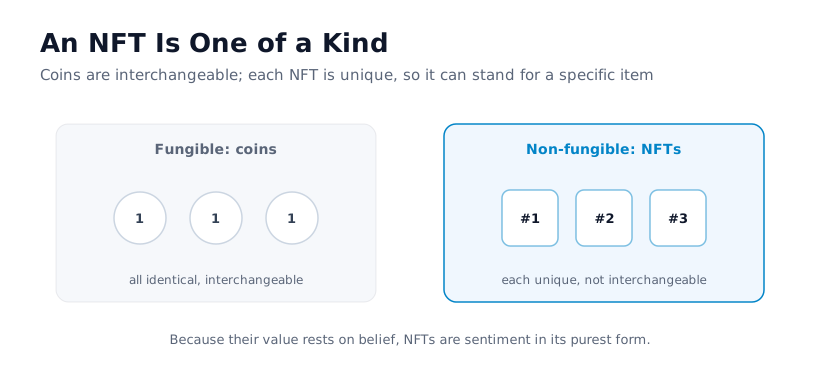
An NFT, or non-fungible token, is a unique record of ownership stored on a blockchain. Unlike a coin, where one unit is identical to another, each NFT is one of a kind, which lets it represent a specific item like art, a collectible or access. Because their value rests almost entirely on what the crowd believes, NFTs are sentiment in its purest form, which is also why they boomed and busted so violently. This is education, not financial advice.
CFGI data
NFTs are crowd emotion in its purest form, driven by belief rather than cash flow. CFGI does not score individual NFTs, but it measures the wider market mood they ride: a 0 to 100 Fear and Greed score across hundreds of assets, updated every 15 minutes since March 2022, so you can see when the appetite for risk is hot or cold.
Source: CFGI dataset, March 2022 to June 2026.
Key takeaways
- An NFT is a unique, one-of-a-kind ownership record on a blockchain.
- "Non-fungible" means it is not interchangeable, unlike a coin.
- It can represent art, collectibles, membership, tickets or in-game items.
- Its value rests on belief, with no earnings or yield to anchor it.
- That makes the category intensely sentiment-driven and volatile.
What Is an NFT?
A coin is fungible: one Bitcoin is the same as any other, so they are interchangeable. An NFT is non-fungible: each one is unique and not swappable one-for-one. It is a smart contract entry on a blockchain that says, verifiably, who owns a specific item. That item might be digital art, a collectible, a ticket, a membership or an in-game asset. Crucially, the NFT is the ownership record, the verifiable certificate, not always the file itself, a distinction that turns out to matter a great deal.
What NFTs Can Represent
Although NFTs became famous through digital art and profile-picture collections, the underlying technology, a unique, verifiable token of ownership on a blockchain, is far more general than pixel art. NFTs have been used to represent collectible profile pictures that double as community membership, in-game items that players truly own and can trade across games, event tickets that cannot be counterfeited, memberships and access passes that unlock perks or gated communities, music and media rights, domain-like names, and even claims on real-world assets. The common thread is the idea of a tamper-proof, transferable certificate of ownership or authenticity for a specific thing. At their best, NFTs offer something genuinely new: provable digital ownership and scarcity in a digital world where files have always been infinitely copyable. Whether any given NFT delivers on that promise, or is just a speculative jpeg, is exactly the question a buyer has to weigh.
Why Do NFTs Have Value?
For the same reason a signed painting or a rare trading card does: scarcity plus desire. An NFT is worth what the next person will pay, and that depends almost entirely on belief, community and hype rather than any cash flow. Some of that value can be real and durable, the status of owning a piece of a famous collection, access to an active community, or genuine utility, but much of it, especially at the speculative extreme, is pure narrative.
Almost Pure Sentiment
A company has earnings; a bond pays interest. An NFT has neither. Strip those anchors away and what is left is crowd emotion, which is why NFT prices boom and bust faster than almost anything else in markets.
The Boom, the Bust, and the Criticism
No asset class better illustrates the cycle of fear and greed than NFTs. The 2021 mania saw certain collections trade for fortunes amid frenzied FOMO, a textbook bubble running on pure greater-fool dynamics, the belief that someone would always pay more. When the mood turned, the bust was brutal: a great many NFT collections collapsed toward zero, leaving late buyers holding tokens worth a tiny fraction of what they paid. The episode sharpened the long-standing criticisms: that with no cash flow to anchor them, most NFTs are pure speculation; that owning the token often does not even grant rights to the underlying art, which may just be a link to a file stored elsewhere; and that much of the market was hype and wash-trading. Defenders counter that the bubble bursting does not invalidate the underlying technology, and that the projects with real utility and genuine community have endured. The honest read is that NFTs are a real innovation that was wrapped in an enormous speculative mania, and telling the durable value from the empty hype is the whole challenge.
A Real Idea, a Wild Mania
NFTs introduced provable digital ownership, then got swept into a 2021 bubble that mostly collapsed. The lasting value, utility and community, is real; the speculative froth was not. Telling them apart is the skill.
How Do NFTs Fit Market Sentiment?
NFTs are the clearest example of the force CFGI measures. They thrive in greed, when risk appetite is high and the crowd is chasing the next thing, and they freeze in fear, when the same crowd pulls back to safety. Because they sit at the very far, speculative end of the risk spectrum, with no fundamentals to cushion them, NFTs act almost as a pure barometer of risk appetite: a booming NFT market is a hallmark of peak greed, while a frozen one signals deep risk-off fear. CFGI does not put a score on each NFT, but the broad market mood that lifts or sinks them is exactly what the Crypto Fear and Greed Index reads, from 0 to 100, across the wider market. Watching that gauge is a way of reading the risk-on, risk-off tide that NFTs, more than almost any other asset, rise and fall with.
Frequently asked questions
What is an NFT?
A non-fungible token: a unique, verifiable record of ownership stored on a blockchain. Unlike a coin, where one unit equals another, each NFT is one of a kind, so it can represent a specific item like art, a collectible, a ticket or a membership.
What does non-fungible mean?
Not interchangeable. Money is fungible: any one pound is the same as another. An NFT is unique, so it cannot be swapped one-for-one with another, which is what lets it represent a specific, one-of-a-kind item.
Do you own the actual artwork with an NFT?
Usually you own a verifiable record of ownership on the blockchain, which may or may not include rights to the underlying file, often the NFT is effectively a link to a file stored elsewhere. What you definitely own is the token itself, a key criticism of the category.
Why are NFTs so volatile?
Because their value rests on belief, not cash flow. With no earnings or yield to anchor them, NFT prices swing with crowd sentiment, booming in greed and collapsing in fear, as the 2021 mania and subsequent bust showed. This is education, not financial advice.
CFGI.io, Market sentiment research
The CFGI research team builds and maintains the CFGI Fear and Greed Index: a 0 to 100 sentiment score from 10 sub-indicators across hundreds of crypto assets and the equity market, refreshed every 15 minutes. We have tracked market emotion through multiple full crypto and equity cycles.
Think we missed something?
Spotted a gap, disagree with a take, or think we should cover a new topic? Message us and we'll act on your input.
Message us on TelegramKeep reading
This article is educational and is not financial advice. Crypto and equities are volatile and you can lose money. See our disclaimer.