Crypto
What Is a Liquidation In Crypto?
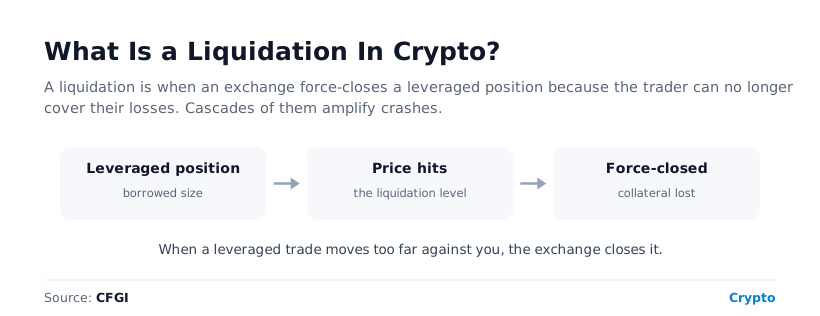
Quick answer
A liquidation is when an exchange automatically closes a trader’s leveraged position because the price moved against them far enough that their collateral can no longer cover the loss. In crypto, where high leverage is common, mass liquidations can cascade: forced selling pushes the price down, which triggers still more liquidations. This self-reinforcing loop is a big reason crypto crashes are so sudden and so violent.
CFGI data
Liquidation cascades are fear in its rawest form. They cluster at sharp drops, exactly when CFGI plunges toward Extreme Fear, below 20 on its 0 to 100 scale. CFGI has tracked that mood since March 2022, and the forced selling a cascade unleashes is a big reason deep-fear readings so often line up with capitulation lows.
Source: CFGI dataset, March 2022 to June 2026.
Key takeaways
- A liquidation is a forced close of a leveraged position when collateral runs out.
- The higher the leverage, the smaller the move needed to wipe you out.
- Mass liquidations cascade, amplifying crashes in a self-reinforcing loop.
- In 2025, a single October cascade topped 19 billion US dollars in a day.
- Cascades cluster at moments of Extreme Fear and often mark capitulation lows.
When Leverage Runs Out of Room
Trading with leverage means borrowing to control a position larger than your own funds. Your own money is the collateral, or margin. If the price moves against you, that collateral shrinks, and once it falls below the exchange’s maintenance threshold, the position is liquidated, closed automatically, so the loss does not spill past your margin. In crypto futures, this is usually triggered by the "mark price", a smoothed reference price, rather than the last trade, to stop a single bad print from wiping people out unfairly.
Leverage and Your Liquidation Price
The key number is your liquidation price, the level at which the position gets closed, and leverage decides how close it sits to where you entered. The more you borrow, the smaller the move it takes to wipe you out.
| Leverage | Adverse move to liquidation |
|---|---|
| 2x | About 50% |
| 10x | About 10% |
| 25x | About 4% |
| 50x | About 2% |
| 100x | About 1% |
How leverage shrinks your margin for error (approximate).
At 100x, a 1% wobble, an ordinary hour in crypto, is enough to end the trade. This is why high leverage is less an investment and more a countdown, and why the exchanges that offer it the loudest tend to profit the most from it.
Why Liquidations Cascade
In a heavily leveraged market, liquidations feed on themselves. A drop forces some positions to close, and because closing a long means selling, that forced selling pushes the price lower, which drags the next batch of positions below their own liquidation price, which forces more selling. The loop is worst when lots of traders are bunched at similar leverage near the same price and there is not enough liquidity to absorb the wave of forced orders. This cascade is part of why crypto is so volatile and why a routine sell-off can tip into capitulation within minutes.
The Biggest Cascades
The scale can be staggering. Across 2025, forced liquidations totalled roughly 150 billion US dollars, and a single cascade on the 10th and 11th of October 2025 exceeded 19 billion dollars in a day by reported figures, with some estimates far higher. The telling detail is that 85 to 90 percent of those liquidations were long positions, traders betting on higher prices who had crowded in with borrowed money. When everyone is leaning the same way, the unwind is brutal, because there is no one left on that side to buy. Long positions usually dominate because crypto bull runs breed optimism, and that crowded optimism is precisely what a cascade punishes when the mood finally turns.
Reading the Warning Signs
Cascades are hard to time but not invisible. Two gauges hint at building risk. Rising open interest, the total value of outstanding leveraged bets, shows how much borrowed money is in the market. The funding rate, the periodic payment between longs and shorts, shows which way that leverage leans: strongly positive funding means crowded longs paying to keep their bets open. High open interest plus heavily one-sided funding does not guarantee a cascade, but it is the dry tinder that a sharp move can ignite.
The Quiet Tell
When everyone is leveraged long and funding is sharply positive, the market is primed for a long squeeze. The same setup in reverse, crowded shorts, sets up a short squeeze higher.
Liquidations, Fear and Capitulation
Liquidation cascades are sentiment turned physical. They erupt at the exact moments the crowd panics, and the forced selling drives prices to levels that fundamentals alone would not, which is why those moments so often coincide with the deepest readings on the Crypto Fear and Greed Index. When the gauge plunges into Extreme Fear, below 20 on its 0 to 100 scale, a leverage washout is frequently the cause. Counter-intuitively, those capitulation points have historically marked some of the better moments to be buying rather than selling.
Frequently asked questions
What is a liquidation in crypto?
When an exchange force-closes a leveraged position because the price moved against the trader far enough that their collateral can no longer cover the loss. The trader loses their margin.
How does leverage affect liquidation?
The higher the leverage, the closer the liquidation price to your entry. At 10x roughly a 10% adverse move wipes the position; at 50x about 2%; at 100x as little as 1%.
Why do liquidations cause crashes to accelerate?
Because they cascade: a drop forces positions to close, the forced selling pushes the price lower, and that triggers more liquidations. The loop amplifies a sell-off, especially when leverage is crowded and liquidity is thin.
How are liquidations related to fear?
They cluster at sharp drops, when sentiment plunges toward Extreme Fear below 20. The forced selling often coincides with capitulation lows, which have historically been turning points. This is education, not financial advice.
CFGI.io, Market sentiment research
The CFGI research team builds and maintains the CFGI Fear and Greed Index: a 0 to 100 sentiment score from 10 sub-indicators across hundreds of crypto assets and the equity market, refreshed every 15 minutes. We have tracked market emotion through multiple full crypto and equity cycles.
Think we missed something?
Spotted a gap, disagree with a take, or think we should cover a new topic? Message us and we'll act on your input.
Message us on TelegramKeep reading
This article is educational and is not financial advice. Crypto and equities are volatile and you can lose money. See our disclaimer.