Crypto
Fear and Greed Index vs Open Interest
Quick answer
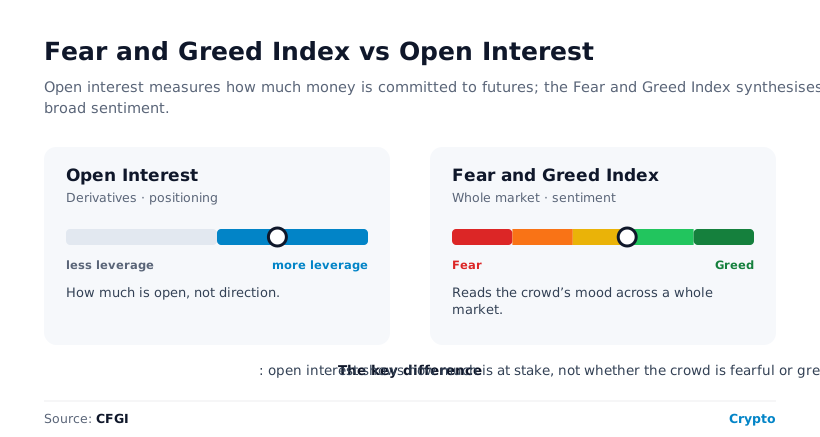
Open interest is the total value of outstanding futures contracts, a gauge of how much capital and leverage is committed to a market. The Fear and Greed Index instead synthesises 10 indicator groups into a single 0 to 100 sentiment score. Open interest tells you how much is at stake, not which way; the Fear and Greed Index tells you how the crowd feels. Read together, they show both the size and the mood of a move. This is education, not financial advice.
CFGI data
Open interest is a derivatives measure; CFGI is a sentiment synthesis. CFGI distils 10 indicators into one 0 to 100 score across hundreds of assets and four timeframes since March 2022, giving a comparable mood read that rising or falling open interest alone cannot provide.
Source: CFGI dataset and public derivatives-market information, June 2026.
Key takeaways
- Open interest is the total value of outstanding futures contracts.
- It shows how much capital and leverage is committed, not direction.
- Read with price, it shows whether new money is long or short.
- High open interest means more fuel for liquidation cascades.
- The index shows the mood; open interest shows the stakes.
Commitment vs Sentiment
Open interest counts the contracts that are open and unsettled. Rising open interest means new money and leverage are entering; falling open interest means positions are being closed. It is a measure of conviction and exposure, but on its own it does not say whether that exposure is fearful or greedy. The Fear and Greed Index supplies the mood. By blending 10 indicators into a single 0 to 100 score, it reads whether the crowd is fearful or greedy, context that open interest by itself lacks.
| Open interest | Fear and Greed Index | |
|---|---|---|
| Measures | Committed futures capital | Broad sentiment |
| Rising means | New money and leverage | Toward greed (if score up) |
| Source | Derivatives market | 10 indicator groups |
| Coverage | Liquid futures markets | hundreds of assets |
| Best as | A conviction gauge | A mood gauge |
Open interest versus the Fear and Greed Index.
What Open Interest Actually Tells You
A subtlety that trips many people up: open interest, on its own, does not tell you whether the market is bullish or bearish, because every contract has a long on one side and a short on the other, so the two always balance. What it actually measures is participation, how much exposure is still standing rather than which way it leans. That is why open interest is most useful read alongside price. Rising open interest as price rises suggests new long money is entering and the uptrend has fresh fuel; rising open interest as price falls suggests new shorts are piling in; and falling open interest in either direction signals that positions are being closed and the market is "deleveraging", with traders reducing risk. So open interest does not give you a direction by itself, it tells you whether a move is being driven by fresh conviction or merely by existing positions changing hands, which is a different and complementary question to the one the Fear and Greed Index answers.
Open Interest and Fragility
Where open interest becomes especially powerful, and where it connects most directly to sentiment, is as a measure of fragility. High open interest means a large amount of leveraged exposure is built up in the system, and leverage is the fuel for liquidation cascades, the violent, self-reinforcing sell-offs (or short squeezes) that happen when forced liquidations trigger more forced liquidations. The most dangerous setups arise when high and rising open interest coincides with an extreme in sentiment: a market deep in Extreme Greed with surging open interest is one where a huge, crowded, over-leveraged long position has accumulated, leaving it acutely vulnerable to a sharp reversal if anything spooks it. In effect, open interest tells you how much dry, leveraged tinder has piled up, while the Fear and Greed Index tells you how hot the emotional conditions are. Together they paint a vivid picture of how fragile a market has become.
OI Is the Leveraged Tinder
High open interest means a lot of leverage is built up, the fuel for liquidation cascades. Paired with Extreme Greed, it marks a crowded, fragile market primed for a sharp reversal.
Using Them Together
Combined, they are revealing. A market at Extreme Greed with surging open interest is heavily leveraged and crowded, a fragile setup. Fear with falling open interest suggests positions are being unwound and the market is deleveraging, often a healthier, if painful, reset. The index reads the emotion; open interest reads how much is riding on it. Neither predicts the next move, but watching the two together, the mood and the leverage behind it, gives a fuller sense of a market’s condition than either alone: not just whether the crowd is greedy or fearful, but how much capital and risk is committed to that feeling, which is what determines how violently the situation could unwind.
Frequently asked questions
What is open interest?
The total value of outstanding, unsettled futures contracts in a market, a gauge of how much capital and leverage is committed. Rising open interest means new money is entering; falling open interest means positions are being closed.
Does open interest show if the market is bullish or bearish?
Not on its own, because every contract has a long and a short, so they balance. It measures participation, not direction. Read with price, rising open interest as price rises suggests new longs; as price falls, new shorts.
What does rising open interest with Extreme Greed mean?
It points to a heavily leveraged, crowded market, often a fragile setup, because high open interest is the fuel for liquidation cascades. The combination of high exposure and extreme sentiment leaves the market primed for a sharp reversal.
Should I use open interest or the Fear and Greed Index?
Both, ideally. Open interest shows the stakes, how much leverage is committed; the index shows the mood. Together they describe the size and emotion of a move, and how fragile it has become. This is education, not financial advice.
CFGI.io, Market sentiment research
The CFGI research team builds and maintains the CFGI Fear and Greed Index: a 0 to 100 sentiment score from 10 sub-indicators across hundreds of crypto assets and the equity market, refreshed every 15 minutes. We have tracked market emotion through multiple full crypto and equity cycles.
Think we missed something?
Spotted a gap, disagree with a take, or think we should cover a new topic? Message us and we'll act on your input.
Message us on TelegramKeep reading
This article is educational and is not financial advice. Crypto and equities are volatile and you can lose money. See our disclaimer.