Stocks
What Is Margin?
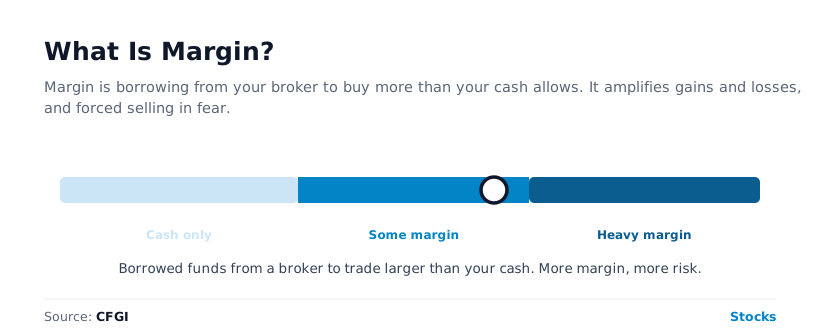
Quick answer
Margin is money borrowed from your broker to buy more securities than your own cash would allow. It magnifies both gains and losses: a position bought partly with borrowed money rises and falls faster relative to what you actually put in. You also pay interest on the loan, and if losses mount the broker can issue a margin call, forcing you to add funds or sell. That is how margin turns an ordinary fall into forced selling, and fear into something mechanical. This is education, not financial advice.
CFGI data
Margin makes fear mechanical. When prices fall, margin calls force selling regardless of conviction, deepening drops and pushing sentiment lower. A Fear and Greed Index plunging toward Extreme Fear, below 20 on its 0 to 100 scale, during a sharp decline often reflects exactly this forced, leverage-driven selling.
Source: CFGI methodology and standard margin definitions, to June 2026.
Key takeaways
- Margin is borrowing from your broker to buy more than your cash allows.
- It magnifies both gains and losses on the cash you commit.
- You pay interest on the borrowed money, a cost even if the stock is flat.
- A margin call can force you to add funds or sell at the worst time.
- Aggregate margin debt is itself a market sentiment signal.
Borrowed Buying Power
With a margin account, you can put up part of a position’s value and borrow the rest from your broker, using the securities you own as collateral. It is a form of leverage: if a stock you bought on margin rises, your return on the cash you actually committed is amplified. The catch is that the same works brutally in reverse, a fall hits your committed cash much harder, and you still owe the full borrowed amount no matter what the position does.
How Margin Works: A Worked Example
Numbers make it vivid. Say you put up 10,000 dollars of your own cash and borrow another 10,000 on margin, giving you a 20,000 dollar position. If the stock rises 10%, the position is worth 22,000; after repaying the 10,000 loan, your equity is 12,000, a 20% gain on your 10,000, double the stock’s move. But if the stock falls 10% to 18,000, your equity drops to 8,000, a 20% loss. Leverage has doubled the outcome in both directions. The higher the proportion you borrow, the more extreme that multiplication becomes, which is the entire appeal and the entire danger of margin in one example.
The Cost: Margin Interest
Margin is not free money. You pay interest on the borrowed amount for as long as you hold the position, and that cost quietly works against you the whole time. It means a margin trade has to overcome the interest just to break even: a stock that goes nowhere still costs you the carry. In a low-rate world that drag is modest, but when interest rates are high the cost of margin rises with them, making leveraged positions meaningfully more expensive to hold. Forgetting the interest is a common way leveraged trades disappoint even when the stock behaves.
The Rules: How Much You Can Borrow
Margin is regulated to stop it getting out of hand. In the US, the "initial margin" rule lets a broker lend up to 50% of a purchase, so you must put up at least half yourself. After that, a "maintenance margin", typically a minimum of 25%, sets the floor your equity must stay above as the position moves. The gap between the two is your cushion: you can buy at 50% equity, but trouble begins only if losses drag you down toward the 25% line. Knowing where that line sits is the difference between using margin deliberately and being caught out by it.
The Real Danger: The Margin Call
The sharpest risk in margin is the margin call. If losses erode your equity below the maintenance level, the broker demands more funds, or simply sells your positions automatically to recover its loan, often without warning and frequently at the very bottom of a sharp drop. Worse, margin calls tend to arrive across many accounts at once during a sell-off, and the forced selling pushes prices lower, triggering still more calls, a self-reinforcing spiral. It is the mechanism by which leverage turns a routine decline into a cascade, and why over-using margin can be ruinous.
The Rule of Thumb
Borrow less than the maximum and keep a cushion. The investors who blow up on margin are almost always the ones who used the most leverage with the least room to spare.
Margin Debt As a Market Signal
Margin is not just personal; in aggregate it is a window into the market’s mood. Total margin debt, the sum of what all investors have borrowed to buy stocks, is published and widely watched as a sentiment indicator. When the crowd is confident, margin debt climbs as people borrow to amplify their bets; when caution sets in, they pay it down. Tellingly, peaks in margin debt have preceded major market tops by months, because maximum borrowing tends to coincide with maximum greed. A surge in collective leverage is one of the quiet warning signs that a market is running hot.
Margin and Fear
Margin amplifies the emotional cycle at both ends. In greed, cheap and plentiful borrowing fuels over-extension, pushing prices higher than fundamentals justify; in fear, margin calls force selling regardless of what any investor actually believes, deepening declines into capitulation. A Stock Fear and Greed Index plunging on heavy, accelerating selling often reflects this forced, leverage-driven unwind rather than a calm reassessment of value. Understanding how much margin is in the market helps explain why some drops turn violent so fast, and why the deepest fear readings so often coincide with the most crowded leverage.
Frequently asked questions
What is margin?
Money borrowed from your broker to buy more securities than your cash would allow, using your holdings as collateral. It magnifies both gains and losses on the cash you commit, and you pay interest on the loan.
How does margin amplify returns?
By letting you control a larger position with less of your own money. If you put up half and borrow half, a 10% move in the stock becomes roughly a 20% move in your equity, in either direction.
What is a margin call?
When losses erode your equity below the required maintenance level, the broker demands more funds or sells your positions automatically, often without warning and at the worst possible moment.
How does margin relate to fear and greed?
It amplifies the cycle: cheap borrowing fuels greed and over-extension, while margin calls force selling in fear, deepening declines. Aggregate margin debt is itself a sentiment signal, peaking near market tops. This is education, not financial advice.
CFGI.io, Market sentiment research
The CFGI research team builds and maintains the CFGI Fear and Greed Index: a 0 to 100 sentiment score from 10 sub-indicators across hundreds of crypto assets and the equity market, refreshed every 15 minutes. We have tracked market emotion through multiple full crypto and equity cycles.
Think we missed something?
Spotted a gap, disagree with a take, or think we should cover a new topic? Message us and we'll act on your input.
Message us on TelegramKeep reading
This article is educational and is not financial advice. Crypto and equities are volatile and you can lose money. See our disclaimer.