Crypto
What Are Gas Fees?
Quick answer
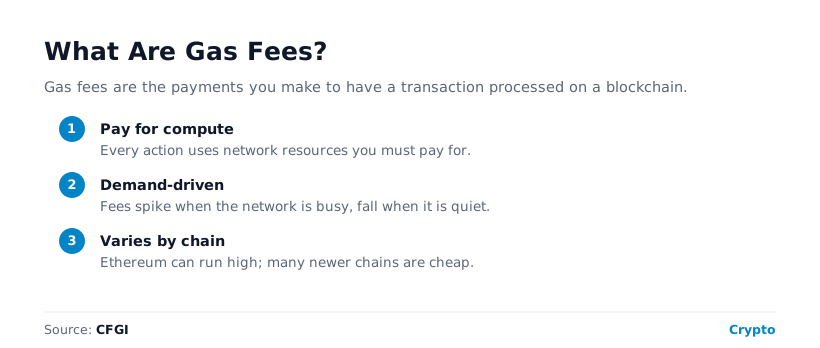
Gas fees are the payments you make to have your transaction processed and recorded on a blockchain. They go to the network for the computing work involved, are quoted in tiny units called gwei, and rise when the network is busy and fall when it is quiet. In that sense gas fees are a live demand gauge: spiking fees mean everyone is transacting at once, which often coincides with greedy, frantic markets. This is education, not financial advice.
CFGI data
Gas fees are a rough real-time read on network demand, and demand spikes tend to line up with the greedy extremes CFGI measures on its 0 to 100 scale. When fees soar because everyone is rushing to trade or mint, the crowd is usually at its most active, the same froth a Fear and Greed reading of Extreme Greed reflects.
Source: CFGI dataset, March 2022 to June 2026.
Key takeaways
- Gas fees pay the network to process your transaction.
- They are quoted in gwei, a billionth of an ether.
- They rise with congestion and fall when the network is quiet.
- EIP-1559 split fees into a burned base fee and a validator tip.
- Layer 2 networks are the main way to pay far less.
Paying for Block Space
A blockchain can only process so many transactions at a time, so space in each block is limited. Gas fees are what you pay to claim some of that space. When demand is low, fees are cheap; when thousands of people want their transactions in the next block, they bid fees up, and the network prioritises the highest bidders. "Gas" is a fitting name: just as a car needs fuel to run, every action on the network needs gas to be carried out.
Gas, Gwei and How a Fee Is Calculated
On Ethereum, gas fees are paid in its native currency, ether, but quoted in a smaller unit called "gwei", where one gwei is a billionth of an ether. Your total fee is, roughly, the amount of gas your transaction consumes multiplied by the price you pay per unit of gas. The amount of gas depends on how much computational work the action requires: a simple transfer of ether uses little gas, while a complex action, swapping tokens on a decentralised exchange or minting an NFT, uses far more. So two things drive your fee: how complicated your transaction is, and how busy the network is when you send it.
Why Fees Spike: Congestion
Because block space is fixed, fees are set by a constant auction for it. When demand for transactions exceeds the space available, users outbid each other and fees rocket to ration access. The triggers are predictable: bursts of market volatility as everyone rushes to trade, hyped NFT launches, popular token airdrops, and heavy decentralised-finance activity can all flood the network at once. In the worst congestion, a simple transaction that costs cents on a quiet day can cost tens or even hundreds of dollars, pricing ordinary users out entirely. High gas is, fundamentally, the price of everyone wanting to use the network at the same moment.
Fees Are an Auction
You are not paying a fixed price; you are bidding against everyone else for limited block space. The busier the network, the higher the winning bids, which is why fees swing so wildly.
EIP-1559: Base Fee and Tip
In August 2021, Ethereum changed how fees work with an upgrade called EIP-1559, which split each fee into two parts. The "base fee" is a reserve price set automatically by the network based on how full recent blocks have been, rising when the network is busy and falling when it is quiet, which makes fees more predictable. Crucially, the base fee is "burned", destroyed rather than paid to anyone, which permanently removes ether from circulation and can make ether deflationary during heavy use. On top of the base fee, you can add an optional "priority tip" to the validator, a higher tip jumps your transaction up the queue when blocks are congested. Base fee for inclusion, tip for speed.
How to Pay Less
For most users, the answer to high fees is to stop transacting on Ethereum’s main chain at all. "Layer 2" networks, such as Arbitrum, Optimism, Base and zkSync, process transactions off the main chain in bulk and then post compressed proofs back to it, so they inherit Ethereum’s security while charging a tiny fraction of the fees. For everyday actions like swapping tokens or sending stablecoins, a Layer 2 is usually the cheapest option by far. Beyond that, most wallets let you choose a slower, cheaper speed with a smaller tip, and transacting during quiet periods, when the base fee is low, can save meaningful money on anything that is not urgent.
What Fees Reveal
Because fees track demand for block space, sustained high gas can signal a hot, crowded market, lots of trading, minting and speculation at once. That froth often shows up at the same time as Extreme Greed on the Crypto Fear and Greed Index. It is not a precise indicator, fees also spike on a single viral NFT mint with no broader greed, but persistent, broad fee spikes are a sign the whole crowd is very active. Read alongside a sentiment gauge, soaring gas can corroborate the picture of a market running hot, with everyone rushing to act before the moment passes.
Frequently asked questions
What are gas fees?
Payments you make to have a transaction processed and recorded on a blockchain. They go to the network for the computing work involved, are quoted in gwei (a billionth of an ether on Ethereum), and rise when the network is busy.
Why do gas fees go up?
Because block space is limited and fees are set by an auction. When many people want transactions processed at once, they bid fees up to be prioritised, so fees rise sharply with congestion and fall when the network is quiet.
What is EIP-1559?
A 2021 Ethereum upgrade that split fees into a "base fee", an automatic reserve price that is burned (removed from circulation), and an optional "priority tip" paid to validators for faster inclusion. It made fees more predictable.
How can I reduce gas fees?
Use a Layer 2 network like Arbitrum, Optimism, Base or zkSync, which offer far lower fees while inheriting Ethereum’s security. You can also choose a slower speed with a smaller tip and transact during quiet periods. This is education, not financial advice.
CFGI.io, Market sentiment research
The CFGI research team builds and maintains the CFGI Fear and Greed Index: a 0 to 100 sentiment score from 10 sub-indicators across hundreds of crypto assets and the equity market, refreshed every 15 minutes. We have tracked market emotion through multiple full crypto and equity cycles.
Think we missed something?
Spotted a gap, disagree with a take, or think we should cover a new topic? Message us and we'll act on your input.
Message us on TelegramKeep reading
This article is educational and is not financial advice. Crypto and equities are volatile and you can lose money. See our disclaimer.