Crypto
How to Not FOMO In Crypto
Quick answer
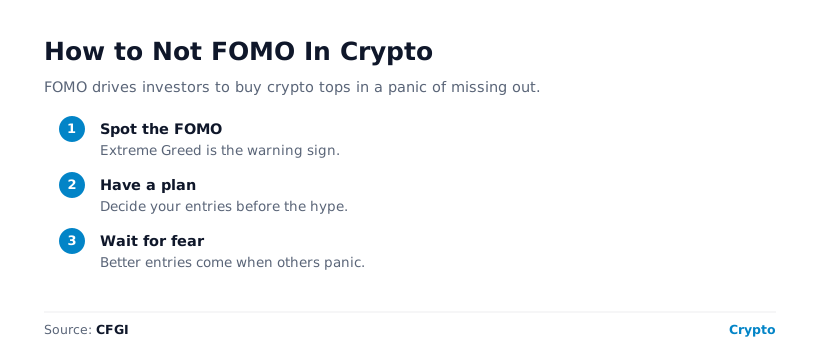
Resisting FOMO in crypto comes down to replacing emotion with a plan. The fear of missing out is strongest exactly when prices have already run far and risk is highest, so the antidote is to decide your rules in calm times, reframe what you are actually afraid of missing, and use the Fear and Greed Index as a reality check. When you feel the urge to chase and the index reads Extreme Greed, that agreement is the warning, not the green light. This is education, not financial advice.
CFGI data
The index is a direct FOMO check. When you feel the pull to chase a pumping coin and CFGI reads Extreme Greed across hundreds of assets, your emotion and the data agree, which is the signal to slow down. CFGI’s per-asset scoring shows whether one coin is running hotter than the market.
Source: CFGI dataset, March 2022 to June 2026.
Key takeaways
- FOMO is strongest when prices have already run and risk is high.
- It is rooted in regret aversion, social proof and herd instinct.
- Replace emotion with rules set in calm times.
- Reframe FOMO: there is always another opportunity.
- Use the index as a reality check on the urge to chase.
Why Crypto FOMO Is So Strong
Crypto is built for FOMO: prices move fast, social media amplifies every winner, and stories of overnight gains are everywhere. The result is the fear of missing out pushing people to buy after a coin has already surged, near the point of greatest risk. The feeling is fear, fear of being left behind, but the behaviour is reckless. You cannot delete the instinct, but you can build a process that keeps it from driving your decisions, and the first step is understanding why it grips you so hard.
The Psychology of FOMO
FOMO is so powerful because it taps into deep, hardwired features of human psychology, not into any rational judgement about the asset. One driver is "regret aversion": the imagined pain of watching others get rich while you sit out is felt intensely, often more intensely than the fear of an actual loss, so you act to avoid that future regret. Another is "social proof": when you see a crowd piling into a coin and posting their gains, your brain takes it as evidence that the trade must be right, "everyone can’t be wrong". A third is the ancient "herd instinct", the deep-seated urge to run with the group, which once kept our ancestors safe. Crypto then pours fuel on all of this: a 24/7 market, social feeds engineered to surface the biggest winners, influencers with an incentive to hype, and the dopamine hit of watching a number go up. Recognising that the urge is an emotional reflex, manufactured by your wiring and amplified by the environment, rather than a sound analytical conclusion, is the crucial first step to not obeying it.
It Is a Reflex, Not Analysis
FOMO is regret aversion, social proof and herd instinct, amplified by a 24/7, influencer-driven market. It feels like a rational read on opportunity, but it is an emotional reflex. Naming it is the first defence.
Practical Ways to Resist It
- Decide in advance what you would buy, at what price, and how much, before any pump.
- When you feel the urge to chase, pause and check the Fear and Greed Index.
- If it reads Extreme Greed and you feel greedy too, treat that agreement as a stop sign.
- Use a schedule like regular buying so you are not deciding in the heat of a rally.
- Remember that there is always another opportunity; missing one is not a loss.
The Check
FOMO and Extreme Greed pointing the same way is the moment to slow down, not speed up. The index turns a feeling into something you can check. This is education, not financial advice.
Reframe What You Are Afraid of Missing
A powerful mental shift is to challenge the core assumption underneath FOMO: that this opportunity is now-or-never. In crypto, it almost never is. The market is endlessly cyclical and produces a constant stream of new coins, narratives and setups, so missing one pump does not mean missing your only chance, there will always be another. Internalising "there is always another opportunity" drains much of FOMO’s urgency. It also helps to weigh the true asymmetry of the situation: missing a gain costs you nothing you ever had, your account is exactly as it was, whereas chasing a top and being wrong costs you real money. A "missed" 100% move you never bought does not hurt your balance; a 50% loss on a coin you FOMO’d into at the peak very much does. Reframed this way, the disciplined choice to sit out an overheated rally feels less like painful self-denial and more like simple risk management, you are not "missing out" so much as declining to take a poor, late-cycle bet, and keeping your capital intact for a better setup that is certain to come.
Frequently asked questions
How do I stop FOMO in crypto?
Replace emotion with a plan: decide your rules in calm times, use a schedule, reframe what you fear missing (there is always another opportunity), and check the Fear and Greed Index when you feel the urge to chase. Agreement with Extreme Greed is a warning.
Why is crypto FOMO so strong?
Because it taps deep psychology, regret aversion, social proof and herd instinct, then crypto amplifies it with a 24/7 market, social feeds that surface winners, hype-driven influencers and the dopamine of a rising number. It feels rational but is an emotional reflex.
How should I reframe FOMO?
Challenge the "now-or-never" assumption: crypto is cyclical and there is always another opportunity. And weigh the asymmetry, missing a gain costs you nothing you had, while chasing a top and being wrong costs real money. Sitting out an overheated rally is risk management, not missing out.
How does the Fear and Greed Index help with FOMO?
It turns a feeling into a check. When your urge to chase and an Extreme Greed reading agree, that is a prompt to slow down rather than buy, and per-asset scoring shows whether a specific coin is running hotter than the market. This is education, not financial advice.
CFGI.io, Market sentiment research
The CFGI research team builds and maintains the CFGI Fear and Greed Index: a 0 to 100 sentiment score from 10 sub-indicators across hundreds of crypto assets and the equity market, refreshed every 15 minutes. We have tracked market emotion through multiple full crypto and equity cycles.
Think we missed something?
Spotted a gap, disagree with a take, or think we should cover a new topic? Message us and we'll act on your input.
Message us on TelegramKeep reading
This article is educational and is not financial advice. Crypto and equities are volatile and you can lose money. See our disclaimer.