Crypto
What Is a Crypto Airdrop?
Quick answer
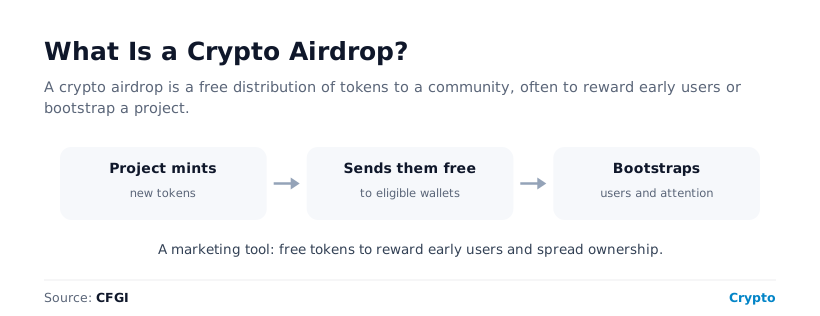
A crypto airdrop is when a project distributes free tokens to a group of wallets, often to reward early users, spread ownership across a community, or market a new token. Some airdrops are genuine, life-changing rewards; others are pure marketing, and a dangerous minority are scams designed to lure you into a malicious contract. Free tokens are nice, but airdrops are also a magnet for greed, fraud and a surprise tax bill, so they are worth understanding before you chase them.
CFGI data
Airdrop manias are a greed signal. The scramble to farm and flip free tokens peaks when the crowd is most risk-hungry, the conditions CFGI reads as Extreme Greed, 80 or above on its 0 to 100 scale, tracked since March 2022. When everyone is hunting the next big drop, sentiment is usually running hot.
Source: CFGI dataset, March 2022 to June 2026.
Key takeaways
- An airdrop distributes free tokens to a set of wallets.
- Types include standard, task-based, holder and retroactive drops.
- Retroactive drops reward past users and can be hugely valuable.
- Sybil farmers and wallet-drainer scams plague the space.
- Airdropped tokens are usually taxed as income when you receive them.
Free Tokens, With a Purpose
Projects airdrop tokens for several reasons: to reward people who used the protocol early, to spread ownership and governance across a community, or simply to win attention for a launch. For users, a well-timed airdrop can be a genuine windfall, which is exactly why the anticipation of future airdrops now drives an enormous amount of on-chain activity, as people try to qualify for drops that have not been announced yet.
The Types of Airdrop
- Standard. Open to anyone who signs up or holds a wallet, used mainly for awareness.
- Task-based (bounty). You earn tokens by completing actions, following, sharing, testing.
- Holder. Distributed to people who already hold a particular token or NFT.
- Retroactive. Rewards users who interacted with a protocol before it had a token, often the most valuable kind, because it cannot be gamed after the fact.
The Legendary Airdrops
A few retroactive drops have become crypto folklore. In September 2020, Uniswap gave 400 of its new UNI tokens to every wallet that had ever used the exchange, a reward worth more than 12,000 US dollars per recipient at its peak, simply for having used the product earlier. In March 2023, the Arbitrum network distributed its ARB token to users based on how much they had transacted and bridged. Drops like these turned ordinary early users into beneficiaries of huge windfalls, and they are the reason "use protocols early, just in case" became a strategy in its own right.
Airdrop Farming and Sybil Attacks
Where there is free money, there is gaming. "Airdrop farmers" try to maximise their share by spreading activity across many wallets, and at the extreme this becomes a "Sybil attack", where one person controls hundreds or thousands of fake wallets to look like a crowd of genuine users. The amounts are serious: in one airdrop, roughly a hundred freshly created wallets claimed millions of tokens worth around 170 million dollars. Projects now fight back with Sybil-detection, trying to filter out the bots so real users get a fair share, an ongoing cat-and-mouse game that shapes how modern airdrops are designed.
Where Airdrops Go Wrong: Scams and Drainers
The darker side is outright theft. A common trap is an unexpected token simply appearing in your wallet that, when you try to claim or sell it, asks you to connect to a malicious site or approve a draining contract that empties your funds. These "wallet drainers" are devastatingly effective: in 2025 alone they stripped tens of millions of dollars from over a hundred thousand holders, and most of those drains happened during airdrop-claim attempts. The safe rule is simple and absolute: never interact with tokens you did not expect, never enter your seed phrase to "claim" anything, and treat every "claim your airdrop" link with the same suspicion as a rug pull.
The One Rule
A real airdrop never needs your seed phrase and never needs you to approve an unfamiliar contract to "unlock" it. Anything that does is trying to drain your wallet.
The Tax Catch
There is a sting people forget: in many places, an airdrop is taxable. Airdropped tokens are typically treated as ordinary income equal to their fair market value at the moment you gain control of them. That can create a nasty surprise, you may owe tax on the value of a token the day it landed, even if its price later collapses and you never sold. A "free" airdrop is not always free once the tax authority is counted, which is one more reason to understand a drop before chasing it, rather than treating every windfall as pure profit.
Airdrops and Market Sentiment
Airdrop frenzy is a sentiment signal in its own right. The scramble to farm, claim and flip free tokens intensifies when risk appetite is high and fades when fear returns, which maps onto the greedy end of a Crypto Fear and Greed Index. When "airdrop season" is everywhere and the gauge is flashing Extreme Greed, it is usually the moment to slow down, not speed up, because that is exactly when scams multiply and judgement slips. Free tokens are most tempting precisely when caution is most valuable.
Frequently asked questions
What is a crypto airdrop?
A free distribution of tokens to a set of wallets, often to reward early users, spread ownership, or market a new project. Types include standard, task-based, holder and retroactive drops.
What was the Uniswap airdrop?
In September 2020, Uniswap gave 400 UNI tokens to every wallet that had used the exchange, a retroactive reward worth over 12,000 US dollars per recipient at its peak. It is one of the most famous airdrops in crypto.
What is airdrop farming?
Trying to maximise an airdrop by spreading activity across many wallets. At the extreme it becomes a Sybil attack, where one person runs thousands of fake wallets to claim an unfair share, which projects now try to detect and exclude.
How do I stay safe with airdrops?
Never interact with tokens you did not expect, never enter your seed phrase to claim anything, and avoid "claim your airdrop" links and unknown contract approvals. Most wallet drains happen during airdrop claims. This is education, not financial advice.
CFGI.io, Market sentiment research
The CFGI research team builds and maintains the CFGI Fear and Greed Index: a 0 to 100 sentiment score from 10 sub-indicators across hundreds of crypto assets and the equity market, refreshed every 15 minutes. We have tracked market emotion through multiple full crypto and equity cycles.
Think we missed something?
Spotted a gap, disagree with a take, or think we should cover a new topic? Message us and we'll act on your input.
Message us on TelegramKeep reading
This article is educational and is not financial advice. Crypto and equities are volatile and you can lose money. See our disclaimer.