Markets
How Accurate Is the Fear and Greed Index Historically?
Quick answer
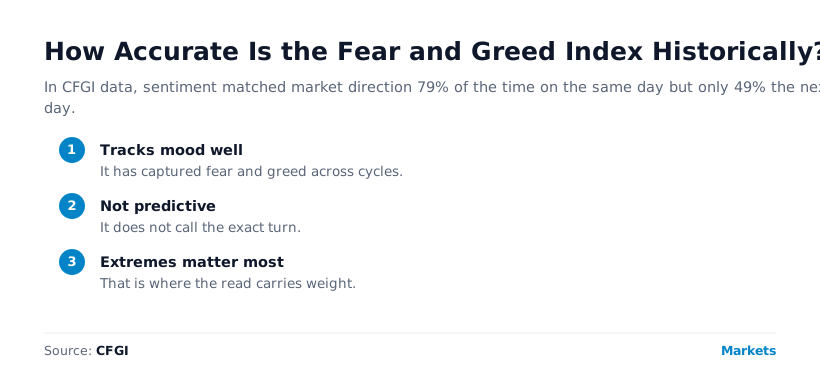
Historically, the Fear and Greed Index is very good at describing the present and poor at predicting the next day. In CFGI data, the score matched the market’s direction about 79% of the time on the same day, but only around 49%, essentially a coin flip, on the next day. The aggregate hides a richer story, though: at the extremes and over longer horizons, the historical record is more favourable. The honest picture is an accurate read of current mood, with a long-horizon contrarian edge at the tails, not a daily forecasting tool. This is education, not financial advice.
CFGI data
The numbers are clear about what the index is for. In CFGI data, sentiment aligned with same-day market direction 79% of the time, but next-day alignment fell to 49%. The index measures today’s mood with high fidelity; it does not predict tomorrow, though its extremes have carried a longer-horizon signal.
Source: CFGI dataset, 2021 to June 2026.
Key takeaways
- Same-day direction match: about 79%.
- Next-day direction match: about 49%, a coin flip.
- The daily aggregate measures description, not prediction.
- The extremes carry a longer-horizon contrarian edge the aggregate hides.
- It is an accurate present-tense gauge, not a forecasting tool.
What the Data Says
Accuracy depends entirely on what you ask the index to do. Asked to describe today’s mood, it is highly accurate. Asked to predict tomorrow’s move, it is no better than chance. The CFGI record makes the distinction concrete.
| Question | CFGI match rate |
|---|---|
| Matches same-day direction | ~79% |
| Matches next-day direction | ~49% |
CFGI sentiment versus market direction.
How the Figures Are Measured
The test behind these numbers is simple. For each day in the dataset, you compare the direction implied by the sentiment score, leaning greedy or leaning fearful, against the market’s actual direction, up or down, both on the same day and on the following day. Do that across years of readings since 2021 and you get a match rate: how often the two agreed. The same-day comparison asks whether the gauge accurately reflects what is happening as it happens; the next-day comparison asks whether today’s reading has any power to call tomorrow. The two questions sound similar but produce very different answers.
Same-Day 79%: Reading the Present
The 79% same-day match is strong, and easy to interpret. Sentiment and price largely move together within a day: when the market falls, fear rises and the score drops; when it climbs, greed builds and the score rises. So a high same-day match is really a statement that the gauge does its core job well, it captures the day’s mood faithfully. This is description, not prediction. It tells you the thermometer is well calibrated, reading the present accurately, which is exactly what you want a sentiment gauge to do first.
Next-Day 49%: The Honest Limit
The drop to 49% the next day is the number that matters most, and the most honest one. At 49%, the index is essentially a coin flip for calling the following day’s direction, meaning it has no reliable short-term predictive power. That is not a flaw to be engineered away; it reflects reality. Day-to-day moves are dominated by fresh news and noise that no measure of yesterday’s mood can anticipate. Any sentiment product advertising high next-day accuracy should be met with suspicion, and publishing the unflattering 49% is a sign the data is being reported straight rather than spun.
Why Honesty Matters Here
A gauge that admits it cannot call tomorrow is more trustworthy than one that claims it can. The 49% figure is a feature of integrity, not a weakness to hide.
Why the Extremes Tell a Richer Story
The daily aggregate, though honest, hides something important, because it averages every reading together, including the long, uninformative stretches in the neutral middle. The historical edge of a fear and greed gauge has never lived in the daily average; it lives in the tails. Backtests across markets repeatedly find that periods of Extreme Fear have been followed by above-average forward returns, and Extreme Greed by more frequent pullbacks, over weeks and months rather than the next single day. So a 49% next-day match and a genuine long-horizon contrarian edge are not contradictions: they are answers to different questions, one about tomorrow’s direction, the other about the months that follow an emotional extreme.
Reading the Historical Record Honestly
Holding both facts together is the mature way to read the data. The headline accuracy, 79% same-day and 49% next-day, is the honest aggregate, and it warns against short-term forecasting. The extremes layer a real, evidence-backed contrarian signal on top, but only over longer horizons and with the usual caveat that past patterns do not guarantee future results. Backtests can flatter a signal if read carelessly, so the right posture is neither blind faith nor blanket dismissal: the index is an accurate present-tense gauge with a useful edge at the extremes, and nothing more is being claimed.
What This Means for Using It
The practical takeaway from the data is consistent with everything above. Treat the score as an accurate gauge of where sentiment is now, valuable context for your decisions, and as a long-horizon contrarian flag when it reaches an extreme, while being deeply sceptical of anyone using it to predict the next move. The Fear and Greed Index reads the mood and, at the extremes, hints at the odds over time; it does not call the turn. Used within those limits, the historical record supports it; used beyond them, it will disappoint.
Frequently asked questions
How accurate is the Fear and Greed Index historically?
In CFGI data it matched same-day market direction about 79% of the time, but only around 49% the next day. It is an accurate read of current mood, not a short-term predictor, though its extremes have carried a longer-horizon edge.
Can the Fear and Greed Index predict the market?
Not the next day, where its match rate is about 49%, essentially a coin flip, because daily moves are dominated by unpredictable news. Over longer horizons, its extremes have historically been more informative.
If next-day accuracy is 49%, why do the extremes work?
Because they answer a different question. The 49% is about tomorrow’s direction; the contrarian edge is about returns over weeks and months following an extreme reading. A daily average hides that longer-horizon pattern.
So how should I use it?
As an accurate gauge of where sentiment is now, and as a long-horizon contrarian flag at extremes, while being sceptical of anyone using it to predict the next move. This is education, not financial advice.
CFGI.io, Market sentiment research
The CFGI research team builds and maintains the CFGI Fear and Greed Index: a 0 to 100 sentiment score from 10 sub-indicators across hundreds of crypto assets and the equity market, refreshed every 15 minutes. We have tracked market emotion through multiple full crypto and equity cycles.
Think we missed something?
Spotted a gap, disagree with a take, or think we should cover a new topic? Message us and we'll act on your input.
Message us on TelegramKeep reading
This article is educational and is not financial advice. Crypto and equities are volatile and you can lose money. See our disclaimer.