Crypto
Does the Fear and Greed Index Work for Altcoins?
Quick answer
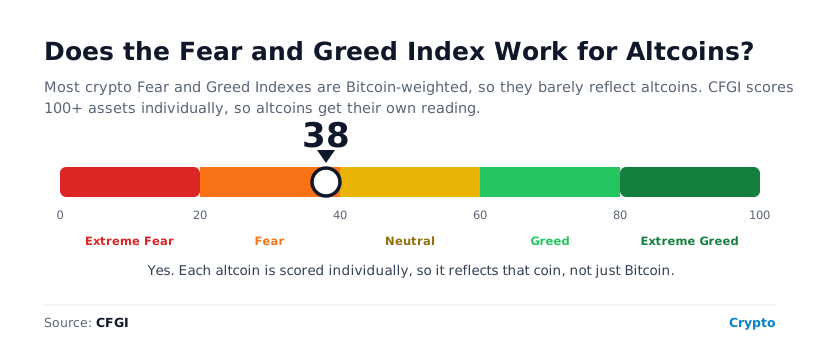
It depends on the index. Most crypto Fear and Greed indexes are Bitcoin-weighted, so they do not really work for altcoins, they mostly track Bitcoin. CFGI scores hundreds of assets individually, so each altcoin gets its own 0 to 100 reading. That matters because altcoins routinely swing to greater extremes than Bitcoin and often move on their own catalysts, which a Bitcoin-weighted market number hides completely. This is education, not financial advice.
CFGI data
Altcoins routinely sit at different sentiment from Bitcoin, which only per-asset scoring captures. CFGI has scored hundreds of assets individually every 15 minutes since March 2022; on 23 May 2024 the most fearful and most greedy major coins were 61 points apart, a spread a Bitcoin-weighted index simply cannot show.
Source: CFGI dataset, March 2022 to June 2026.
Key takeaways
- Bitcoin-weighted indexes barely reflect altcoins.
- CFGI scores hundreds of assets individually, including altcoins.
- Altcoins are more volatile and reach greater sentiment extremes.
- Money rotates between Bitcoin and altcoins, which per-asset scoring tracks.
- Thin altcoins give noisier readings, so treat the extremes with care.
Why a Market Number Misses Altcoins
If a crypto Fear and Greed Index is weighted toward Bitcoin, its headline score is mostly a Bitcoin reading. For an altcoin that is running on its own story, that number can be close to meaningless: it might say "neutral" while the coin in front of you is in a euphoric frenzy. To read an altcoin’s sentiment honestly, you need a score for that altcoin specifically, and CFGI provides exactly that, scoring hundreds of assets individually.
Altcoins Swing Harder
There is a structural reason altcoins need their own gauge: they move more. Most are smaller, less liquid and more speculative than Bitcoin, so they tend to amplify its moves and then add volatility of their own on top. When Bitcoin rises 10%, a popular altcoin might rise 30%; when Bitcoin falls, altcoins often fall further and faster. That higher "beta" means their sentiment regularly reaches more extreme readings, deeper Extreme Fear in a sell-off, hotter Extreme Greed in a run, than Bitcoin does. A market average smooths all of that away, which is precisely the information an altcoin trader most wants to keep.
Alt Season and Rotation
Crypto money does not sit still; it rotates. In a typical cycle, gains start in Bitcoin, then spill into large altcoins, then into smaller ones, the pattern traders call "alt season". During these rotations, Bitcoin dominance falls as capital floods into alts, and altcoin sentiment can be running red-hot while Bitcoin’s own mood has already cooled. A Bitcoin-weighted index, by construction, is blind to this hand-off. Per-asset scoring lets you watch greed migrate across the market in real time, which is often where the action, and the risk, has moved.
Each Altcoin Has Its Own Story
Beyond volatility, altcoins are driven by catalysts that have nothing to do with Bitcoin. XRP swings on legal rulings, Ethereum on network upgrades, and memecoins on pure viral hype. Each can be fearful or greedy independently of the others. The clearest proof is in CFGI’s own data: on 23 May 2024, the gap between the most fearful and most greedy major coins reached 61 points on the 0 to 100 scale, an enormous divergence that a single blended number would have erased entirely. Whenever an altcoin’s score splits from the market’s, that gap is telling you the coin is trading on its own narrative.
The Core Point
A market-wide crypto index answers "how does the crowd feel about crypto?". It does not answer "how does the crowd feel about this coin?". For altcoins, only the second question matters.
How CFGI Scores Altcoins
CFGI scores each of hundreds of assets from its own market behaviour, volatility, momentum, volume and other signals, and refreshes every reading every 15 minutes across multiple timeframes. The one honest caveat is liquidity: a very thin, lightly traded altcoin produces a noisier score than a deep, heavily traded one, because a few large trades can swing its data. That does not break the reading, but it is a reason to lean on the extremes and the trend rather than every small wiggle when you are looking at smaller coins.
How to Use Altcoin Sentiment
The most powerful use is divergence. Scan an altcoin’s score against Bitcoin and the market: when they disagree, you have learned something a single number could never tell you. As with any fear and greed gauge, treat it as a contrarian context tool, deep Extreme Fear hinting at value, runaway Extreme Greed hinting at caution, rather than a precise timing signal. And with altcoins especially, remember that a hot reading on a thin coin can be fragile, so always ask what is driving it before you act. A practical habit is to read three layers together: the coin’s own score, Bitcoin’s, and the market-wide reading. The coin tells you its story, Bitcoin tells you the tide it is swimming in, and the market average tells you the weather over the whole ocean.
Read Altcoins On Their Own
Frequently asked questions
Does the Fear and Greed Index work for altcoins?
Only if it scores them individually. Bitcoin-weighted indexes mostly track Bitcoin and barely reflect altcoins. CFGI scores hundreds of assets on their own, so each altcoin gets its own 0 to 100 reading.
Why do altcoins need their own score?
Because they are more volatile than Bitcoin, reach greater extremes, and often move on their own catalysts like upgrades, legal news or viral hype. A market average blends that away; a per-asset score reveals it.
What is alt season?
A phase where capital rotates out of Bitcoin into altcoins, sending altcoin sentiment hot while Bitcoin’s cools. Bitcoin dominance falls, and per-asset scoring lets you watch the rotation a market-wide index cannot see.
How many assets does CFGI score?
More than 100, individually, every 15 minutes across multiple timeframes. Thinner coins give noisier readings, so the extremes and the trend matter more than small moves. This is education, not financial advice.
CFGI.io, Market sentiment research
The CFGI research team builds and maintains the CFGI Fear and Greed Index: a 0 to 100 sentiment score from 10 sub-indicators across hundreds of crypto assets and the equity market, refreshed every 15 minutes. We have tracked market emotion through multiple full crypto and equity cycles.
Think we missed something?
Spotted a gap, disagree with a take, or think we should cover a new topic? Message us and we'll act on your input.
Message us on TelegramKeep reading
This article is educational and is not financial advice. Crypto and equities are volatile and you can lose money. See our disclaimer.