Stocks
What Is the Dow Jones?
Quick answer
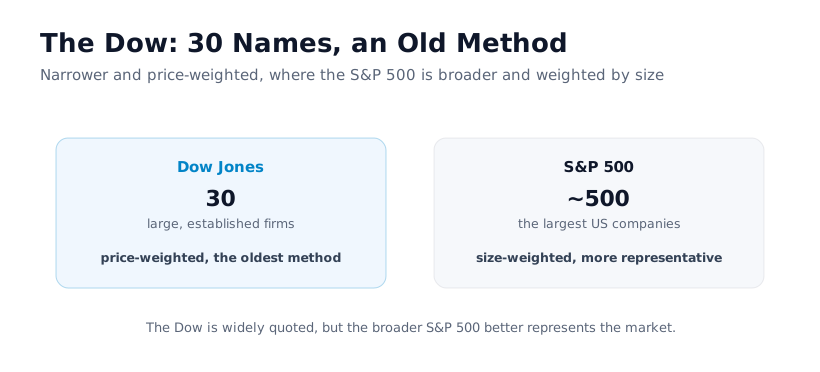
The Dow Jones Industrial Average, often just "the Dow", is one of the oldest stock indices, dating to the 1890s. It tracks 30 large, established US companies. Unlike the S&P 500, it is price-weighted, an older and quirky method where higher-priced shares count more regardless of company size, and far narrower. It is the headline number most quoted in the news, though the broader S&P 500 is the more representative gauge of the market. This is education, not financial advice.
CFGI data
The Dow tracks 30 established companies, a steadier slice of the market whose mood CFGI reads alongside the broader benchmarks. The Stock Fear and Greed Index scores stock sentiment from 0 to 100, updated daily since 2021 across major indices and leading stocks.
Source: CFGI dataset, 2021 to June 2026.
Key takeaways
- The Dow tracks 30 large, established US companies.
- It is one of the oldest stock indices, from the 1890s.
- It is price-weighted, so higher-priced shares count more.
- It is narrower than the S&P 500, which is more representative.
- It survives mainly on history and name recognition.
What Is the Dow Jones?
The Dow Jones Industrial Average is a stock market index of 30 large, well-known US companies. Created in the 1890s by Charles Dow, it is one of the oldest market gauges and remains a household name, the number most likely to be read out on the evening news. It aims to capture the health of major American business in a single figure, and for over a century it has served as a shorthand for "the market", even though it captures only a small, peculiar slice of it.
How the Dow Differs From the S&P 500
- Size: the Dow holds just 30 companies; the S&P 500 holds around 500.
- Weighting: the Dow is price-weighted (higher-priced shares count more); the S&P 500 is weighted by company value.
- Representativeness: because it is narrow and price-weighted, the Dow is far less representative of the whole market than the S&P 500.
In short, the Dow is the famous old name, but the S&P 500 is what professionals actually use to gauge the US market, and the Nasdaq is the tech-heavy third benchmark.
The Quirk of Price-Weighting
The Dow’s strangest feature is that it is "price-weighted", which means a stock’s influence depends on its share price, not the size of the company. A stock trading at 500 dollars sways the Dow ten times more than one at 50 dollars, even if the 50-dollar company is far larger and more important to the economy. This is a legacy of the 1890s, when simply averaging share prices was the practical way to build an index. Most modern indices, including the S&P 500, instead weight by market capitalisation, the total value of a company, which makes far more economic sense. The price-weighting quirk is the main reason analysts consider the Dow a flawed, if charming, relic, and prefer the S&P 500 as a true market gauge.
Price, Not Size
In the Dow, a high share price, not a big company, gives a stock more sway. A pricey but small firm can move the Dow more than a giant with a low share price, which is why the index is considered quirky.
Why the Dow Still Matters
Given its flaws, why does the Dow endure? Largely history and habit. It is one of the longest continuously running market measures in existence, offering a record that stretches back over a century, and it is the index the general public knows by name, "the Dow is up 200 points" is a headline everyone understands. Its 30 members are blue-chip giants chosen to span major industries, so it does still convey something about the health of large, established American business. The honest summary is that the Dow is more famous than it is useful: a beloved, historic headline number worth knowing about, but one most serious investors quietly set aside in favour of the broader, fairer S&P 500.
One practical consequence of the price-weighting worth remembering: because the Dow is quoted in "points" rather than percent, a "200-point drop" sounds dramatic but means very little on its own without knowing the index level. A 200-point move is a fraction of a percent on a Dow near 40,000, but would have been a crash decades ago when the index was far lower. Always translate Dow points into a percentage before reacting to the headline, the raw number is one of the more misleading figures in finance.
What Does the Dow’s Mood Signal?
The Dow leans toward large, established, often more defensive companies, so it can feel a touch steadier than the tech-heavy Nasdaq. Comparing the moods of the three benchmarks can be telling: when the Dow holds up while the Nasdaq falls, money may be rotating from growth toward safety, a sign of growing caution beneath a calm-looking headline. CFGI scores stock sentiment on the Stock Fear and Greed Index, updated daily, capturing the equity crowd’s mood across these benchmarks, and because it also scores leading stocks individually, you can look beneath the index to the companies driving it.
Frequently asked questions
What is the Dow Jones?
The Dow Jones Industrial Average, a stock index of 30 large, established US companies created in the 1890s. It is one of the oldest market gauges and the headline number most quoted in the news.
How many companies are in the Dow?
Thirty large, established US companies, chosen to represent major sectors of the economy. It is far narrower than the S&P 500’s roughly 500.
Why is the Dow price-weighted?
It is a legacy of its 1890s origins, when averaging share prices was the simplest way to build an index. It means a higher-priced stock sways the index more than a bigger company with a lower price, which is why analysts consider it flawed.
Is the Dow or the S&P 500 a better market gauge?
The S&P 500 is generally considered more representative, because it is broader and weighted by company value. The Dow remains popular mainly for its history and name recognition. This is education, not financial advice.
CFGI.io, Market sentiment research
The CFGI research team builds and maintains the CFGI Fear and Greed Index: a 0 to 100 sentiment score from 10 sub-indicators across hundreds of crypto assets and the equity market, refreshed every 15 minutes. We have tracked market emotion through multiple full crypto and equity cycles.
Think we missed something?
Spotted a gap, disagree with a take, or think we should cover a new topic? Message us and we'll act on your input.
Message us on TelegramKeep reading
This article is educational and is not financial advice. Crypto and equities are volatile and you can lose money. See our disclaimer.