Stocks
What Is an Index Fund?
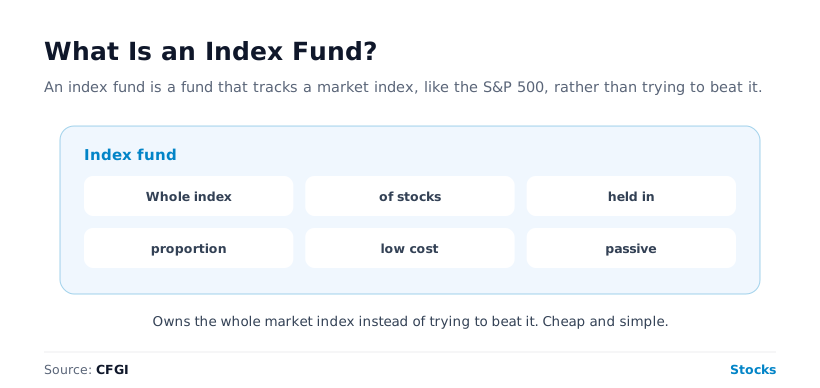
Quick answer
An index fund is a fund that simply tracks a market index, such as the S&P 500, by holding the same companies in the same proportions. It does not try to pick winners or beat the market; it aims to match it, at very low cost. That passive approach, plus broad diversification in a single holding, is why index funds have grown from a ridiculed experiment in the 1970s into the default choice for millions of long-term investors.
CFGI data
An index fund removes the hard part of picking stocks, but not the hardest part of all: sitting still when the crowd panics. The biggest threat to an index investor’s returns is selling in fear and buying in greed, the exact mood CFGI scores on a 0 to 100 scale, daily for stocks since 2021, which makes the gauge a useful gut-check against undoing a sound strategy at the worst moment.
Source: CFGI dataset, 2021 to June 2026.
Key takeaways
- An index fund tracks an index instead of trying to beat it.
- It holds the index’s companies in the same proportions, at very low cost.
- John Bogle launched the first retail index fund in 1976, to ridicule.
- Over 15 years, around 90% of active US large-cap funds trail the S&P 500.
- The hard part is not the strategy but holding it through fear and greed.
Matching the Market, Not Beating It
A market index like the S&P 500 measures a slice of the market. An index fund buys that slice: the same companies, weighted the same way, so its return tracks the index. There is no manager trying to outguess the market, which keeps costs low and removes the risk of a manager underperforming. Because one fund holds hundreds of companies, it delivers diversification in a single purchase. An index fund can be packaged as a traditional mutual fund or as an ETF that trades on an exchange.
Where It Came From: "Bogle’s Folly"
The index fund was not always obvious. John Bogle founded Vanguard in 1974 and, in 1976, launched the first index fund for ordinary investors, tracking the S&P 500, giving individuals a strategy that had been reserved for big institutions. The reception was brutal. Critics mocked it as "un-American" and a guaranteed path to mediocrity, and the launch raised only around 11 million dollars, which Bogle himself later called an abject failure. "Bogle’s Folly", they called it. That folly grew into one of the largest funds on earth, worth well over a trillion dollars, and reshaped how the world invests.
Why It Works: Fees and Averages
The logic is almost arithmetic. As a group, all investors collectively own the market, so as a group they earn the market return, minus their costs. That means the average actively managed dollar, weighed down by higher fees, must underperform a cheap index dollar over time. The evidence is overwhelming: the long-running SPIVA studies find that over a 15-year horizon, roughly 90% of actively managed US large-cap funds underperform the S&P 500 after fees. Paying more to try to beat the market, on average, buys you lower returns, which is the entire case for owning it cheaply instead.
The Core Insight
You cannot control the market’s return, but you can control your costs. An index fund maximises the thing you control and stops fighting the thing you cannot.
Index Fund, ETF Or Mutual Fund?
These names overlap and confuse people, so it helps to separate them. "Index fund" describes a strategy: tracking an index rather than trying to beat it. "Mutual fund" and "ETF" describe structures: how the fund is bought and priced. An index fund can be either, an index mutual fund priced once a day, or an index ETF that trades all day on an exchange. What they share, and what matters most, is a tiny fee and the goal of matching the market. When people praise "low-cost index investing", they mean exactly this, whichever wrapper it comes in.
What Index Funds Do and Don’t Protect Against
It is important to be clear-eyed about the risk. An index fund spreads single-company risk: if one firm in the index collapses, it is a tiny fraction of your holding. But it does nothing to protect against market-wide risk. In a crash, an index fund falls right along with the index it tracks, because it is the index. Index funds reduce one important kind of risk, the danger of betting everything on a single company, but they leave you fully exposed to the ups and downs of the whole market, which is the price of capturing its long-run returns.
The Hard Part Is Doing Nothing
The strategy is simple to describe and surprisingly hard to follow. The biggest threat to an index investor is not the market; it is their own behaviour. Study after study finds a "behaviour gap": investors earn less than the very funds they own, because they sell in panic near the bottom and pile back in near the top. An index fund only delivers its famous long-run returns to the person who actually holds it through the scary parts. Doing nothing, when every instinct screams to act, turns out to be the hardest and most valuable skill in passive investing.
Index Funds and Market Sentiment
This is where sentiment quietly matters even to the most hands-off investor. The emotion that wrecks an index strategy, panic in a crash, euphoria in a boom, is exactly what a Stock Fear and Greed Index measures on a 0 to 100 scale. Used well, the gauge is not a trading signal but a mirror: when it screams Extreme Fear and you feel the urge to sell your index fund, that is precisely the moment the data, and history, suggest holding on. Knowing the crowd is at an extreme can be the nudge that keeps you from undoing a sound plan at the worst possible time.
Frequently asked questions
What is an index fund?
A fund that tracks a market index, like the S&P 500, by holding the same companies in the same proportions. It aims to match the market at low cost, rather than beat it.
Who invented the index fund?
John Bogle launched the first index fund for individual investors at Vanguard in 1976. It was ridiculed as "Bogle’s Folly" at the time and raised only about 11 million dollars, but the idea went on to reshape investing.
Why do index funds beat most active funds?
Because investors collectively earn the market return minus costs, so the higher-fee active average must trail a cheap index over time. SPIVA data shows around 90% of US large-cap active funds underperform the S&P 500 over 15 years.
Are index funds safe?
They spread single-company risk through diversification, but they still fall with the market in a downturn, because they are the market. They reduce one kind of risk, not all of it. This is education, not financial advice.
CFGI.io, Market sentiment research
The CFGI research team builds and maintains the CFGI Fear and Greed Index: a 0 to 100 sentiment score from 10 sub-indicators across hundreds of crypto assets and the equity market, refreshed every 15 minutes. We have tracked market emotion through multiple full crypto and equity cycles.
Think we missed something?
Spotted a gap, disagree with a take, or think we should cover a new topic? Message us and we'll act on your input.
Message us on TelegramKeep reading
This article is educational and is not financial advice. Crypto and equities are volatile and you can lose money. See our disclaimer.