Stocks
What Is a Mutual Fund?
Quick answer
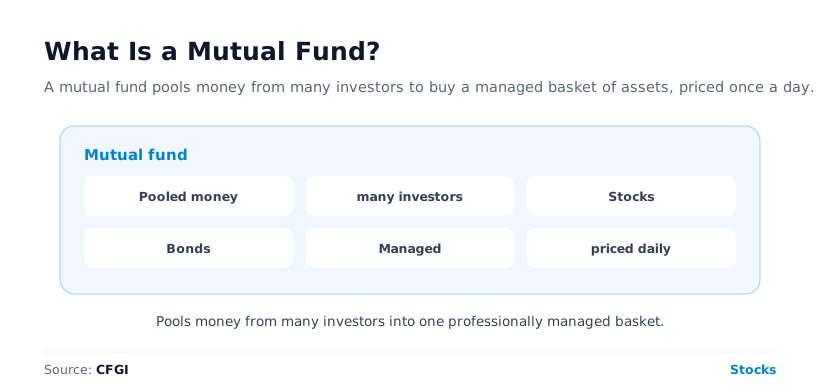
A mutual fund pools money from many investors and uses it to buy a basket of assets, run by a professional manager. You own units of the fund rather than the underlying holdings, and the fund is priced once a day after the market closes, at its net asset value. It offers diversification and management in a single product, but usually at higher fees than a simple index fund or ETF, and most actively managed funds fail to beat the index they are trying to outdo.
CFGI data
Mutual-fund flows are a textbook sentiment signal, and a badly timed one: ordinary investors tend to pour money in near greedy market tops and pull it out near fearful bottoms. CFGI reads that same mood directly on a 0 to 100 scale, refreshed daily for stocks since 2021, the contrarian check that buying high and selling low ignores.
Source: CFGI dataset, 2021 to June 2026.
Key takeaways
- A mutual fund pools many investors’ money into one managed basket.
- It is priced once a day at net asset value (NAV), not traded live.
- Fees include an annual expense ratio and sometimes sales "loads".
- Over 15 years, more than 85% of active US large-cap funds trail the S&P 500.
- A low-cost index fund is a mutual fund that simply tracks an index.
Pooled, Managed and Diversified
A mutual fund collects money from many people and invests it together. A manager decides what the fund holds, and each investor owns units representing a slice of the whole. That gives you instant diversification and professional management without picking individual stocks yourself, which is why mutual funds became the backbone of retirement saving and hold trillions of dollars.
Unlike a share or an ETF, a mutual fund does not trade through the day. It is priced once daily, after markets close, and everyone who buys or sells that day transacts at the same single price.
The Fees: Expense Ratios and Loads
Fees are where mutual funds quietly cost you, and they come in two forms. The expense ratio is an annual percentage of your money, skimmed in tiny daily increments to pay the fund’s costs; it can range from a few hundredths of a percent for an index fund to well over 1% for an active one. On top of that, some funds charge a "load", a sales commission: a front-end load taken when you buy, or a back-end load taken when you sell. "No-load" funds avoid these. None of these fees sound large in a single year, but compounded over decades they can swallow a startling share of your returns, which is why low fees are one of the few things in investing almost guaranteed to help you.
Mutual Fund Versus ETF
| Mutual fund | ETF | |
|---|---|---|
| Trades | Once a day at NAV | Throughout the day |
| Often | Actively managed | Passively tracks an index |
| Fees | Usually higher | Usually lower |
| Tax efficiency | Lower | Higher |
Two ways to own a basket.
Many mutual funds are actively managed, trying to beat the market, which is where the higher fees go. An index fund is simply a low-cost mutual fund that tracks an index instead of trying to outsmart it.
The Uncomfortable Truth About Active Funds
Here is the finding that reshaped how a generation invests. Year after year, the SPIVA studies, which compare active funds to their benchmarks, reach the same verdict: most active managers lose to a simple index over time. Over a 15-year horizon, more than 85% of US large-cap active funds have underperformed the S&P 500 after fees, and once taxes are counted the gap widens further. The reason is not that managers are foolish; it is arithmetic. As a group, active investors cannot beat the market they collectively are, and their fees guarantee that the average active dollar trails a cheap index dollar.
The Takeaway
Paying more for active management buys you, on average, lower returns. The exceptions exist, but they are hard to identify in advance, which is the whole case for low-cost index investing.
Mutual Funds, ETFs and Index Funds
It helps to see how the three relate, because the names overlap. A mutual fund is the pooled-and-priced-once-a-day structure. An ETF is a similar basket that trades on an exchange all day. An index fund is a strategy, passively tracking an index, that can be packaged as either a mutual fund or an ETF. So an index fund and an actively managed fund can both be mutual funds, but they are worlds apart in cost and approach. When people praise "low-cost index investing", they usually mean an index fund or ETF with a tiny expense ratio, whichever wrapper it comes in.
Mutual Funds and Market Sentiment
Mutual-fund flows are one of the oldest sentiment indicators around, and a cautionary one. Ordinary investors have a long, well-documented habit of pouring money into funds after a long rally, when greed is high and prices are stretched, and yanking it out after a crash, when fear peaks and prices are cheap, the exact opposite of buy-low-sell-high. That collective mistiming is the very mood a Stock Fear and Greed Index measures on a 0 to 100 scale. Watching the gauge is a useful antidote to following the herd into a fund at precisely the wrong moment.
Frequently asked questions
What is a mutual fund?
A fund that pools money from many investors to buy a professionally managed basket of assets. You own units of the fund, and it is priced once a day at its net asset value after the market closes.
What is NAV?
Net asset value: the total value of a fund’s holdings minus its liabilities, divided by the number of units. It is the single daily price at which a mutual fund is bought and sold.
How is a mutual fund different from an ETF?
A mutual fund is priced and traded once a day and is often actively managed; an ETF trades through the day on an exchange and usually passively tracks an index, generally at lower fees and with more tax efficiency.
Do mutual funds beat the market?
Most actively managed ones do not. Over a 15-year period, more than 85% of US large-cap active funds have underperformed the S&P 500 after fees, which is the core argument for low-cost index funds. This is education, not financial advice.
CFGI.io, Market sentiment research
The CFGI research team builds and maintains the CFGI Fear and Greed Index: a 0 to 100 sentiment score from 10 sub-indicators across hundreds of crypto assets and the equity market, refreshed every 15 minutes. We have tracked market emotion through multiple full crypto and equity cycles.
Think we missed something?
Spotted a gap, disagree with a take, or think we should cover a new topic? Message us and we'll act on your input.
Message us on TelegramKeep reading
This article is educational and is not financial advice. Crypto and equities are volatile and you can lose money. See our disclaimer.