Stocks
How to Avoid Emotional Investing
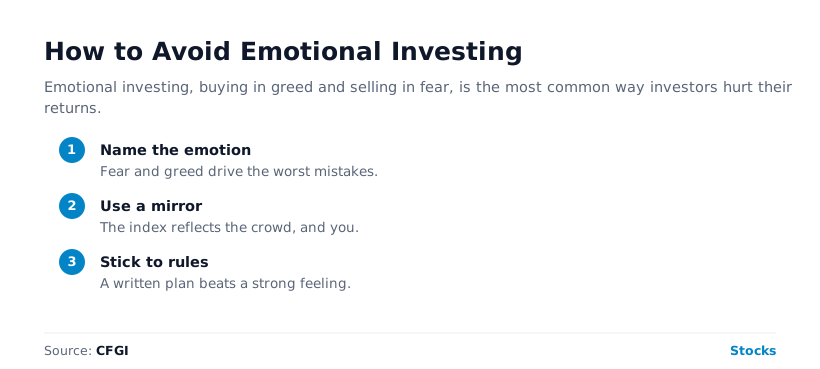
Quick answer
You avoid emotional investing by deciding your rules in advance and removing the moments where emotion takes over. That means setting a plan, using a schedule like regular investing, defining what you will do at extremes before you reach them, building systems rather than relying on willpower, and using a Fear and Greed Index as a mirror to catch when you are being swept along by the crowd. This is education, not financial advice.
CFGI data
A sentiment gauge is a practical de-biasing tool: it labels the crowd objectively, so you can check your own feeling against it. CFGI reads the market from 10 measurable signals, the same number whether you are euphoric or panicked, which is exactly what an emotional decision needs as a counterweight.
Source: CFGI dataset; stocks since 2021, crypto since March 2022.
Key takeaways
- Decide your rules before emotion arrives, not during.
- Know the biases: loss aversion, FOMO, herding, overconfidence.
- Use a schedule to remove timing decisions.
- Build a system rather than relying on willpower.
- Use a sentiment index as a mirror for your own bias.
Why Emotion Costs Investors
The pattern that hurts returns is simple: buy in greed near tops, sell in fear near bottoms, the exact opposite of "buy low, sell high". It is driven by loss aversion, FOMO and herd behaviour. The cost is real and measurable: studies of investor behaviour consistently find that the average investor earns less than the very funds they hold, precisely because they jump in and out at the wrong emotional moments, a shortfall often called the "behaviour gap". You cannot delete these instincts, but you can build a process that gives them less room to act.
The Emotions That Drive Bad Decisions
The first step to defeating emotional investing is to recognise the specific culprits, because they are predictable and well-documented. The big ones are: loss aversion, the tendency to feel a loss about twice as painfully as an equivalent gain, which drives panic-selling; FOMO and greed, the fear of missing out that makes us chase rising assets near tops; herd behaviour, the instinct to follow the crowd because its size feels like safety; overconfidence, which makes us trade too much and take too much risk after a few wins; and recency bias, which makes us assume whatever just happened will continue, so we expect rallies to last forever and crashes to never end. None of these is a character flaw; they are universal features of human psychology. But naming them turns a vague "I felt nervous and sold" into a recognisable pattern you can prepare for in advance.
Name the Bias to Tame It
Loss aversion, FOMO, herding, overconfidence and recency bias are predictable and universal. Recognising which one you are feeling is the first step to not acting on it.
Practical Ways to Take Emotion Out
- Write a plan in calm times: what you own, why, and what would change your mind.
- Use a schedule. Regular, fixed-amount investing removes the daily decision of when to buy.
- Decide your actions at extremes before you reach them, so the rule, not the feeling, acts.
- Use a sentiment gauge as a mirror. When you feel the urge to chase or panic, check it against the reading.
- Step back from the screen. Most emotional decisions are made in the heat of a move.
The Mirror
A Fear and Greed Index is most useful here not as a signal but as a check on yourself: if you feel greedy and the index reads Extreme Greed, that agreement is the warning, not the green light. This is education, not financial advice.
Build a System, Not Willpower
The deepest insight in all of this is that willpower is the wrong tool. In the heat of a crash or a euphoric rally, when adrenaline is high and the crowd is screaming, even disciplined people make emotional decisions, relying on self-control at the moment of maximum stress is a losing strategy. The answer is to build systems that make the right behaviour the default and remove the moment of decision altogether. Automate your investing so contributions happen on a schedule without you choosing the timing. Use rebalancing rules that mechanically sell strength and buy weakness. Write your plan down and treat it as a contract with your calmer, rational self, made in advance to govern your future, panicking self. The goal is to engineer the emotion out of the process beforehand, so that when the storm hits, you simply follow a plan rather than make a fraught decision.
A Contract With Your Calm Self
Don’t rely on staying calm in a crash; decide in advance and automate. A written plan is a contract your rational self makes to govern your future, panicking self.
The Fear and Greed Index As a Mirror
Within that system, a Stock Fear and Greed Index plays a specific and valuable role: it is an objective mirror for your own emotion. The danger of emotional investing is that your feelings seem like insight, your fear feels like prudence, your greed feels like conviction, when really you are just being swept along with the crowd. A sentiment gauge gives you an external, unemotional reading to check yourself against. If you feel a powerful urge to buy and the index confirms the whole market is in Extreme Greed, that agreement is not validation, it is the warning that you are part of a euphoric crowd. Used this way, the index does not tell you what to do; it tells you what you are feeling, objectively, which is often exactly the reality check an emotional decision needs.
Frequently asked questions
How do you avoid emotional investing?
Decide your rules in advance, know the biases at work, use a schedule to remove timing decisions, build systems rather than relying on willpower, and use a sentiment index as a mirror to catch when you are being swept along.
What emotions cause bad investing decisions?
Loss aversion (panic-selling), FOMO and greed (chasing tops), herd behaviour (following the crowd), overconfidence (trading too much) and recency bias (assuming the recent trend continues). They are universal, but naming them helps you prepare.
Why build a system instead of using willpower?
Because willpower fails under stress, in a crash or euphoric rally, even disciplined people decide emotionally. Automating contributions, using rebalancing rules and writing a plan removes the moment of decision, so you follow a plan instead of making a fraught choice.
How does the Fear and Greed Index help?
As a mirror. If your feeling matches an extreme reading, that agreement is a prompt to slow down rather than act, because it means you are part of a one-sided crowd. It is a check on bias, not a trigger. This is education, not financial advice.
CFGI.io, Market sentiment research
The CFGI research team builds and maintains the CFGI Fear and Greed Index: a 0 to 100 sentiment score from 10 sub-indicators across hundreds of crypto assets and the equity market, refreshed every 15 minutes. We have tracked market emotion through multiple full crypto and equity cycles.
Think we missed something?
Spotted a gap, disagree with a take, or think we should cover a new topic? Message us and we'll act on your input.
Message us on TelegramKeep reading
This article is educational and is not financial advice. Crypto and equities are volatile and you can lose money. See our disclaimer.