Stocks
What Is a Bid-Ask Spread?
Quick answer
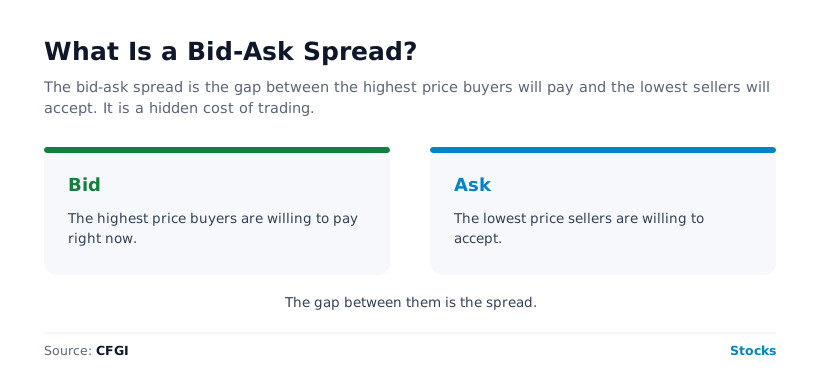
The bid-ask spread is the difference between the highest price a buyer is willing to pay (the bid) and the lowest price a seller will accept (the ask). It is effectively a hidden cost of trading: you buy at the ask and sell at the bid, so the spread is what you give up the instant you make a round trip. Tight spreads signal liquid, healthy markets; wide spreads signal illiquid or stressed ones, which makes the spread one of the most useful numbers on the screen.
CFGI data
A widening spread is a small fear signal, and fear is what CFGI scores. Spreads stretch in the stressed, illiquid conditions that pull the Stock Fear and Greed Index toward Extreme Fear, below 20 on its 0 to 100 scale, so a sudden widening across the market is the microstructure quietly agreeing with a falling sentiment reading.
Source: CFGI methodology, 10-input 0 to 100 model.
Key takeaways
- The bid is the top buy price; the ask is the lowest sell price.
- The spread is the gap between them, and a cost on every round trip.
- Tight spreads mean liquidity; wide spreads mean thin or stressed markets.
- The spread is the most direct gauge of a market’s liquidity.
- Limit orders let you trade inside the spread rather than pay it.
The Cost Hiding In the Price
At any moment, buyers post the most they will pay (the bid) and sellers the least they will take (the ask). The ask always sits a little above the bid, and that gap is the spread. Because you buy at the higher ask and sell at the lower bid, you start every trade slightly behind: the spread is a cost you pay even before the price has moved at all. It rarely appears on a statement as a fee, which is exactly why so many people overlook it.
A Worked Example
Suppose a stock shows a bid of 50.00 and an ask of 50.02. If you buy a share and immediately sell it again, you pay 50.02 and receive 50.00, losing 2 cents, the spread, without the price moving a fraction. On a heavily traded stock that 2-cent spread is trivial. But the figure that matters is the spread as a percentage: 2 cents on a 50 dollar stock is tiny, while a 10-cent spread on a 1 dollar stock is a punishing 10% you must overcome before you even break even. This is why the spread quietly punishes frequent traders and cheap, illiquid stocks the most.
Tight Versus Wide Spreads
| Spread | Typical market | Signals |
|---|---|---|
| Very tight (a cent or less) | Large-cap stocks, major FX | Deep liquidity, heavy volume |
| Moderate | Mid-caps, busy markets | Healthy but less deep |
| Wide (cents to dollars) | Small-caps, penny stocks | Thin liquidity, higher cost |
| Suddenly widening | Any market under stress | Fear, caution, risk |
What the spread width tends to mean.
In the most heavily traded stocks, market makers compete fiercely and the spread shrinks to a penny or less. In a thinly traded name, with few buyers and sellers, the spread can blow out to a meaningful slice of the price.
The Spread Is a Liquidity Gauge
Beyond being a cost, the spread is the single most direct read on a market’s liquidity. A narrow spread means many participants are competing closely, so you can trade quickly without moving the price much. A wide spread means the opposite: few participants, and a real penalty for transacting in a hurry. Professionals watch the spread precisely because it measures, in one number, how cheaply and quickly you can get in and out. When you are sizing up an unfamiliar stock or token, the spread tells you a great deal about how easy it will be to sell later.
What Makes Spreads Widen
Spreads are not fixed; they breathe with conditions. They widen when volume is low, such as outside main trading hours, and in thinly traded securities where there are simply not enough orders nearby. Above all, they widen under stress: when volatility spikes and fear takes over, market makers pull back and demand a bigger cushion to protect themselves from being run over, so the cost of trading rises at exactly the moment people most want to trade. A sharp, market-wide widening of spreads is therefore a genuine signal that conditions have turned choppy.
How to Manage the Spread
- Use limit orders to set your price and trade inside the spread, rather than a market order that pays it.
- Favour liquid, heavily traded names where the spread is naturally tight.
- Judge the spread as a percentage of the price, not just in cents.
- Be wary of cheap, low-volume stocks where a wide spread can dwarf any gain.
- Avoid trading in fast, fearful conditions when spreads blow out.
The Spread and Market Sentiment
The bid-ask spread is one of the most immediate places fear shows up. Long before a headline confirms a sell-off, spreads quietly stretch as liquidity providers grow cautious, which is the same stress that drives a Stock Fear and Greed Index toward its lower readings on the 0 to 100 scale. In that sense the spread is a micro view of the same mood the index measures at the macro level: when both are flashing caution, the market is telling you, in two different languages, that liquidity is thinning and risk is rising.
Frequently asked questions
What is the bid-ask spread?
The difference between the highest price a buyer will pay (the bid) and the lowest a seller will accept (the ask). You buy at the ask and sell at the bid, so the spread is a hidden cost on every round trip.
Why does the spread matter?
It is a cost you pay on every trade and the clearest gauge of liquidity. Tight spreads keep trading cheap; wide spreads make it expensive, which hits frequent traders and illiquid, low-priced stocks hardest.
What makes spreads widen?
Low volume, thin liquidity and market stress. In thinly traded stocks, outside main hours, or during fearful, volatile conditions, market makers widen spreads to manage risk.
How can I avoid paying the spread?
Use limit orders to trade at a price you set rather than a market order that crosses the spread, stick to liquid names with tight spreads, and avoid cheap, low-volume stocks. This is education, not financial advice.
CFGI.io, Market sentiment research
The CFGI research team builds and maintains the CFGI Fear and Greed Index: a 0 to 100 sentiment score from 10 sub-indicators across hundreds of crypto assets and the equity market, refreshed every 15 minutes. We have tracked market emotion through multiple full crypto and equity cycles.
Think we missed something?
Spotted a gap, disagree with a take, or think we should cover a new topic? Message us and we'll act on your input.
Message us on TelegramKeep reading
This article is educational and is not financial advice. Crypto and equities are volatile and you can lose money. See our disclaimer.