Stocks
What Is a Stop-Loss Order?
Quick answer
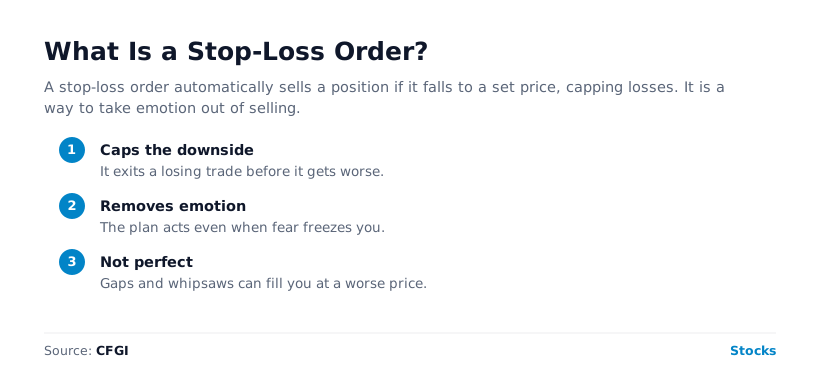
A stop-loss order is an instruction to your broker to sell a position automatically if its price falls to a level you set in advance. When the price hits that level, the order triggers and sells, capping a loss without you having to watch the market or make the decision in the heat of a drop. By deciding the exit calmly beforehand, a stop-loss takes some of the fear out of selling, though it is not foolproof: in a fast or gapping market it can fill below your stop. This is education, not financial advice.
CFGI data
A stop-loss is pre-committed discipline against fear. It works much like deciding your response to extreme readings in advance: a rule, set in calm, that acts so panic does not. CFGI’s role is the same, a steady reference so decisions are not made purely on emotion.
Source: CFGI dataset and standard order-type definitions, June 2026.
Key takeaways
- A stop-loss sells automatically if price falls to a set level.
- When triggered, it becomes a market order.
- It caps a loss and takes emotion out of selling.
- It is not foolproof: gaps can fill below the stop, and dips can whipsaw it.
- A trailing stop moves up with the price to lock in gains.
A Pre-Set Exit
Say you buy a stock at 100 and decide you do not want to lose more than 10%. A stop-loss order at 90 instructs your broker to sell automatically if the price reaches that level. You make the hard decision once, in advance, rather than freezing or panicking when the drop actually happens. It is one of the simplest and most widely used risk-management tools, a way to define your maximum acceptable loss before you are emotionally invested in the outcome.
How a Stop-Loss Works
The mechanics are worth understanding, because they explain the tool’s limits. A stop-loss sits dormant until the price falls to your chosen "stop price". At that moment it triggers, and, in its basic form, it converts into a market order to sell at the next available price. This is the crucial detail: the stop price is the trigger, not a guaranteed sale price. In a normal, liquid market the two are almost identical, so a stop at 90 sells right around 90. But because the triggered order is a market order, the actual fill depends on whatever price is available the instant it fires, which in calm conditions is fine, and in turbulent ones is exactly where the catch lies.
The Limits: Gaps and Whipsaws
A stop-loss is a useful tool, not a guarantee, and it fails in two specific ways. First, gaps: if bad news breaks overnight and a stock opens far below your stop, the triggered market order fills at that lower opening price, not at your stop, so a stop at 90 might sell at 80 if the stock gaps straight through it. Second, whipsaws: a brief, sharp dip can trigger your stop and sell you out, only for the price to rebound minutes later, leaving you out of a position you wanted to keep. Setting the stop too tight makes whipsaws more likely; setting it too loose lets losses run further. There is no perfect level, which is why a stop-loss manages risk rather than eliminating it.
A Trigger, Not a Guarantee
The stop price triggers a market order; it does not lock in a sale price. In a gapping market a stop can fill well below where you set it, so it caps risk imperfectly.
Trailing Stops and Variations
There are useful variations on the basic stop. A "trailing stop" sets the stop a fixed percentage or dollar amount below the market price and moves up as the price rises, but never down, so it locks in gains automatically: a 10% trailing stop on a stock that climbs from 100 to 150 follows it up, only selling if it falls 10% from its peak. A "stop-limit" order, instead of becoming a market order when triggered, becomes a limit order, which guarantees you will not sell below a set price but risks not selling at all if the price blows straight through. Each variation trades one risk for another, the trailing stop chases the trend, the stop-limit protects price at the cost of certainty, and the right choice depends on what you are most trying to avoid.
Stops and Emotion
The real value of a stop-loss is behavioural. It is a rule set in a calm moment that acts when fear would otherwise take over, removing the in-the-moment decision that panic or paralysis would hijack. This is the same logic as deciding in advance how you will respond to a Fear and Greed Index extreme: both replace an emotional decision with a planned one. The deeper principle, shared by all good risk management, is that the calm version of you is a far better decision-maker than the frightened version, so you let the calm one set the rules and the rules do the acting. A stop-loss is simply that principle, automated, and a sentiment gauge is a calm reference that serves the very same purpose.
Frequently asked questions
What is a stop-loss order?
An instruction to sell a position automatically if its price falls to a level you set in advance, designed to cap a loss without you watching the market. When the price hits the stop, the order triggers and sells.
How does a stop-loss work?
It sits dormant until the price falls to your chosen stop price, then triggers and, in its basic form, becomes a market order to sell at the next available price. The stop price is the trigger, not a guaranteed sale price.
Is a stop-loss guaranteed?
No. In a fast or gapping market the triggered market order can fill well below your stop, and a brief dip can trigger a sale just before a recovery (a "whipsaw"). It manages risk but does not guarantee an exact price.
What is a trailing stop?
A stop set a fixed percentage or amount below the market price that moves up as the price rises but never down, locking in gains. It only sells if the price falls that set distance from its peak. This is education, not financial advice.
CFGI.io, Market sentiment research
The CFGI research team builds and maintains the CFGI Fear and Greed Index: a 0 to 100 sentiment score from 10 sub-indicators across hundreds of crypto assets and the equity market, refreshed every 15 minutes. We have tracked market emotion through multiple full crypto and equity cycles.
Think we missed something?
Spotted a gap, disagree with a take, or think we should cover a new topic? Message us and we'll act on your input.
Message us on TelegramKeep reading
This article is educational and is not financial advice. Crypto and equities are volatile and you can lose money. See our disclaimer.