Stocks
What Is a Retail Investor?
Quick answer
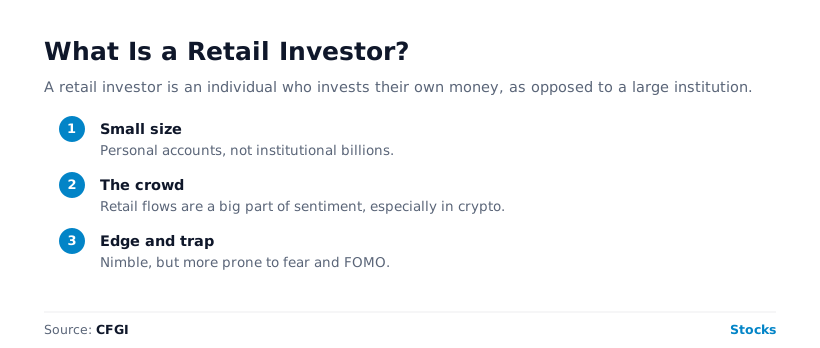
A retail investor is an individual investing their own money through a regular brokerage account, as opposed to an institution managing money for others. That is most ordinary people buying stocks, funds or crypto. Retail investors were once a small slice of the market, but commission-free apps have made them a force Wall Street can no longer ignore. They tend to feel fear and greed most acutely, which is both their famous weakness and, handled well, the source of a real long-term edge.
CFGI data
Retail flows are a sentiment signal. Retail buying tends to surge near greedy tops and dry up at fearful bottoms, the classic buy-high, sell-low pattern, which is exactly the crowd behaviour CFGI scores on a 0 to 100 scale and contrarians watch. The gauge exists, in part, to help an individual avoid being the textbook example.
Source: CFGI dataset, behavioural-finance framing.
Key takeaways
- A retail investor invests their own money individually.
- It contrasts with institutions that invest pooled money for others.
- Trading apps lifted retail to around a fifth of US trading volume.
- The 2021 GameStop squeeze showed retail’s collective power.
- Retail’s emotional swings are its weakness, but patience is its edge.
Investing Your Own Money
A retail investor is simply an ordinary individual, you, a friend, a colleague, buying and selling through a personal brokerage account. The opposite is an institutional investor: a pension fund, hedge fund or bank deploying huge pooled sums on behalf of others. Once a small share of all trading, retail has grown enormously as commission-free apps and fractional shares lowered the barrier to entry, turning investing from something done through a broker into something done on a phone in a few taps.
Retail Versus Institutional
| Retail investor | Institutional investor | |
|---|---|---|
| Whose money | Their own | Other people’s, pooled |
| Resources | Limited | Vast data and research |
| Share of US volume | Around a fifth | The majority |
| Main weakness | Emotion and timing | Herding, forced selling |
Two very different kinds of investor.
Institutions have more resources, data and access, but they are not free of bias either. The gap in influence has narrowed: in liquid, high-profile names, coordinated retail flows now genuinely move prices, even though retail is still a minority of total volume.
The Rise of Retail
The shift has been dramatic. Before the pandemic, individual investors made up only low single digits of daily US trading; today they account for roughly a fifth. The driver was technology: app-based brokers made trading free, instant and, in some cases, deliberately "gamified" to encourage frequent activity, while fractional shares let someone buy a slice of a 500 dollar stock for a few dollars. This democratisation is genuinely good, more people can build wealth in markets than ever before, but it is double-edged, because the same frictionless, game-like design that lowers the barrier can also encourage the impulsive, emotional trading that hurts returns.
GameStop and the Meme-Stock Moment
Retail announced its new power in January 2021, when individual investors organising on Reddit’s WallStreetBets forum drove shares of the struggling retailer GameStop up by more than 1,600% in a matter of weeks. The aim was partly a "short squeeze" against hedge funds that had bet against the stock, and for a moment the crowd of small traders inflicted real pain on some of Wall Street’s giants. The episode, later dramatised as "Dumb Money", was messy and many latecomers lost heavily, but its lesson stuck: a coordinated crowd of retail investors had become a force the professionals could no longer dismiss.
The "Dumb Money" Reputation
Retail has long carried the unflattering nickname "dumb money", on the theory that individuals reliably buy near tops and sell near bottoms while the "smart money" does the opposite. There is real truth in it: the behaviour gap, where investors earn less than the funds they own because of bad timing, is largest among the most active retail traders. But the label is also too neat. Plenty of institutions herd and blow up too, and the meme-stock era showed retail shaping outcomes rather than just suffering them. The honest version is that retail is more emotional, not more stupid, and emotion is something anyone can learn to manage.
The Reframe
Retail’s disadvantage is not intelligence or information; it is discipline. The data and access gap matters far less than the gap in temperament, and temperament is the part you control.
Retail’s Real Edge
Counterintuitively, the individual investor holds some genuine advantages over the giants. A retail investor answers to no clients, faces no quarterly performance review, and cannot be forced to sell at the bottom by redemptions or risk limits, the very pressures that make big funds sell at the worst moment. They can hold a position through a storm, ignore short-term noise, and invest small amounts patiently for decades. The professional’s edge is information and scale; the individual’s edge is patience and freedom. Used well, that freedom can more than offset the resource gap, but only for those who resist the emotional pull that sinks most active traders.
Retail and Sentiment
Retail investors are often the most emotional participants, drawn in by FOMO near the top and scared out near the bottom. That is not a moral failing, it is human nature, and it is why surges in retail buying are sometimes read as a contrarian warning. A Fear and Greed Index exists precisely to help individuals see when the crowd, themselves included, is at an emotional extreme, and to turn retail’s greatest weakness, feeling the swings, into the discipline that is its greatest strength.
Frequently asked questions
What is a retail investor?
An individual who invests their own money through a regular brokerage account, as opposed to an institution that manages pooled money for others.
How is a retail investor different from an institution?
Retail investors trade their own savings with fewer resources; institutions deploy huge pooled sums with more data and access and account for most market volume. Retail is now around a fifth of US trading.
What was the GameStop meme-stock event?
In January 2021, retail investors organising on Reddit drove GameStop up more than 1,600%, partly to squeeze hedge funds that had bet against it. It showed that a coordinated retail crowd could move markets and pressure professionals.
Why do retail investors often buy high and sell low?
Because they tend to feel fear and greed most acutely, drawn in by FOMO near tops and scared out near bottoms. A sentiment gauge helps resist that, and retail’s freedom to be patient is its real edge. This is education, not financial advice.
CFGI.io, Market sentiment research
The CFGI research team builds and maintains the CFGI Fear and Greed Index: a 0 to 100 sentiment score from 10 sub-indicators across hundreds of crypto assets and the equity market, refreshed every 15 minutes. We have tracked market emotion through multiple full crypto and equity cycles.
Think we missed something?
Spotted a gap, disagree with a take, or think we should cover a new topic? Message us and we'll act on your input.
Message us on TelegramKeep reading
This article is educational and is not financial advice. Crypto and equities are volatile and you can lose money. See our disclaimer.