Stocks
How to Use the Fear and Greed Index With Index Funds
Quick answer
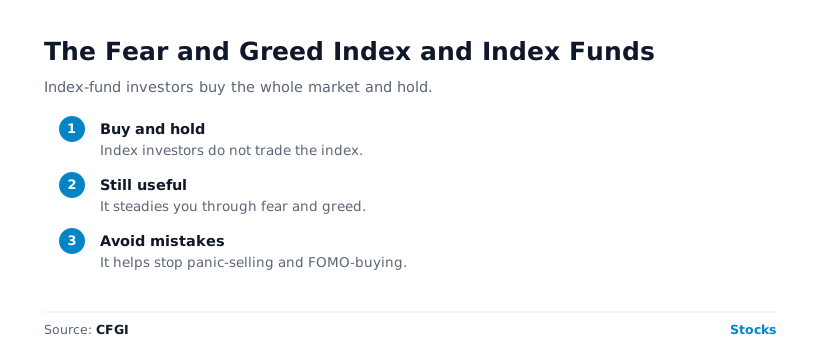
Index funds let you own a whole market in one low-cost holding, and they are designed to be bought and held for years, not traded on sentiment. So the Fear and Greed Index is not a timing signal for an index-fund investor. Its real value is psychological: it provides perspective during frightening drops, reframing a scary fall as a normal, passing bout of Extreme Fear, so you keep contributing instead of panic selling. It is a tool for staying the course. This is education, not financial advice.
CFGI data
For index-fund holders, CFGI is perspective, not a signal. Its record since 2021 shows that Extreme Fear, like the equity reading of 3 on 8 April 2025, was always temporary. Knowing the whole market’s fear is a recurring, passing state on the 0 to 100 scale is what helps a passive investor keep buying through it rather than selling at the bottom.
Source: CFGI dataset, 2021 to June 2026.
Key takeaways
- Index funds own a whole market and are built to be held for years.
- Timing index funds on sentiment usually does more harm than good.
- The index helps as perspective during scary drops, not as a signal.
- Its job here is to help you keep contributing, not to time the market.
- Regular contributions through fear quietly buy more when prices are low.
A Buy-And-Hold Vehicle
An index fund tracks a whole market, like the S&P 500, in a single, low-cost holding. The strategy is simple and powerful: own the market, keep contributing, and let compounding work over years. Trying to jump in and out of index funds usually does more harm than good, because it reintroduces exactly the stock-picking and market-timing risk the strategy was designed to remove.
So the Fear and Greed Index is not a buy or sell signal here. Its value to a passive investor is psychological: it gives perspective in the moments when a downturn makes holding feel unbearable, which is precisely when most damage is done.
Why Timing Index Funds Backfires
The case against timing is not opinion; it is one of the best-documented findings in investing. Market returns are wildly concentrated in a handful of days, and those days cluster near the bottoms, right after the scariest falls, when a frightened investor is most likely to have sold. Miss just a few of the market’s best days, often by stepping out during fear, and long-run returns collapse. The "behaviour gap" describes the result: the average investor earns noticeably less than the very funds they own, purely because of badly timed buying and selling. For an index-fund holder, doing nothing is not laziness; it is the strategy working.
Where Sentiment Actually Helps
If the index is not a signal, how can it help at all? By being a mirror. When the market is plunging and every instinct screams to sell, a glance at a gauge reading deep Extreme Fear reframes the moment. It tells you the whole crowd is panicking, that this is a recognisable, recurring state, and that historically it has always passed. CFGI’s own record makes the point: the equity score has fallen as low as 3 in deep panic and recovered every time. That perspective is what turns an unbearable drop into a survivable one, and a potential panic-sale into a held position.
Keep Buying
For index-fund investors, the index works best as a reason to keep contributing through fear, the opposite of a timing tool. This is education, not financial advice.
How an Index-Fund Investor Can Use It
- Keep your regular contributions going, no matter the reading, in good times and bad.
- When a market drop feels frightening, check the index: market-wide Extreme Fear is normal and has always passed.
- Use that perspective to resist the urge to stop buying or to sell out at the bottom.
- Do not let greedy readings tempt you to over-contribute or chase a hot market.
- Treat the index as context, never as a reason to time the fund in or out.
Dollar-Cost Averaging Through Fear
There is a quiet superpower in simply continuing to invest a fixed amount on a schedule, an approach called dollar-cost averaging. Because the same contribution buys more units when prices are low, an automatic, unchanged contribution during a fearful market is doing the contrarian thing, "buy when others are fearful", without you having to summon any courage. The Fear and Greed Index can make this easier to stomach: when it confirms the market is in Extreme Fear, you can see that your regular buy is landing at a discount, not catching a falling knife. The discipline does the work; the gauge just reassures you it is the right kind of discipline.
The One Disciplined Exception
There is a structured way to lean into sentiment without falling into timing, and it is rebalancing. If you hold a target mix, say a set split between stock index funds and bonds, periodically restoring that mix mechanically sells what has run up and buys what has fallen. In a fearful, fallen market, rebalancing naturally directs money into the cheaper stock funds, a rules-based version of buying low. The key difference from timing is that it follows a fixed schedule and a fixed target, not your emotions or a gauge reading, which is what keeps it disciplined rather than reactive.
Frequently asked questions
Should I trade index funds with the Fear and Greed Index?
No. Index funds are designed to be held. The index helps only as perspective during scary drops, so you keep contributing instead of panic selling. Timing them on sentiment usually hurts returns.
How does the index help index-fund investors?
By reframing a frightening, market-wide drop as Extreme Fear, a normal recurring state that has always passed. That perspective helps you stay the course and keep your contributions going.
What is the behaviour gap?
The well-documented finding that the average investor earns less than the very funds they own, because they sell in panic near the bottom and buy back near the top. Avoiding it is the main way sentiment awareness can help a passive investor.
Can sentiment improve index-fund returns?
Mainly by stopping bad behaviour, like panic selling at the bottom, and by reassuring you that regular buying through fear is sound. Trying to time index funds on sentiment usually hurts. It is context, not a signal. This is education, not financial advice.
CFGI.io, Market sentiment research
The CFGI research team builds and maintains the CFGI Fear and Greed Index: a 0 to 100 sentiment score from 10 sub-indicators across hundreds of crypto assets and the equity market, refreshed every 15 minutes. We have tracked market emotion through multiple full crypto and equity cycles.
Think we missed something?
Spotted a gap, disagree with a take, or think we should cover a new topic? Message us and we'll act on your input.
Message us on TelegramKeep reading
This article is educational and is not financial advice. Crypto and equities are volatile and you can lose money. See our disclaimer.