Stocks
Fear and Greed for Long-Term Investors
Quick answer
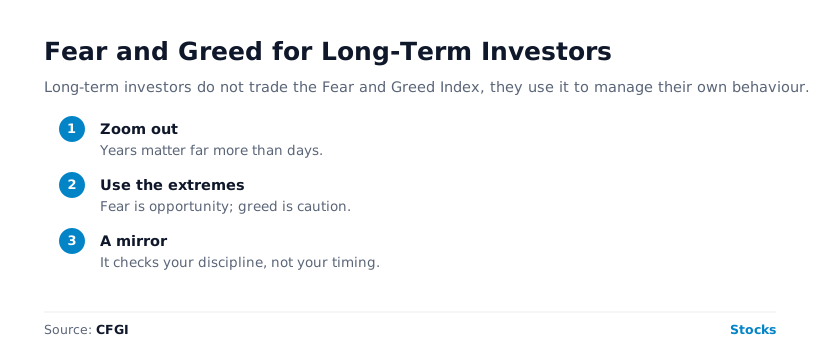
For a long-term investor, the Fear and Greed Index is less a timing tool and more a behaviour check. Its real value is helping you avoid the two costly mistakes: buying in Extreme Greed because everyone is euphoric, and selling in Extreme Fear because everyone is panicking. Those emotional errors, not poor stock-picking, are what most hurt long-term returns. Used as a guardrail, the index protects a long-term plan from short-term emotion. This is education, not financial advice.
CFGI data
Long-term results are wrecked by emotional timing more than by patience. CFGI stock data since 2021 shows fear arriving fast and euphoria staying scarce, the score hit an extreme-fear 3 on 8 April 2025, exactly the kind of moment a long-term investor is tempted to sell and later regrets.
Source: CFGI dataset, 2021 to June 2026.
Key takeaways
- Long-term investors use it to manage behaviour, not to trade.
- Emotional timing, not stock-picking, hurts long-term returns most.
- Its value is avoiding buying the top and selling the bottom.
- Extreme Greed is a prompt to check you are not over-exposed.
- Extreme Fear is a prompt to ask whether panic is justified before acting.
The Biggest Risk Is Your Own Behaviour
Over a long horizon, the damage usually comes not from picking the wrong asset but from acting at the wrong moment: chasing in euphoria, capitulating in panic. The Fear and Greed Index is a measure of exactly the emotion that drives those mistakes, which makes it a useful mirror. For a long-term investor, in other words, the enemy is rarely the market and almost always oneself, the temptation to abandon a sound long-term plan in a moment of fear or greed, and a tool that measures that very emotion is well suited to keeping it in check.
The Behaviour Gap
There is a striking and well-documented phenomenon in investing called the "behaviour gap": studies repeatedly find that the average investor earns noticeably less than the very funds they own, and the reason is not bad fund selection but bad timing, buying in after a run-up out of greed and selling out during a crash out of fear. The maths of this is brutal, because a large share of the market’s long-run gains comes from a tiny handful of its best days, and those best days cluster right after the worst ones, in the violent rebounds that follow a plunge. An investor who panic-sells during a crash is therefore most likely to be out of the market for exactly the powerful recovery that drives their long-term return, locking in the loss and missing the bounce. This is the single most important reason a long-term investor should care about sentiment at all: not to time the market, but to recognise and resist the emotional impulses, at precisely the moments they are strongest, that create the behaviour gap and quietly devastate long-run results.
Bad Timing, Not Bad Picks
The average investor underperforms their own funds because of emotional timing, not stock selection. The best days cluster after the worst, so panic-selling locks in the loss and misses the rebound.
How a Long-Term Investor Uses It
- At Extreme Greed: check you are not over-exposed or adding on hype. It is a moment to rebalance, not to chase.
- At Extreme Fear: pause before selling. Ask whether the panic reflects a real change in the long-term case, or just a loud crowd.
- In the middle: ignore it. Sentiment is most informative at the extremes, and noise in between.
Important
The index does not tell a long-term investor to buy or sell. It is a prompt to slow down and check your reasoning at emotional extremes. Stay within a plan you set in calmer times. This is education, not financial advice.
Time In the Market Beats Timing the Market
Underpinning all of this is one of investing’s most durable truths: over the long run, "time in the market" tends to beat "timing the market". Markets have historically recovered from every crash and trended upward over long horizons, so the patient investor who stays invested and lets compounding work is, more often than not, rewarded, while the one who jumps in and out trying to dodge the dips usually does worse, undermined by the behaviour gap. Used as a behaviour check, the Fear and Greed Index helps you sit through the fear and resist the greed, which over years tends to matter far more than any single well-timed trade. It will not improve your stock-picking or predict the next move, but by helping you avoid the emotional mistakes that sabotage long-term returns, it does something arguably more valuable for a long-term investor: it helps you stay the course, which is where the real money is made. In that sense, the index is less an investing tool than a self-control tool, and for the long-term investor, self-control is very often the scarcest and most valuable resource of all. This is education, not financial advice.
Frequently asked questions
Should long-term investors use the Fear and Greed Index?
Yes, but as a behaviour check rather than a timing tool. Its value is helping you avoid buying in Extreme Greed and selling in Extreme Fear, the emotional mistakes that hurt long-term returns most, far more than poor stock-picking does.
What is the behaviour gap?
The well-documented finding that the average investor earns less than the funds they own, because of bad timing: buying after run-ups in greed and selling in crashes out of fear. The market’s best days cluster after the worst, so panic-selling misses the recovery.
Does it tell me when to buy or sell?
No. It tells you how emotional the crowd is. For a long-term investor that is a prompt to check your reasoning at extremes, not a buy or sell signal. Time in the market beats timing it. This is education, not financial advice.
When should I ignore it?
In the neutral middle, around 40 to 59, where sentiment is noise. The index is most useful at the extremes, under 20 and over 80, where it can catch you about to make an emotional mistake.
CFGI.io, Market sentiment research
The CFGI research team builds and maintains the CFGI Fear and Greed Index: a 0 to 100 sentiment score from 10 sub-indicators across hundreds of crypto assets and the equity market, refreshed every 15 minutes. We have tracked market emotion through multiple full crypto and equity cycles.
Think we missed something?
Spotted a gap, disagree with a take, or think we should cover a new topic? Message us and we'll act on your input.
Message us on TelegramKeep reading
This article is educational and is not financial advice. Crypto and equities are volatile and you can lose money. See our disclaimer.