Markets
Fear and Greed Index for Passive Investors
Quick answer
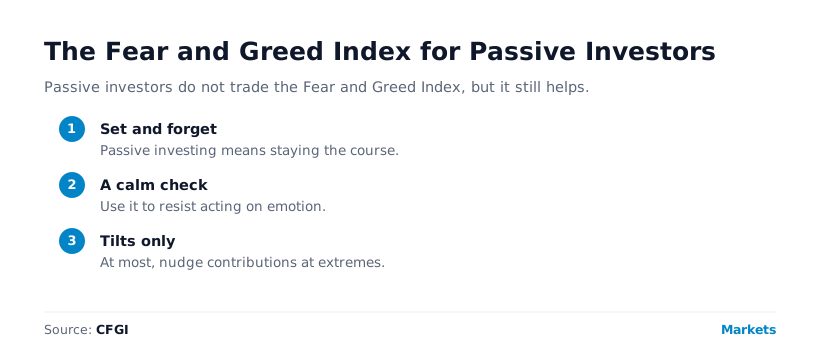
Passive investors, who buy broad funds and hold for the long term, do not need to trade on the Fear and Greed Index, and should not. But it still has value as a behavioural anchor. Seeing that a scary drop is just Extreme Fear, a normal, recurring state, can help a passive investor avoid the single worst mistake, panic selling at the bottom. Used this way, it supports the strategy rather than disrupting it. This is education, not financial advice.
CFGI data
For long-term holders, CFGI is reassurance, not a trigger. Its history since 2021 shows Extreme Fear, like the equity 3 on 8 April 2025, always passed. Seeing that a frightening moment is a recurring state, not the end, is what helps passive investors stay invested.
Source: CFGI dataset, 2021 to June 2026.
Key takeaways
- Passive investors should not trade on the index.
- Passive investing is buying broad funds and holding, cheaply.
- It still helps as a behavioural anchor.
- The biggest passive mistake is selling at the bottom.
- Seeing fear as normal helps avoid panic selling.
Why a Passive Investor Cares At All
The whole point of passive investing is to not react: buy broad, low-cost funds, keep contributing, and let time do the work. Active timing usually hurts. So why look at a sentiment index at all? Because the greatest threat to a passive plan is not the market, it is the investor abandoning the plan in a panic. That is where the index helps. It reframes a frightening drop as something measurable and recurring, which makes it easier to sit still and do the hard, valuable thing: nothing.
What Passive Investing Is
Passive investing is the strategy of buying broad, diversified index funds or ETFs that simply track a whole market, then holding them for the long term while trading as little as possible. Rather than trying to beat the market by picking winners or timing entries, a passive investor aims to capture the market’s overall long-run return at the lowest possible cost. The case for it is overwhelming and well-evidenced: the large majority of active fund managers fail to beat a simple low-cost index over the long run, and their higher fees compound into a serious drag. By keeping costs minimal, staying broadly diversified and letting compounding work over years and decades, passive investing has proven a remarkably effective approach for most people. Its quiet discipline, do little, hold on, keep contributing, is its whole strength, which is precisely why protecting that discipline from emotion matters so much.
The One Mistake That Wrecks a Passive Plan
For all its simplicity, passive investing has a single great vulnerability, and it is not in the strategy but in the human running it: panic-selling during a crash. The maths of this mistake is brutal. A large share of the market’s long-run gains comes from a tiny handful of its very best days, and those best days cluster right after the worst ones, in the violent rebounds that follow a plunge. The passive investor who panics and sells during a crash therefore tends to be out of the market for exactly the powerful recovery that drives their long-term return, crystallising the loss and missing the bounce. This "behaviour gap" is why studies repeatedly show the average investor underperforms the very funds they own. The entire edge of passive investing, capturing the long-run trend, depends on staying invested through the scary parts, which makes resisting that one panicked sale the most important thing a passive investor ever does.
Selling the Bottom Is the Fatal Move
The market’s best days cluster right after its worst. Panic-selling in a crash locks in the loss and misses the rebound, the one mistake that can undo years of patient passive investing.
How to Use It Without Breaking the Strategy
- Keep contributing on schedule regardless of the reading.
- When a drop feels unbearable, check the index: Extreme Fear is normal and has always passed.
- Use that perspective to avoid the one fatal move, selling at the bottom.
- Do not let a greedy reading tempt you into over-investing or chasing.
- Treat it as reassurance and context, never as a timing signal.
Stay the Course
For passive investors, the index is most valuable as a reason not to act, a reminder that today’s fear is a recurring state, not a permanent one. This is education, not financial advice.
Reassurance, Not a Signal
It is worth being clear about the spirit in which a passive investor should use the index, because it is the opposite of how a trader uses it. A trader might watch for an extreme as a prompt to act; a passive investor watches for an extreme as a prompt not to. The reading’s only real job here is to provide perspective and reassurance, to put a calm, objective number on a frightening moment and remind you that the market has felt this way before and recovered every time so far. Seeing that a terrifying drop registers as "Extreme Fear", a known, recurring, temporary state rather than a unique catastrophe, is exactly the kind of reframing that helps you keep your finger off the sell button. Used this way, far from tempting a passive investor to abandon their strategy, the index quietly helps them stick to it, which is the whole game.
Frequently asked questions
Should passive investors use the Fear and Greed Index?
Not to trade. But it helps as a behavioural anchor: seeing that a scary drop is just Extreme Fear, a normal recurring state, makes it easier to avoid panic selling and stay the course.
What is passive investing?
Buying broad, low-cost index funds or ETFs that track a whole market and holding them long term while trading as little as possible. The aim is to capture the market’s long-run return cheaply, rather than beating it, an approach most active managers fail to outperform.
What is the biggest mistake for passive investors?
Panic-selling during a crash. The market’s best days cluster right after the worst, so selling the bottom locks in the loss and misses the rebound, the "behaviour gap" that makes the average investor underperform their own funds.
Can a passive investor ignore the index entirely?
Yes, and many do. Its only real value here is behavioural: as reassurance and perspective, never as a signal to act. It should never be treated as financial advice. This is education, not financial advice.
CFGI.io, Market sentiment research
The CFGI research team builds and maintains the CFGI Fear and Greed Index: a 0 to 100 sentiment score from 10 sub-indicators across hundreds of crypto assets and the equity market, refreshed every 15 minutes. We have tracked market emotion through multiple full crypto and equity cycles.
Think we missed something?
Spotted a gap, disagree with a take, or think we should cover a new topic? Message us and we'll act on your input.
Message us on TelegramKeep reading
This article is educational and is not financial advice. Crypto and equities are volatile and you can lose money. See our disclaimer.